
By Jeremy Appel, Local Journalism Initiative Reporter
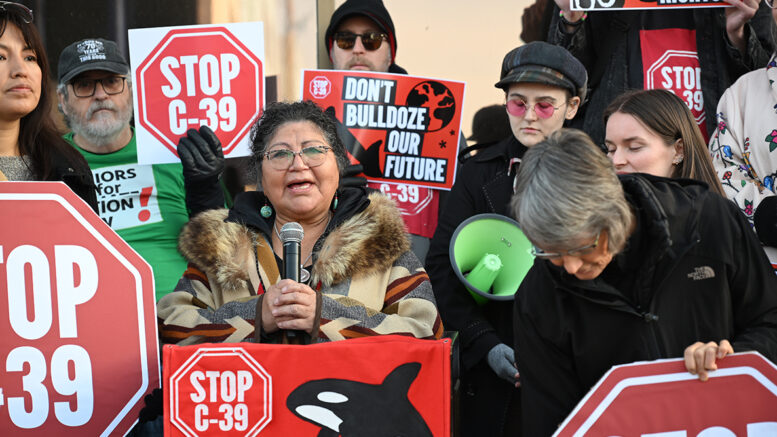
(ANNews) – Speakers at a protest outside Edmonton Centre MP Eleanor Olszewski’s office on Nov. 12 say that the federal Liberals’ Building Canada Strong Act represents a threat to Indigenous rights, labour and the climate.
The protest was organized as part of a nation-wide day of action against Bill C-39, as the act is also known, which saw dozens of demonstrations outside of Liberal MPs’ offices.
The day of action was co-ordinated by a coalition of 16 groups, including the Union of B.C. Indian Chiefs and the Canadian Union of Public Employees, as well as civil society organizations such as Common Horizon, 350.org and Greenpeace Canada.
Olszewski, whose office was closed during Thursday’s protest, serves both as minister of emergency management and community resilience and minister of economic development for the Prairies.
Elder Cleo Reese of Fort McMurray First Nation in Treaty 8 told protestors that Prime Minister Mark Carney is gutting environmental regulations, eroding First Nations Treaty rights and suppressing organized labour under the “guise of standing up to [U.S. President] Donald Trump.”
Noting Carney’s repudiation of Trump’s 51st state taunts and the landslide result in favour of Alberta remaining in Canada during October’s referendum, Aisha Hoedl of Climate Justice Edmonton asked, “When are we going to start acting like it?”
Bill C-39 is an extension of last year’s Building Canada Act, which exempts major infrastructure projects from a series of laws and regulations if the federal government deems the project to be in the “national interest.”
The Building Canada Strong Act goes further by giving the government the ability to create “regions of national interest,” exempting multiple projects at once from certain regulations and legislation that could delay construction, which the legislation requires to occur within a year of a project’s approval.
In a Nov. 5 letter to Prime Minister Carney, the Union of B.C. Indian Chiefs said that this truncated timeline “risks the Crown being unable to adequately fulfill its constitutional obligations and prejudicing First Nations’ own decision-making processes.”
The right to free, prior and informed consent enshrined in the United Nations Declaration on the Rights of Indigenous Peoples isn’t referenced in the 243 pages of Bill C-39.
“A more efficient federal regulatory system cannot be achieved by compressing the exercise of those rights or treating consultation as a procedural step that must fit within a predetermined project schedule,” the letter added.
The legislation also removes a five-year sunset clause contained in the Building Canada Act, making a project’s regulatory exemptions permanent, and allows a designated project’s construction to begin prior to the streamlined impact assessment process.
Hoedl said that Bill C-39 is being sold to the public as legislation that will reduce “red tape” that’s standing in the way of economic growth.
“But what they are not telling you is that that alleged red tape is the glue holding our environmental protection acts together,” said Hoedl.
The legislation, she added, “ensures our very foundation, the ground that we walk on and the water that we drink, is put at risk.”
“The people working the land and the Indigenous Peoples who have called this home since time immemorial are being silenced and undermined for a profit, a profit that will not find its way back to us,” Hoedl said.
Bill C-39, which was introduced in September and is currently being studied by a special committee, is an omnibus bill, meaning it includes changes to multiple pieces of legislation and must be either accepted or rejected in full.
The legislation also updates the Labour Code of Canada to enable the government to invoke the “public interest” to order an end to an otherwise legal strike by appointing a special mediator to impose a settlement.
Reese likened Carney to Conservative former prime minister Stephen Harper, who also sought to implement far-reaching changes through omnibus legislation, igniting the Idle No More Movement in 2012.
“To me it doesn’t really make a huge difference if you’re Conservative or Liberal,” she said.
“It depends on what you’re standing for, and if you’re standing for pushing through mega projects without proper guidelines, without proper environmental assessments, then that is dangerous and it’s not something that we should allow.”
Noting the presence of organized labour at the rally, Reese invoked the language of “seniority,” which protects employees who have been in a workplace the longest
“Indigenous people, we have seniority. Don’t forget that,” she said. “That’s why we’re here, and the fact that you’re here supporting us is really important.”
The loosening of environmental regulations, added Reese, will make it easier for Suncor to dump treated tailings fluid into the Athabasca watershed, which Alberta’s government has already exempted from a provincial environmental assessment.
Reese emphasized that Treaty 8, which was signed in 1899, is in force “until the waters stop flowing, the grass stops growing, and the sun stops shining.”
“The government really has to come to terms with that,” she said.
Alberta Federation of Labour president Gil McGowan told attendees that the legislation “dramatically undermines the right to strike,” just as it undermines environmental protections.
The bill, as written, gives the government too much discretion in determining what is in the public interest, McGowan said, describing its vague language as providing a “free pass for governments,” whether they decide to end a strike or force an infrastructure project through the regulatory process.
“Prime Minister Carney and the Liberal government risk fracturing that coalition that is necessary for us to stand up to Donald Trump,” he cautioned, “because that coalition, which gives him the power to be more effective on the political stage, both at home and abroad, depends on everyone being included and supported.”

Be the first to comment on "Protestors in Edmonton say Bill C-39 will erode Treaty relations, environmental regulations and labour rights"