
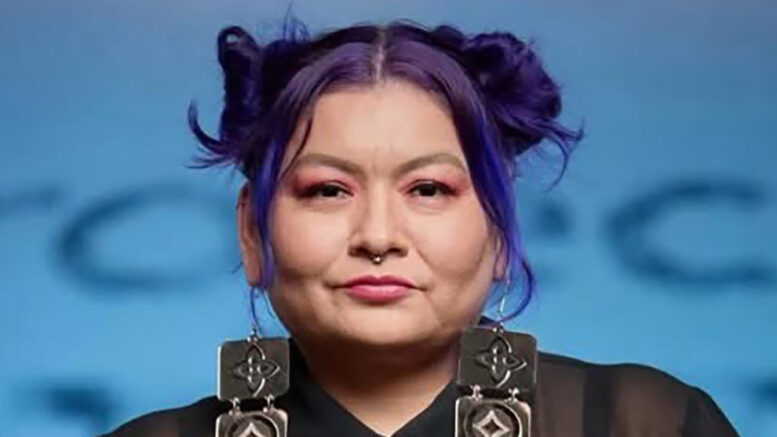
Edmonton designer hopes her appearance on Crave’s Project Runway Canada will inspire Indigenous youth, celebrate family legacy and create more opportunities for fashion and the arts in First Nations communities.
By Chevi Rabbit , Local Journalism Initiative Reporter
(ANNews) – For Edmonton fashion designer Heather Bouchier, fashion has always been more than clothing. It is a creative expression shaped by family, culture, personal inspiration and a legacy she did not fully understand until she was already building a career of her own.
Now, Bouchier is preparing to take that creativity to a national audience as a contestant on the second season of Project Runway Canada, premiering November 20 on Crave.
For the designer, the opportunity represents years of dedication, but also something much bigger: the chance to bring greater visibility to Indigenous designers and encourage the next generation to pursue their creative ambitions.
“I was always into fashion as a kid,” Bouchier said.
Her interest eventually led her to the Academy of Fashion Design in Saskatoon, where she studied in 2001. At the time, she was pregnant with her son and raising him as a single mother.
She recalled having to make a decision between pursuing hairdressing or attending fashion school. “I was trying to decide. I really like doing hair too. I wanted to start doing hair. So it was either hair school or fashion school, and I chose fashion school.”
That decision became the beginning of a career that would take her to fashion shows and major events across North America and beyond.
Bouchier’s creative process often begins with something ordinary. Inspiration can come from a movie, a television show, an object or even the shape and colour of a tree. “Usually it just starts with a thought in my head, or something that I’ve been inspired by, whether it’s a movie or a TV show, or just something on a day-to-day,” she explained.
From there, she begins sketching, imagining the finished garment and finding materials that will bring the design to life. But some of her most meaningful inspiration comes from much closer to home.
A legacy stitched through generations
Bouchier credits her family as her greatest source of inspiration, particularly her late grandmother, Edna Rose Seeseequasis. She said she discovered only after beginning her own career that her grandmother had been a master seamstress.
“When I found that out, I was like, ‘Oh, that makes a lot of sense.’ That’s something that’s in my DNA, and I didn’t even realize it all this time.”
According to Bouchier, her grandmother travelled to First Nations reserves in Saskatchewan during the 1960s and 1970s, teaching young women how to sew. She compared her grandmother’s work to the workshops and cultural programming offered in communities today, where people share practical skills such as sewing, ribbon skirt-making and other forms of traditional craftsmanship.
“My grandma used to do that back in the day,” she said.
For Bouchier, learning about her grandmother’s accomplishments gave her own fashion journey a deeper meaning. “She was like a pioneer,” she said.
The discovery strengthened her connection to her family’s creative history and helped her recognize that the skills she was developing had a connection to the generations before her.
She also designed a custom gown for Tia Wood’s Juno Awards appearance, working with stylist Jason Pillay. The design featured a large rose on the back, inspired by her grandmother’s middle name. Bouchier had originally considered incorporating horsehair into the gown but ultimately decided the design was stronger without it. The rose became a meaningful tribute to her Kokum, bringing family history into a contemporary red-carpet design.
A pinch-me moment on Project Runway Canada
When Bouchier stepped into the Project Runway Canada workroom for the first time, the experience was difficult to put into words. As someone who had watched both the Canadian and American versions of the fashion competition, seeing the workroom and its familiar branding was surreal.
“Wow, I’m really here. I’m really here,” she recalled thinking.
She described the moment as one that gave her goosebumps. “It was a very special moment.”
Although she had already shared aspects of her life on social media, participating in reality television introduced a different level of public exposure. Bouchier said it took time to adjust to the cameras and the unfamiliar environment.
She also recognizes that appearing on a national platform can bring criticism and potential racism, particularly in the current political climate. “Racism isn’t unheard of, especially on these kinds of platforms, and that’s definitely something to consider when you’re feeling vulnerable,” she said.
Despite those concerns, she remains proud of what she has accomplished and what the opportunity represents.
Following the cast announcement, Bouchier said she was overwhelmed by the support from her family, friends and Indigenous communities. “I get emotional about it and really happy, like, to be representing Indigenous designers.”
She is also sharing the season with fellow Indigenous designer Dillon James Hayes, a Métis designer from Kamloops, British Columbia.
Taking the platform back to community
While competing on television is a major milestone, Bouchier hopes the opportunity will create possibilities beyond her own fashion career. She wants to use her platform to promote Indigenous designers, encourage arts programming and help young people see fashion as a legitimate career path.
Through her work with the Indigenous Empowerment Fashion Collective and Edmonton Indigenous Fashion Week, she has already been involved in producing and curating fashion events. Now, she hopes to expand that work by connecting with First Nations communities, discussing barriers faced by Indigenous and Two-Spirit people in the arts, and encouraging greater investment in creative programming.
Bouchier believes young people should have opportunities to explore their interests, whether those interests involve fashion, design, music or other creative pursuits. She also wants to challenge the idea that pursuing a career in the arts means having to leave one’s community.
Her message extends to Indigenous people living both on and off reserve. “You can still follow your dreams and live within the spaces that you don’t always think that you can,” she said.
She hopes to see more emphasis placed on arts and fashion programming within First Nations communities, creating opportunities for young people to discover their talents and develop their skills without feeling they must leave their homes to succeed.
For Bouchier, representation is not simply about being seen on television. It is about making room for others to imagine themselves in spaces they may not have previously considered possible.
The people behind the designer
Bouchier is quick to acknowledge that her career has not been built alone. She credits her husband, Louis, her family and friends for supporting her throughout her journey. “My husband Louis, he’s basically financed my career since I started,” she said.
When she was learning to sew, Louis purchased her sewing machines and continued supporting her creative ambitions. She also recognizes the Banff Centre for Arts and Creativity for helping elevate her work through artist residencies, creative opportunities and access to new techniques. Her experience there included exploring 3D printing and incorporating modern technology into traditional materials and techniques, including dentalium shell work.
The Banff Centre’s support helped her expand her artistic practice while connecting with other Indigenous artists. Today, Bouchier continues to develop her own designs while producing fashion shows, teaching workshops and mentoring others. She hopes to maintain that work while making the most of her growing public profile.
“To me, this is the biggest platform that I’ve received so far, and I’m hoping that I can use it in the best possible way… the best positive way, while still maintaining my own design and my own work,” she said.
As she prepares for her television debut, Bouchier carries with her the support of her family, the memory of her Kokum Edna Rose and the encouragement of Indigenous communities cheering her on.
Her journey is a reminder that creative talent can be nurtured across generations, that fashion can be a powerful form of storytelling, and that young people should be encouraged to pursue their dreams wherever they call home.
For Bouchier, the runway may be national, but the inspiration begins with family, culture and community.

Be the first to comment on "Heather Bouchier brings Indigenous fashion to ‘Project Runway Canada’"