By Chevi Rabbit, Local Journalism Initiative Reporter
(ANNews) – A children’s television series is bringing Cree language, Indigenous storytelling and cultural teachings to a new generation through the adventures of a grandmother and her young granddaughter.
Created by Métis and Nehiyaw filmmaker April Johnson, Kokum & Dot is an eight-episode children’s series combining live action, puppetry and Woodland Cree-inspired animation. Produced by Johnson’s Vancouver-based company, Ekosi Productions Inc., in partnership with Second Son, the series was developed for young viewers ages four to seven.
Johnson, who is originally from Muskoday First Nation in Saskatchewan, founded Ekosi Productions in 2022. The company focuses on sharing Indigenous, women and LGBTQ2+ stories with Canadian and international audiences.
The idea for Kokum & Dot began during the COVID-19 pandemic, when Johnson was taking online Cree language classes with Elder Dorothy Visser, whom she affectionately calls Kokum Dorothy.
Visser, originally from Saddle Lake, Alberta, now lives on the West Coast. Johnson said she was inspired by the Elder’s passion for Cree language, culture and teaching children.
“She’s very passionate about Cree language and culture and preserving Cree. She teaches all ages, but she loves teaching children, and she likes using puppetry in her teaching,” Johnson said.
The experience prompted Johnson to consider how the Elder’s teachings could reach a wider audience through television and media.
“So I was really inspired as a producer to see if there was a way within the media industry to preserve some of her teachings,” she said.
Johnson began pursuing development funding in 2022. The project eventually received the green light from TELUS Independent to produce its first season, initially planned as a limited series. The production later secured support for a second season.
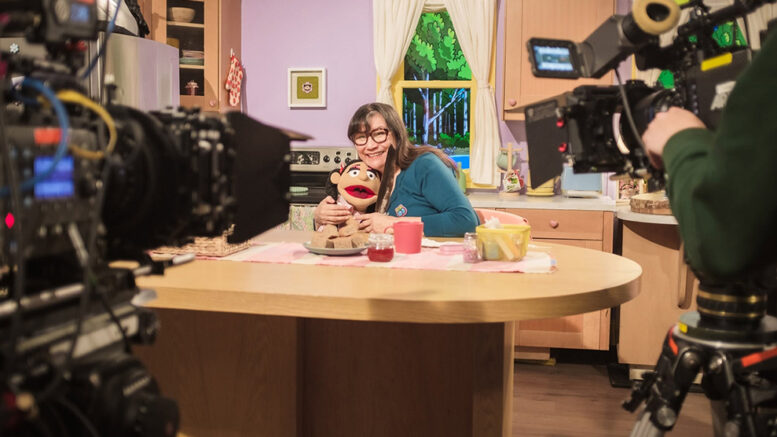
The series is directed and produced by Johnson, with Jules Koostachin writing the first season. Indigenous actor and musician Renae Morriseau plays Kokum, while Dot is brought to life through puppetry. The production also features original music composed by Morriseau.
The characters were developed with several ideas in mind, including highlighting intergenerational relationships and the importance of family.
“Kokum” is the Cree word for grandmother, while Dot is a childlike form of the name Dorothy. The characters also carry a deeper meaning connected to Visser’s life.
Johnson explained that Dot symbolically represents Kokum Dorothy as a young child before she attended residential school. The story offers a way to honour the Elder’s childhood and her connection to her family, land and territory.
Each episode follows Kokum and Dot as they discuss a problem and explore one of the Seven Sacred Teachings. The storytelling moves from the puppet-based interactions between the characters into an animated world, where Dot encounters animals and learns through her experiences on the land.
Because the production is based on the West Coast, the animated sequences also provide an opportunity to represent Treaty 6 territory and the animals connected to Kokum Dorothy’s childhood experiences.
Each season consists of eight episodes, approximately 11 minutes each, with the Seven Sacred Teachings woven throughout the storytelling.
Johnson said the teachings are introduced through the animals and their symbolic connections. For example, the eagle, which symbolizes love, appears in the first and final episodes, creating a recurring connection throughout the season. The turtle is connected to truth, while the moose is associated with respect.
The series uses repetition to reinforce the teachings, allowing young viewers to follow Dot’s learning journey.
“It’s a little repetitive, but sometimes we feel that repetition can help with teachings,” Johnson said.
As Dot interacts with the animals and the land, she begins to understand the lesson before returning home to share what she has learned with Kokum.
The production also places an emphasis on Indigenous representation behind the scenes, bringing Indigenous creators into different departments and stages of development.
Johnson said the project continued to evolve as more Indigenous artists and filmmakers became involved.
“The more that you’re working with Indigenous creators, the show keeps evolving and getting stronger because of the Indigenous representation that we have across all the departments of the show,” she said.
Johnson said an Elder was involved throughout every phase of the project, helping ensure cultural knowledge and teachings remained central to the production.
The Season 1 creative team included writer Jules Koostachin, lead actor and music composer Renae Morriseau, Elder and knowledge keeper Dorothy Visser, animation producer Tanner Zurkowski, production designer Olivia Cox, woodland animation artist Stephen Gladue, director of photography Cameron Watts and assistant director Samantha Damm. Executive producer Patti Poskitt also contributed to the series.
The animation was produced with Calibrate Collective, adding a distinct visual style to the show’s live-action and puppetry format.
The series was made with support from TELUS Independent and other industry funding partners, including Creative BC, the Canada Media Fund and the Indigenous Screen Office.
Since its release, Johnson said the response has been encouraging. She was initially nervous about how audiences would receive a project she had spent years developing.
“I love to see not only Cree families interacting with the show, but seeing other Indigenous viewers liking and learning things, but also non-Indigenous,” she said.
She has also heard from educators interested in introducing the series into classrooms as a way to support learning about Indigenous culture, language and teachings.
The first season has been made available through TELUS platforms in British Columbia and Alberta, with distribution also expanding to Saskatchewan through SaskTel. Johnson said sharing the series with audiences, including her home community, has been an important part of the project’s journey.
Although the series was originally intended to be limited to one season, the opportunity to produce a second season has opened the door to further storytelling. Production on Season 2 began in June 2026.
Johnson credited TELUS Independent for believing in the project and supporting its continuation.
She said conversations, consultations, story-editing sessions and writers’ room discussions continue to generate new ideas for expanding the teachings and stories within the series.
“There’s so many opportunities within this show for great storytelling that I think can help children feel confident in their culture, but also just teach a bigger audience, not only just Métis Cree families,” she said.
For Johnson, the goal is to preserve and share Indigenous language, culture and knowledge while creating something children and families can enjoy together.
“I would love everyone to watch the show.”
Viewers can learn more about the series through Ekosi Productions and TELUS Independent. The show is also listed on Apple TV.

Be the first to comment on "Popular children’s television series Kokum & Dot brings Cree language and cultural teachings to a new generation"