By Chevi Rabbit, Local Journalism Initiative Reporter
(ANNews) – What began as a practical way to pay off a car loan has grown into a thriving collective where Métis artists support one another, share their culture, and create opportunities for future generations.
For Métis artist Kelsey Olsen, the beginnings of Michif Makers were surprisingly ordinary. “I started it because I have a really high loan on my car and I wanted to pay my car off early,” Olsen said. “That’s what started it.”
At the time, she was working in a position where she didn’t feel her experience and knowledge were being fairly valued. “I also was working a job where I wasn’t necessarily being paid in the way that I felt was fair for the amount of knowledge I hold,” she said. “So I was just doing that to supplement my income.”
What started as a side project soon evolved into a full-time career. “It’s taken off now to the point where I can do it full time.”
Today, Michif Makers has become much more than a business. It is a collective that helps Métis artists reach new audiences while easing the challenges of selling their work independently.
Olsen believes the collective reflects a tradition that has long existed within Métis communities. “I think that’s how it’s always been done,” she said. “All the women were at home with their kids, they were all helping each other.”
Many of the artists involved with Michif Makers are mothers balancing careers, families and their creative work. By managing market booths, administration and sales, Olsen allows artists to spend more time creating and less time worrying about logistics.
“Being able to support each other and make it not overwhelming to sell your art has been really important,” she said. “If you’re doing that on your own, keeping stock is a lot, making sure you have the weekends off, and being away from your kids would be hard too.”
Rather than expecting every artist to do everything themselves, the collective shares responsibilities. “I’m happy to take that role from them, and the support that they give me so I’m not always having to push myself to make sure that there’s enough beadwork or tufting or whatever on the table,” Olsen said. “It’s very reciprocal.”
That sense of reciprocity extends beyond the marketplace. Recently, Olsen and fellow artist Kim led a ribbon hoodie workshop for approximately 30 youth at a Métis Nation District 21 cultural camp between Wabasca and Slave Lake. The experience became one of the most meaningful moments of her work. “We didn’t realize the impact that this would have on the kids because we didn’t realize that they don’t teach sewing in many schools nowadays,” she said.
The response surprised her. “They wanted to make more than one, they wanted to stick around and help the other kids.”
For Olsen, the workshop demonstrated that traditional skills remain deeply meaningful when young people are given the opportunity to learn them. “It was very community-based how much everyone wanted to learn and help each other,” she said. “They were excited to go home and show their parents what they made, and they wanted to bring extra home to give their family as well.”
Teaching and mentoring have become just as important to Olsen as creating art herself. “I hope that they will take away wanting to try everything,” she said when asked what she hopes young Métis artists will gain from Michif Makers.
A multidisciplinary artist, Olsen encourages people to experiment with different art forms instead of worrying about perfection.
“I make everything in different styles and I teach everything,” she said. “You don’t have to be a master at any of these, but the fact that you’re practicing and learning all these different skills, it’s making a difference because you can pass that on, or it’s just something to be proud of, knowing that you have all these cultural skills in your back pocket.”
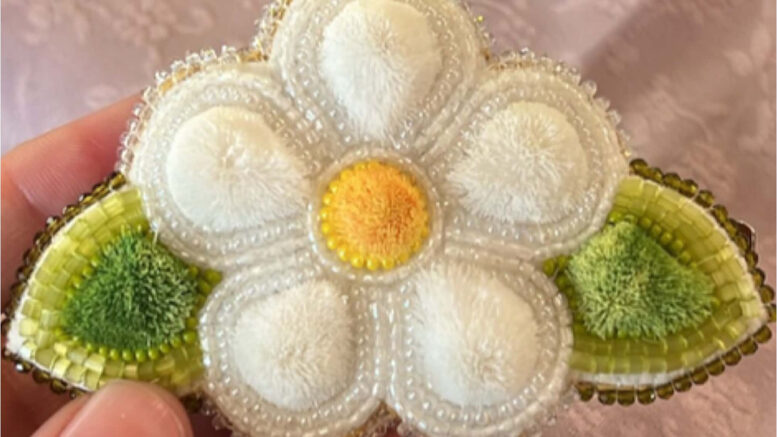
Her own artistic journey began with beadwork after taking a class with Bonnie Lamouche of Gift Lake. Since then, she has expanded into digital illustration and, more recently, tufting, while drawing inspiration from Woodland Cree art, Indigenous artists and traditional tattoo imagery.
Although she works across several mediums, Métis floral designs remain central to her practice. “I’ve been mostly focusing with my beadwork on tufting,” she said. “I do mostly Métis designs with that five-petal flower.”
For Olsen, the familiar floral motif represents more than artistic expression. “I find that… I don’t know, that just makes me feel good doing something that’s so recognizable as Métis.”
She also embraces the repetition of creating similar pieces because it allows her to witness her own growth. “I like the repetition of doing the similar designs over and over again. I can see myself improve, and I can see the difference in my work even like three or four different pieces away. I can see that improvement.”
As Michif Makers continues to grow, Olsen hopes to welcome more artists into the collective. While many of the markets she attends focus on Métis vendors, she says she is always looking to connect with new women and Two-Spirit artists interested in sharing their work. “I’m always interested in new women or Two-Spirit people coming on as a part of the collective,” she said. “There’s no strings attached, and I want to grow because it is hard for us to keep up.”
For Olsen, Michif Makers has become far more than the solution to a financial challenge. It has become a place where artists support one another, traditional skills are shared with the next generation, and Métis creativity continues to flourish through collaboration, mentorship and community.
“If you have a venue to sell your art,” she said, “feel free to message me and we can discuss it further.”
Contact Michif Makers by email at [email protected].

Be the first to comment on "From a Car Loan to Community: How Kelsey Olsen Built Michif Makers Into a Home for Métis Artists"