
By Jeremy Appel, Local Journalism Initiative Reporter
(ANNews) – The chief of Athabasca Chipewyan First Nation is backing the Union of B.C. Indian Chiefs’ call for Canadian Prime Minister Mark Carney and Alberta Premier Danielle Smith to “immediately halt” plans for a new oil pipeline to the West Coast.
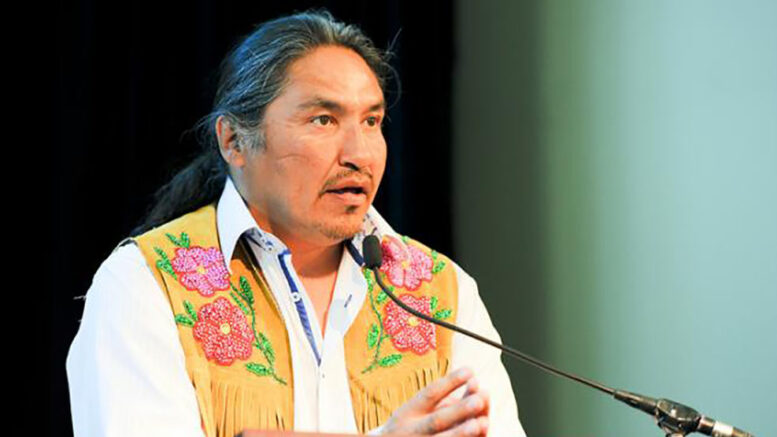
“If the B.C. chiefs say no, I respect what the B.C. chiefs want,” Athabasca Chipewyan Chief Allan Adam told Alberta Native News.
In July, Carney and Smith signed an agreement that committed the federal government to fast-tracking a new one-million barrel a day tar sands pipeline to B.C.’s southern coast, following a similar route to the existing Trans Mountain pipeline.
“This proposal threatens both the inherent rights of First Nations and accelerates the expansion of the fossil fuel industry at a time when communities across the country are already experiencing devastating climate disasters,” reads an Aug. 9 open letter from the Union of B.C. Indian Chiefs (UBCIC) to Carney and Smith.
The letter is signed by UBCIC Grand Chief Stewart Phillip, Gitxaala Nation Chief Councillor Linda Innes and Heiltsuk Tribal Council Chief Councillor Marilyn Slett.
As they penned their open letter, 20,000 people were being forced to evacuate from communities near Okanagan Lake, which is at its lowest level on record due to drought conditions, in B.C.’s southern interior.
Carney plans to submit the proposed pipeline to the Major Projects Office for approval as a “national interest” project by Oct. 1, which would then force the project to proceed.
The UBCIC argues that this is a violation of the duty to free, prior and informed consent enshrined in multiple sections of the UN Declaration on the Rights of Indigenous Peoples, which Canada adopted as law in 2021.
“Canada and Alberta claim that their engagement is early and meaningful, but they have already developed a project concept and corridor, submitted the proposal, named prospective development partners, established an October 1 target, and begun publicly promoting the project’s economic case,” wrote the chiefs.
“Consultation cannot be meaningful if First Nations are invited only to discuss how a predetermined project will proceed.”
The UBCIC added that the “destructive and disastrous consequences of expanding fossil fuel production extend far beyond any single territory.”
“Greenhouse gas emissions do not recognize territorial boundaries, they contribute to a climate crisis that affects every First Nation, every community, and future generations alike,” reads the letter.
In Treaty 8, Chief Adam of Athabasca Chipewyan First Nation (ACFN) has his own concerns with a new pipeline.
“Where do they plan to expand or to get all that oil from once they go ahead and do it? Because if they’re coming from our area here in Fort McMurray where the oil sands are, that ain’t going to happen,” he said.
“We will start launching court cases, and we will tie them all up in court for the next 20 years.”
Adam cited the health impacts of tar sands extraction on the downstream community of Fort Chipewyan, which he fears will be exacerbated by plans to release treated tar sands tailings fluids into the Athabasca River.
“I don’t care what pipelines they dream of,” he added. “They ain’t going to get no approval from ACFN on any further expansions of the oil sands to fill those pipes.”
Neither Alberta’s Ministry of Indigenous Relations nor the Premier’s Office acknowledged requests for comment.
Indigenous Relations spokesperson Karen Folk told The Canadian Press that the pipeline will provide “long-term benefits” to First Nations communities, who will be consulted through “ongoing dialogue … as this work continues.”
This newspaper reached out to Crown-Indigenous Relations and Northern Affairs Canada for comment, which redirected the inquiry to the Privy Council Office.
Spokesperson Pierre-Alain Bujold said that consultations are underway with “potentially impacted Indigenous communities,” as well as the relevant provincial and territorial governments, to determine whether the pipeline should be designated as a national interest project.
If approved by the Major Projects Office, he added, “the project would undergo a streamlined review that upholds rigorous environmental standards and fully respects the rights of Indigenous Peoples.”
In a statement, federal NDP leader Avi Lewis said a new pipeline “defies common sense.”
“You can’t approve a project and then engage in consultation: that is just a pipeline to the courts,” said Lewis.
“And for Canadians across this land, it is a kick in the teeth to call this climate bomb of a project ‘in the national interest.’ It is in Big Oil’s interest for sure. But it doesn’t do a damn thing for people struggling with the cost of food and housing, increased costs from privatized healthcare, and of course the daily anxiety of climate breakdown.”

Be the first to comment on "ACFN chief joins B.C. First Nations to oppose new pipeline"