

By Chevi Rabbit, Local Journalism Initiative Reporter
(ANNews) – For Anita Cardinal, building a stronger future for Indigenous communities means more than challenging barriers. It means creating opportunities, supporting others and making sure the next generation can see possibilities that were not always visible to those who came before them.
A Nêhiyaw (Cree) member of Woodland Cree First Nation, Cardinal is an Alberta lawyer, mother, grandmother and kokum. She is also the founder and chair of the Indigenous Runners Alliance and the founder of Edmonton’s annual Orange Shirt Day Run/Walk, bringing people together through movement, remembrance, education and community.
Her path to becoming a lawyer began when she was 15. It took decades of determination, including working as a paralegal before eventually entering the legal profession.
“I never met an Indigenous lawyer until I was in my mid-30s,” Cardinal said. “It took me 30 years to get here.”
That experience has shaped the legacy she hopes to leave behind. She said her nieces have expressed interest in becoming lawyers, but do not always imagine that career as something within reach.
“Now I have nieces that say that they want to be a lawyer, but they ƒdon’t just imagine it being a possibility. They know it’s a possibility,” she said.
For Cardinal, representation is about more than being able to point to an Indigenous person who has entered the profession. It is about helping young people understand that they can pursue those careers and build on the achievements of those who came before them.
“That’s the legacy we want to leave behind,” she said. “It’s not just let our families and our nieces, nephews, children, and grandchildren… know that it could be possible, but know that it is.”
That commitment to community is also reflected in her work outside the courtroom. Through the Indigenous Runners Alliance, Cardinal has helped create opportunities for Indigenous runners and build a welcoming community around movement, wellness and connection.
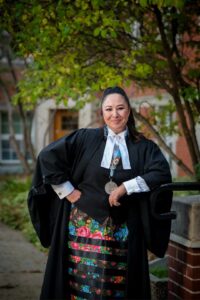
Anita Cardinal in her ribbon skirt and legal attire. Photo by Darlene Hildebrandt.
She also founded the annual Orange Shirt Day Run/Walk in Edmonton, an event that brings Indigenous and non-Indigenous participants together to honour residential school Survivors, remember the children who never returned home and create space for learning and reflection. The event combines running and walking with ceremony and community gathering and has grown beyond Edmonton to include other communities.
For Cardinal, the event is about more than physical activity. It connects movement with remembrance, healing and the responsibility to carry the truth of residential schools forward. Participants can take part at different distances and abilities, making the gathering accessible to families, children, Elders, experienced runners and people who simply want to walk in solidarity.
Her approach to community-building has also evolved as the organizations and initiatives she has helped create have grown. Cardinal said starting something from the ground up can become all-consuming, particularly when resources are limited and much of the work falls on one person.
“I think when you’re starting off and you’re trying to build a community, it becomes all-consuming sometimes, for sure, and you’re working so hard, sometimes with limited resources and, you know, by yourself,” she said.
As more people become involved, leadership requires a different approach, she said. It means learning to trust others, share responsibility and recognize that a community cannot depend on one person to do everything. “You go from being basically one person or a couple people, and then there’s all these wonderful people that you get to work with,” she said.
“You have to learn not to micromanage, to trust the process, trust the people, and you’re working all towards, you know, a common goal and towards the same vision.”
Cardinal said mentorship, lifelong learning and recognizing the knowledge and experience of others are important parts of that growth. “Honestly, that’s all I ever wanted was to support my community,” she said.
She also spoke about the expectations sometimes placed on Indigenous professionals to provide advocacy, education and professional services without compensation. Cardinal said she understands the importance of making professional services accessible to Indigenous communities, particularly when access to advocacy has historically been limited. At the same time, she said Indigenous professionals must also be able to support themselves and have their work valued. “Fair compensation is an important part of respect,” she said.
Her legal work brings her into some of the most difficult areas of family and child welfare. Cardinal works as a roster lawyer representing children in care in Alberta and serves as in-house counsel for her Nation’s child and family services agency.
She said many children involved in the child welfare system are Indigenous, making it important that their voices, identities, families and communities are understood and represented.
Cardinal also pointed to Bill C-92, the federal legislation respecting First Nations, Inuit and Métis children, youth and families. The Act affirms that the inherent right of self-government includes jurisdiction over child and family services. For Cardinal, the legislation recognizes that Indigenous peoples have the right to make decisions about the care and well-being of their children.
However, she said the recognition of Indigenous jurisdiction does not mean the work is finished. She has seen differences in how Indigenous laws and authority are understood and respected across Alberta, and believes continued education and understanding are necessary.
Cardinal is also concerned about changes affecting Indigenous learning within Alberta’s legal profession. She said lawyers need to understand Indigenous history and the experiences of the communities they serve. “We’re seeing an attack on the profession as well, with regards to Indigenous learning, making sure that each lawyer is learning about Indigenous history, but now that has gone,” she said.
She described the changes as making it more difficult for Indigenous perspectives to be supported within the profession. “It just feels like more of an attack on the Indigenous lawyer’s perspective, for support. It’s now feeling even more stifled,” she said.
Alberta’s Regulated Professions Neutrality Act took effect for most regulated professions on Sept. 1, 2026. The legislation restricts professional regulators from making certain types of education and training mandatory, including cultural competency, unconscious-bias and diversity, equity and inclusion training, unless the training relates to professional competence and ethics. The Law Society of Alberta subsequently amended its Code of Conduct in response to the legislation.
Cardinal said the changes reinforce concerns she has about the barriers Indigenous lawyers continue to encounter. “We know that this is not a profession that’s designed for Indigenous people. This is not a – we are not welcome here. We have never been welcome here. It’s a gatekeeping profession that’s designed to keep us out, and I see that again and again,” she said.
She recalled the additional challenges Indigenous law students faced during a property law program at the University of Saskatchewan, describing the experience as another hurdle in an already demanding path. “It was harder than our first year of law,” she said.
Cardinal said Indigenous lawyers can also face tokenization, discrimination and racism in the workplace. She believes those experiences contribute to why some Indigenous lawyers choose to practise independently. “That’s why I see a lot of our Indigenous lawyers become sole practitioners,” she said.
She has also seen more Indigenous-owned law firms emerging and hopes that trend continues. “I’d love to see that trend continue. So hopefully one day, you know, we see that everywhere,” she said.
Despite the challenges, Cardinal continues to focus on the work that brought her into the profession in the first place: supporting her community and creating opportunities for others.
She said the work in child and family services, particularly when it involves intergenerational trauma, can be emotionally demanding. Balancing professional responsibilities with volunteer commitments means making time for spiritual, mental and physical well-being.
Her connection to running and the land is an important part of that balance. Through the Indigenous Runners Alliance and the Orange Shirt Day Run/Walk, she encourages people to reconnect with movement and practices that have been part of Indigenous life since time immemorial.
“Movement is medicine,” Cardinal said. “When we are overwhelmed, when we have anxiety, and we are needing connection, to always remember to go back to the land.”
For Cardinal, the message is also a reminder that strength and healing can be found beyond the demands of work and daily responsibilities.
“Don’t forget that your strength is right out the door,” she said.
“It’s all about balance, honestly. It’s about balance.”

Be the first to comment on "Anita Cardinal: Breaking barriers for the next generation of Indigenous lawyers"