By Chevi Rabbit, Local Journalism Initiative Reporter
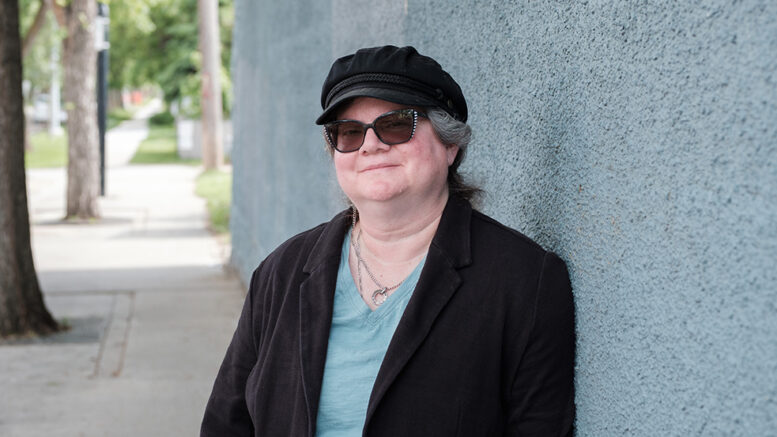
(ANNews) – For more than two decades, Paula Kirman has been documenting Edmonton through a camera lens.
Her work has taken her from peace marches and social justice demonstrations to Indigenous events, missing and murdered Indigenous women awareness initiatives, community gatherings and historical investigations. Along the way, photography evolved into journalism, videography, filmmaking, digital storytelling and communications.
Kirman describes herself as a freelance independent journalist and communications and media consultant, while also working as a community photographer, filmmaker and performing singer-songwriter. “I wear a lot of different hats,” Kirman said.
Her career, however, can be traced back to something much simpler: a lifelong fascination with photography. “I just grew up with, you know, taking pictures and capturing the world around me. It’s a very natural thing to do,” she said.
Kirman said her interest in photography began when she was a child, influenced by her father, who was also an avid photographer. “I think I held a camera in my hand before I could even read and write,” she said.
Over time, that childhood interest became a way of documenting the world around her – and eventually, a way of documenting Edmonton’s social movements.
Finding a purpose behind the camera
Around 2005, Kirman began attending events connected to social justice and human rights. One of the first was a peace march. As she looked around, she noticed something was missing.
“I realized, you know, like somebody should be taking pictures of this, because I had never really seen a lot of coverage of these kind of events in the media,” she said. “Somebody needs to be documenting this.”
She asked the organizer for permission to photograph the event and posted the images online that same evening. At the time, social media was nowhere near as ubiquitous as it is today. Kirman relied on online discussion groups and a makeshift website she had created using a free hosting service. The response surprised her.
“They got so widely shared and viewed that the server literally crashed that I had them on,” she recalled.
The event also included an arrest, which further demonstrated to Kirman that the moments she was witnessing were worth recording. “I realized, wow, you know, maybe I’m onto something here,” she said.
From there, she began attending more events and documenting activism across Edmonton. “It just kind of became my thing, like to document activism in Edmonton.”
What began with a camera gradually expanded into a broader form of community journalism.
A storyteller in many forms
Kirman began her professional career primarily as a writer, but photography soon became another part of her work. Websites, social media, video and filmmaking followed. “I definitely consider myself a storyteller,” she said.
For Kirman, developing different creative skills has also been practical. As an independent journalist, she says she has had to continually learn and adapt. “When I first started out on my career path, I only did writing professionally, and then photography started coming into it, and then websites started coming into it and social media, and then doing video.”
Having access to a video camera allowed her to expand how she documented events. Rather than only photographing a speaker or demonstration, she could record what was actually being said and give audiences who could not attend an opportunity to experience more of the event.
“Sometimes in the media, there’s just sound bites or things are taken out of context,” Kirman said. “I felt it was important to do what I could to record something that was more representative of the events, so that people could get a better idea of the issues and be able to form more informed opinions around those issues.”
That desire to provide context has remained a central part of her approach. “I try to use my skills and use my abilities to highlight social justice and human rights issues to as broad an audience as possible,” she said.
Documenting Indigenous movements
As Kirman became increasingly involved in documenting social justice events, Indigenous events naturally became part of her work. “As I started documenting more and more social justice events, of course, Indigenous events became part of that, not only as an independent documentary photographer and videographer, but also for journalism,” she said.
She has contributed photographs and writing to Indigenous-related publications over the years and recalls the powerful impact of witnessing the early Idle No More movement in Edmonton.
Kirman remembers the first Idle No More event she attended in Churchill Square as an especially emotional experience. “I remember just the very, very first Idle No More event in Churchill Square, which was so huge, and just feeling like I was just breaking out in goosebumps, looking around at all the people who were there,” she said.
She remembers buses arriving from different First Nations communities around Alberta and a large march taking over the street. “I was feeling just this stirring in my soul of how powerful that was,” she said.
Her work also brought her into contact with organizers involved in raising awareness about missing and murdered Indigenous women and girls.
She specifically recalled meeting April Eve Wiberg of Stolen Sisters, Judith Gale, who has been involved with Red Dress Day, and the late Danielle Boudreau, founder of the Edmonton Valentine’s Day Memorial March.
“That has become a cause that is very near and dear to my heart, just because of the tragedy of it all,” Kirman said.
Kirman is clear about her own position as a non-Indigenous person while explaining why the issue matters to her. “I’m not Indigenous, but I am a woman,” she said.
Through her involvement, she said she became more aware of how systemic racism and colonial systems contribute to gender-based violence and its disproportionate impact on Indigenous women and women of colour. “That is just a huge injustice that I feel very strongly about,” she said.
For Kirman, documenting these events became one way of bearing witness.
An online archive of Edmonton
Kirman’s work has also created a digital connection between Edmonton and people outside the city. She wants people beyond Edmonton to be able to see what is happening in the city and understand how local issues connect with social movements elsewhere.
Her website, RadicalCitizenMedia.com, has become an online archive of her photographs and videos. Kirman believes the work represents a portion of Edmonton’s history.
“I would certainly say I’m capturing a part of Edmonton’s history,” she said. “I think that progressive social movements are definitely part of Edmonton’s history, and it’s been my goal to capture as much of that as possible.”
Now, she is considering how her extensive collection might be preserved beyond her own website. “It’s been suggested to me that I start to investigate ways to gather my photos and media to maybe try to get those into the City of Edmonton archives, or, you know, some kind of permanent safekeeping.”
For Kirman, preserving that material is about more than photographs. It is about preserving the perspectives, voices and moments that make up a city’s history. She also recognizes that she is only one person documenting an enormous number of events. Today, smartphones have made it possible for virtually anyone to photograph or film a demonstration or community gathering. Kirman sees that as a positive development.
“If you get three photographers at the same event, you get three different perspectives,” she said. “Everyone shoots from kind of a different angle, a different perspective, and that can be really interesting as well.”
From photography to filmmaking
Kirman’s filmmaking grew organically from the same desire to document and provide context. “My filmmaking kind of got started in kind of a grassroots fashion,” she said.
After photographing protests and events, she began filming them, editing the footage and posting it online. Her goal was once again to provide context and allow audiences to hear what speakers were actually saying. Her filmmaking eventually expanded into projects examining Edmonton neighbourhoods and historical monuments.
As editor of Boyle McCauley News since 2006, Kirman became particularly connected to the Boyle Street and McCauley communities. She also received grants that allowed her to produce films about the neighbourhood, including a short film about life in McCauley.
Another filmmaking project took her in a very different direction: investigating monuments and the difficult histories behind them.
Kirman connected with filmmaker Adam Bentley, who was researching Edmonton monuments with connections to the Second World War and individuals who fought alongside Nazi Germany. Together, they produced two short documentaries examining controversial Edmonton monuments: A Monumental Secret in 2018 and Monumental Secrets in 2022. The films examined monuments and the historical narratives surrounding people connected to Nazi Germany and its collaborators.
Their investigation eventually expanded internationally.
In spring 2024, Kirman and Bentley travelled through Lithuania, Latvia and Estonia, as well as Finland, examining monuments connected to the Second World War and the ways historical memory is represented in public spaces. Their research included monuments associated with Nazi Germany and local collaborators, as well as memorials to Jewish communities destroyed during the Holocaust.
That international investigation became their first full-length feature documentary, No Secret Monuments.
Kirman and Bentley are now beginning to show the film to small audiences and are looking for additional screening opportunities. The film explores the difficult relationship between monuments, collective memory and the commemoration of people connected to the Nazi occupation and its collaborators.
Learn more about No Secret Monuments: No Secret Monuments official website
Watch the trailer: No Secret Monuments trailer
The earlier documentaries are also available online:
Music as another form of storytelling
Photography and filmmaking are only two parts of Kirman’s creative life. She is also a singer-songwriter whose music provides another avenue for exploring social justice, human experience and the complexities of life. Her Bandcamp profile describes music as a way of reaching a wider audience with messages connected to social justice, as well as expressions about life and love. Her music can be found at Paula Eve Kirman on Bandcamp.
Kirman also has an electronic and experimental music project under the name kirmeve, described as exploring drone, noise, electronic music, layered sounds and meditative constructions. Her electronic music is available at kirmeve on Bandcamp.
When asked what she hopes audiences take away from her creative work – whether she is behind a camera, directing a film or performing music – Kirman offered a simple answer: “I hope that people take away something meaningful to them, and something that they can reflect upon.”
Twenty-one years and counting
More than 20 years after that first peace march, Kirman is still carrying a camera, documenting Edmonton’s communities and social movements. The technology has changed. Social media has transformed how photographs and videos are shared. Smartphones have put cameras into the hands of millions of people. But the fundamental reason Kirman photographs has remained remarkably consistent. She believes somebody needs to document what is happening.
“Things just kind of rolled from there,” she said of the evolution of her career. “Here I am, you know, 21 years later and still doing it.”
For Paula Kirman, storytelling is not confined to one medium. It can be a photograph, a news story, a video, a documentary, a song—or an online archive that allows someone years from now to look back and understand what happened in Edmonton.
Her camera has become one way of making sure those moments are not forgotten.

Be the first to comment on "Through the Lens: Paula Kirman’s 21-Year Journey Documenting Edmonton’s Social Movements"