
By Chevi Rabbit, Local Journalism Initiative Reporter
(ANNews) – For nearly 30 years, DerRic Starlight has built a career around storytelling.
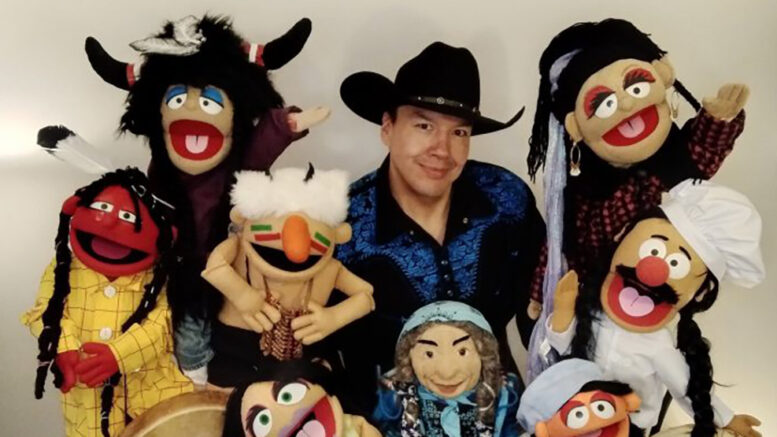
A comedian puppeteer from the Tsuut’ina Nation, Starlight has spent decades bringing laughter to audiences across Canada through comedy, television, and Indigenous puppetry. Inspired by the work of Jim Henson, he became one of Canada’s first Indigenous comedian puppeteers and created a career based on imagination, humour, and connection.
But his newest story, a book titled See-Me Street: My Indigenous Homeless Journey came from a very different place.
After years of performing, Starlight began thinking about the future and what he wanted to leave behind. He began considering what would come next after a lifetime of travelling and performing. “What am I gonna fall back on if I can’t do puppets anymore and travel anymore at an older age?” he said. “I’ve been a writer my entire life. I wanted to become an author at an older age.”
Originally, Starlight thought about writing a book about his career in entertainment, including his years in puppetry and wrestling. But after seeing friends and community members experiencing homelessness, the focus of his story changed. “I thought to myself, you know, why are these people homeless?” Starlight said.
Instead of simply observing from a distance, Starlight decided to spend time learning directly from people living on the streets. “I went out there and I stayed a whole month out in the homeless shelter, the Alpha House in Calgary, in the drop-in center,” he said. “And when the month was up, I thought, you know, this is going somewhere. I don’t have enough material for a whole book, but I have people that I can write about.”
His research continued in Edmonton and Lethbridge, where he spent time listening to people’s experiences and understanding the communities that developed among those experiencing homelessness. “Not just the people, but the way of life, you know, that Indigenous people, they live down there,” Starlight said. “They become a community. Like it’s a downtown reservation, they become a family. They call it the street family.”
DerRic Starlight’s experiences reflect a larger national reality. Men continue to make up the majority of people experiencing homelessness in Canada, representing about two-thirds of emergency shelter users.
For Starlight, homelessness is not caused by one single issue. “A lot of people out there aren’t there just because of addictions,” he said. “It’s because of divorce and bankruptcy and, you know, just life in general.”
He believes communities need to better understand that people experiencing homelessness have different circumstances and require different supports. “There’s gonna be a center, a shelter for people who have addictions and another one that don’t have addictions that are really trying to help themselves,” Starlight said. “If we separate that, you know, I think they would see a lot more progress.”
One of the most important stories in Starlight’s book is about his cousin Leonard, who he unexpectedly encountered during his research. “One of my cousins who’s in the book, his name’s Leonard, he showed up and I was shocked that he was there,” Starlight said. “He was my age. And so I thought, you know, why is he down there?”
For Starlight, Leonard’s story became connected to broader conversations about truth and reconciliation. “This is where a big part of this story came about,” he said. “And it’s about truth and reconciliation.”
Starlight believes the experiences of many Indigenous people facing homelessness are connected to the ongoing impacts of colonial systems. “That relates to residential schools, you know, and it’s an echo, a lost identity that our people are going through,” he said.
“It’s an epidemic that our people are being apprehended by social services,” Starlight said. “Our people are still being taken away, but it’s just a different form of social services.”
During the process of writing the book, Starlight was also confronting his own struggles and beginning his own healing journey. He wanted to “get rid of” his negative relationship with alcohol.
His friendship with Bobbi Currie, a talented powwow dancer and performer, became an important part of that journey. He recognized that Currie had the same ability to bring people together through humour.
“He was, just like myself, a comedian,” Starlight said. “He had them laughing. He had, like, a Bobbi Currie show down there making them laugh and standing up and he would have crowds of them and he would do his thing, silly as he is.”
Starlight believed Bobbi’s talent deserved a larger audience. In 2018, he invited Bobbi to join him on a creative journey that included returning to performance training and filmmaking. The two travelled to Toronto, where Bobbi attended The Second City, before travelling to Vancouver, where Starlight returned to film training to update his skills in the changing digital media landscape.
Together, they created a short film called The Adventures of Buckskin. Bobbi became the lead character, playing an Indigenous superhero in a comedy that reflected his personality and creativity.
“Bobbi became our lead, he was the star of the show,” Starlight said. “He was the main character and had to play a superhero, you know, who shoots panic from his hands and has all these Indigenous, Native superpowers.”
The role was designed around Bobbi’s humour and unique personality. “His only weakness was corn oil, and it was a comedy, but it fit him perfectly, and he fit the part perfectly,” Starlight said.
The experience gave Bobbi a renewed sense of purpose. “He was on cloud nine. He found what he wanted to do,” Starlight said. “And he started dancing again, and he was doing all the things that he wanted to do.”
Starlight believed Bobbi belonged in the entertainment industry. “Again, he belonged on television,” he said.
Their creative work continued during the COVID-19 pandemic, when Bobbi contributed to videos for CTV as a writer and continued sharing his creativity.
For Starlight, Bobbi’s story represents one of the most important messages of the book: people cannot be defined only by their struggles.
Later, Starlight received the opportunity he had dreamed about since childhood. “I got a call from Jim Henson Company,” he said. “And that was the biggest call of my life.”
Before leaving for his audition for the Fraggle Rock reboot, Bobbi encouraged him. “He told me before I left the door, he said, ‘You got this. Don’t worry about it, you got it.’”
Starlight achieved his lifelong dream of becoming a Jim Henson puppeteer. “I became a Jim Henson puppeteer, my goal, you know, that I always wanted to do.”
But when he returned, he learned Bobbi had relapsed and later died. “In the six years that I’ve known him, I never, ever saw him do hard drugs, ever,” Starlight said.
The loss became one of the most powerful lessons in his book. “Relapse is a harder road than anything else,” Starlight said. “When you’re doing good, when you’re doing very well, it only takes just one little moment to take your life away.”
Today, Starlight says the experience transformed his own life. “That was the last day I ever drank alcohol, never touched a cigarette or alcohol ever again,” he said. “So today I’m like nine years of sobriety.”
For Starlight, the book is ultimately about healing, understanding, and ensuring people’s stories are heard. “It’s a healing journey, you know, helping each other, get out of it.”
His message to Indigenous people who want to share their own experiences is simple.
“I encourage Indigenous people to write books,” Starlight said. “It doesn’t matter if you feel like you don’t have an education. You don’t really need one, as long as your story’s told.”
Through comedy, puppetry, and now writing, DerRic Starlight continues doing what he has always done: using stories to help people see each other differently.

Be the first to comment on "Puppeteer DerRic Starlight’s Journey Through Homelessness, Recovery, and Reconciliation"