
By Jeremy Appel, Local Journalism Initiative Reporter
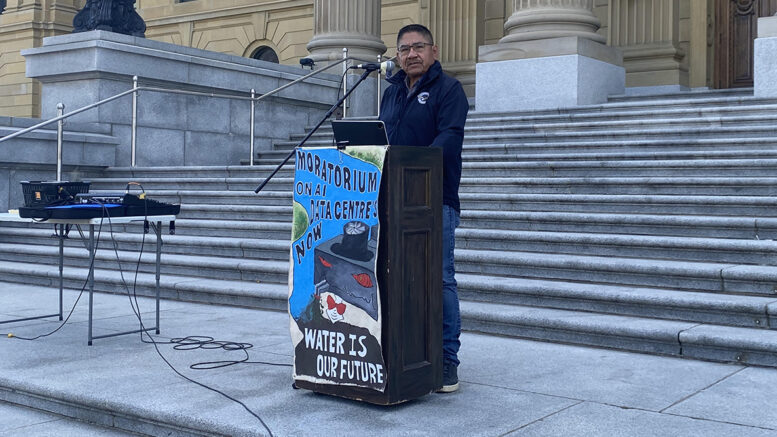
(ANNews) – More than 100 people gathered outside the Legislative Assembly building in Edmonton on Oct. 4 to protest the provincial and federal governments’ permissive approach towards building AI data centres.
Elder Taz Bouchier opened the rally with a land acknowledgement before tying the proposed 7.5-gigawatt Wonder Valley data centre near Grande Prairie’s potential water usage to the oil industry’s plans to release treated tailings fluids into the Athabasca watershed.
“When did people lose sight of how valuable water is to living? When money came into play. That’s all these data centers are about,” said Bouchier.
Sturgeon Lake Cree Nation is challenging the province’s decision to award a water license of 24-million cubic metres to the Municipal District of Greenview for Wonder Valley without consulting the Treaty 8 First Nation, which relies on the Smoky River for its water.
At the protest, Chief Sheldon Sunshine outlined a series of “very basic questions” he has for data centre proponents, including whether existing rules are sufficient “for the size and scale of what is being proposed” and whether there are sufficient water protections.
“What happens to our communities when these projects operate for decades? What happens to the land? What happens to the water? What happens to the wildlife? What happens to the air quality? What happens when multiple projects are operating in the same region? And perhaps most importantly, where is the assessment of the cumulative impacts?” Sunshine asked.
“We can’t look at every project at one time and pretend the others don’t exist. We have to look at the whole picture.”
As first reported by online news outlet Canada’s National Observer, Environment Alberta has exempted Wonder Valley from an environmental assessment.
“Why are governments creating pathways to accelerate these developments before the public has confidence that the rules are strong enough? Why is the push happening so fast? What concessions are being made to attract these projects? Who negotiated those concessions?” asked Chief Sunshine.
“Those are reasonable questions. Asking them does not make us anti-development. It makes us responsible.”
He emphasized that he understands the government’s “economic strategy behind these projects,” in terms of attempting to create a new market for the province’s substantial natural gas resources.
“But economic development cannot come at any cost,” said Sunshine.
“You cannot build a new economy by putting the foundation of that economy on water that communities depend on, land that cannot be replaced, or an electrical system that people already rely on. You cannot call something responsible development simply because it creates jobs. Responsible development means understanding the consequences before you build.”
Edmonton-Strathcona NDP MP Heather McPherson opened her remarks by “acknowledging that Indigenous people in this country are on the front lines of this fight, and on the front lines of so many fights that we are being asked to fight as citizens right now,” referring to First Nations’ opposition to Alberta’s separatist movement.
“We all owe Indigenous people in this province a debt of gratitude for being on the front line, protecting our sovereignty, protecting our climate, protecting our water and our land,” she added.
McPherson called it greatly “frustrating” that data centres are being fast tracked while crucial community needs are being unmet.
“We can’t build the homes that people need in this community, but we can build a data centre. We can’t build clean water facilities for people in this country, but we can build a data center,” she said. “The priority here for this government is to make billionaires wealthy at the expense of every single one of us here.”
McPherson stressed that the consequences of AI are not just environmental, referring explicitly to its use to reduce jobs and as a weapon of war.
“We’re being told it’s going to make our life better,” she said. “You tell that to the tens of thousands of public servants who are losing their jobs because [Prime Minister] Mark Carney thinks AI can do that job for them. You tell that to the Iranian schoolchildren who were bombed because AI made a mistake.”
None of the opponents of AI data centres are “against technology” or construction jobs, added McPherson.
“We’re against getting ripped off. We’re against our rights being subservient to the wealthy and the corporate people that are getting all [the benefits],” she said.

Be the first to comment on "Anti-data centre rally in Edmonton emphasizes Indigenous rights"