By Chevi Rabbit, Local Journalism Initiative Reporter
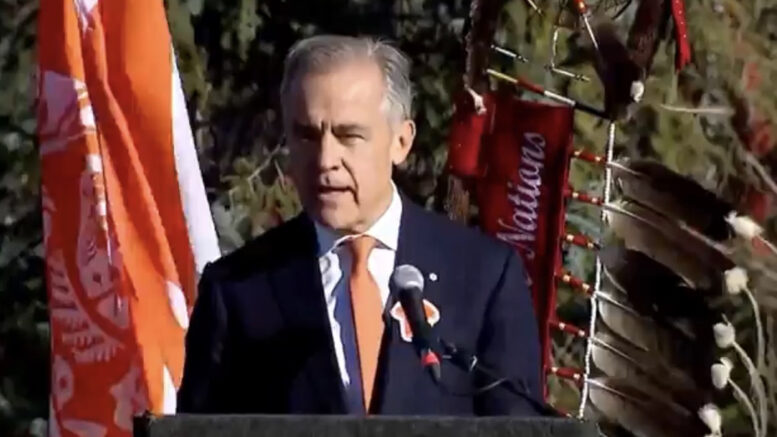
(ANNews) – “Today is about all the truth,” Prime Minister Mark Carney told those gathered Wednesday at Fort Edmonton Park for the National Day for Truth and Reconciliation ceremony, emphasizing that the day was ultimately about remembering the children who attended residential schools, the Survivors who carried those experiences forward, and those who never returned home.
Carney began his remarks by acknowledging the children attending the ceremony with their families, reflecting on his own childhood visits to Fort Edmonton. He said the lessons he took from those visits were “very different, incomplete, partial,” before emphasizing that the day called for a fuller understanding of Canada’s history. “And it’s for the children. Those children, those survivors, those who didn’t survive, but the children who bring forward,” he said. “So to the survivors here with us, and to your families near and far, we’re here to honour you.”
He said the ceremony was an opportunity to hear Survivors’ stories, reflect on a painful chapter in Canadian history and consider the responsibility that comes with knowing that history. “Today’s ceremony calls on us to hear your stories and to reflect on a dark chapter in Canada’s past and to commit to move forward together,” Carney said, pointing to the prayer, music and dance as examples of traditions that have been protected and carried across generations despite the residential school system.
Carney said more than 150,000 First Nations, Métis and Inuit children attended residential schools, many of whom were separated from their homes, families, cultures, languages and identities. “Some never came home,” he said, adding that the history is not distant. “This is not a distant chapter in Canada’s past, but a truth that endures.”
For Carney, remembering the truth also means refusing to separate Indigenous culture from the history of residential schools. “We shouldn’t choose which parts of our history to remember,” he said. “We shouldn’t admire the beadwork and forget the children that were forced into uniforms. We should not honour the drum and ignore the years that it was made to fall silent. And we should not hear the truth of residential schools and fail to act on it.”
He also recognized the Survivors who came forward to the Truth and Reconciliation Commission, saying their willingness to share their experiences placed those truths on the public record. “More than 6,600 brave women and men told the truth to the Truth and Reconciliation Commission,” Carney said. “And because of that courage, it’s now on the record, and responding to these truths is now our responsibility.”
Carney pointed to ongoing federal efforts involving education, housing, drinking water, mental wellness and culturally relevant health care, while acknowledging that significant gaps remain. He also spoke about the importance of Indigenous leadership in future development and conservation, saying reconciliation must involve meaningful partnerships and opportunities for Indigenous Peoples to “develop, operate, and own major infrastructure, to share truly in the prosperity that’s created.”
“My point is we are making some progress, but we know the work of reconciliation is far, far from finished,” Carney said.
Alberta Lieutenant Governor Salma Lakhani followed by speaking about the treaty relationship and the responsibility shared by everyone who calls Alberta home. “Treaty relationships are an essential part of the Crown in Canada, and I am proud to honour them in word and in deed as the Crown representative for Alberta,” Lakhani said. She reminded those gathered that “we are all treaty people” and “all partners in these treaty relationships,” emphasizing the importance of learning about treaties as part of reconciliation.
Lakhani also acknowledged the lasting effects of residential schools, saying the suffering caused by a system intended to erase languages, cultures, identities and family and community connections remains part of the present. “We also recognize that the effects of that history did not end when the schools closed,” she said. “Their legacy continues to be felt across generations.”
At the same time, Lakhani recognized the strength and contributions of Indigenous Peoples, drawing on her experiences meeting chiefs, Elders, knowledge keepers, youth and community leaders throughout Alberta. “Those conversations have deepened my understanding and reinforced an important lesson: reconciliation begins with listening,” she said, describing that as listening with humility, learning with an open heart and taking meaningful action.
“The journey to healing is long,” Lakhani said. “We will walk that road together, listening to the stories, learning from experiences, and sharing the burden.” She added that everyone has a role to play as treaty people and partners, including through caring for the land and one another and “living every day with the Cree concept of Wahkohtowin which translates into kinship.”
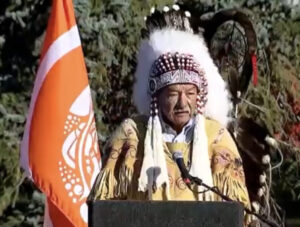
Alexander First Nation Chief George Arcand Jr.
Treaty Six representative and Alexander First Nation Chief George Arcand Jr. then spoke about the importance of truth in moving forward, particularly at a time when the experiences of First Nations people can be challenged by misinformation and competing versions of history.
“The truth First Nations know so well can be difficult,” Arcand said. “And we see it rejected, replaced with opinion and misinformation. Untruths about Canada’s past stand directly in the way of healing our relationship and moving forward in a good way together.”
Arcand called on those gathered to think about the role truth plays in building a future based on mutual respect. “A good future is built on truth and honesty,” he said, urging people to honour the mutual respect and collaboration envisioned by their ancestors during the time of treaty making.
Most importantly, Arcand said, the day belonged to Survivors. “So most importantly today, we honour our survivors,” he said, extending recognition to Survivors attending the ceremony and those joining from across Treaty 6 territory and beyond. He thanked them for their strength and resilience and for carrying their stories even when those truths are difficult for others to hear.
Arcand also remembered the children who never made it home, saying families and communities were being held close “today and every day.” He said the responsibility now belongs to everyone to listen to those truths, carry them forward and ensure they are never forgotten or denied.
“On behalf of the Confederacy of Treaty 6 and my chiefs who are here today, I thank you for coming, being part of this,” Arcand said.
Edmonton Mayor Andrew Knack followed by reflecting on the history of residential schools in Alberta and Edmonton’s role in the national conversation around reconciliation.
Knack noted that Alberta was home to more residential schools than any other province or territory and emphasized that the closure of the schools did not end the harm they caused. “The closure of these schools did not bring the closure to the legacy of harm,” he said. “This truth before reconciliation is important.”
He reflected on Edmonton’s role in the Truth and Reconciliation Commission’s work, noting that in March 2014 the city hosted the seventh and final national event of the Truth and Reconciliation Commission of Canada. Former Mayor Don Iveson was among 14 people included as honourary witnesses, and the year that followed was declared Edmonton’s Year of Reconciliation.
Knack said that moment became a turning point for Edmonton and helped set systemic changes in motion, including the creation of the Indigenous Framework. He credited the strength and courage of Survivors who shared their experiences for helping Edmonton begin its reconciliation journey.
“And so today we honour all those whose lives and families were impacted by the residential school system,” Knack said. “We remember the children whose futures were taken from them, who were never returned to their families, and recognize the grief that still echoes through generations.”
He said the end of September provides an opportunity to sit with the history, listen intentionally and consider how residential schools and colonialism continue to shape culture and institutions.
“Reconciliation is not a destination we will arrive at one day,” Knack said. “Reconciliation is an action and a long-term commitment.”
Knack also reflected on Edmonton’s relationship with the Confederacy of Treaty Six First Nations, including the city’s August gathering marking the 150th anniversary of Treaty Six. He said the treaty should be understood not simply as part of history, but as “a living agreement that continues to guide our relationships today.”
“We must always remember that Edmonton was built on the wisdom and teachings of Indigenous peoples,” Knack said, adding that it is a privilege for the city to have their continued guidance, experience and friendship as Edmonton grows.
The ceremony at Fort Edmonton Park brought together government leaders, Chiefs, Elders, Survivors, families, community members and children to remember those affected by the residential school system and to consider the responsibilities that remain.
For Carney, the day ultimately returned to the same responsibility that shaped his opening remarks: listening, reflecting and acting.
“When we leave here today, let the work of reconciliation continue,” Carney said. “Our responsibility, certainly the responsibility of government, is to reflect, and our task will be to act together.”

Be the first to comment on "Truth Is the Foundation: Edmonton Marks National Day for Truth and Reconciliation"