
By Jeremy Appel, Local Journalism Initiative Reporter
(ANNews) – While youth represent the future of Indigenous leadership, Joel Gamache says that when it comes to economic reconciliation, their voices need to be heard now.
Gamache is the senior manager of national Indigenous youth in STEM programs for Actua, an organization dedicated to educating underrepresented youth in science, technology, engineering and mathematics.
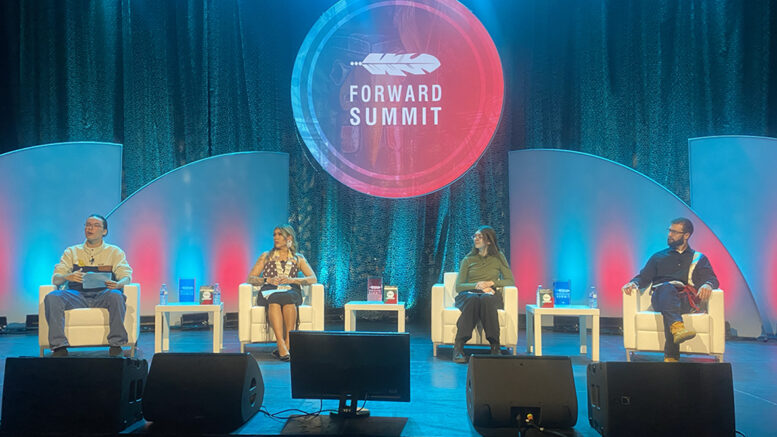
He moderated a May 13 panel of Indigenous youth leaders at the Forward Summit at Grey Eagle Resort and Casino on Tsuut’ina Nation, entitled “‘Passing the Torch’: Indigenous Youth Shaping the Future Economy.”
“We believe it is critically important that Indigenous youth begin to have conversations at the economic reconciliation table, to set the stage for the future to foster meaningful partnership between industry and Indigenous communities,” said Gamache, who is Red River Metis but lives in Okotoks, about 50 km south of Calgary.
The panel, according to Ganache, consisted of “three remarkable Indigenous youth, young leaders who are already helping shape conversations around economic reconciliation, leadership, technology, safety and community.”
‘Stop using shortcuts for cultural knowledge’
Sydney Payne, a member of the Metis Nation of Ontario, is studying history at Western University in London, Ont., and intends on going to law school.
Her remarks focused on the role technology can play in reconciliation, for good and for ill, which was also the tenor of a separate roundtable on Indigenous leadership in artificial intelligence.
Payne cautioned against an over-reliance on AI in the classroom, which she’s experienced firsthand, leading to a high school teacher conveying inaccurate information about Indigenous spirituality.
“The tool went beyond just missing a few details,” explained Payne. “Instead, it provided complete misinformation, generalizing all Indigenous people into one group with identical practices.”
She added that the teacher denied there was a water crisis, simply “because the algorithm said so.”
“These digital shortcuts used in classrooms create a negative feedback loop, in which students are getting flawed information and graduate ready to carry that misinformation into the workforce,” said Payne.
Truth and Reconciliation Commission Call to Action 92 calls on corporate Canada to adopt the United Nations Declaration on the Rights of Indigenous Peoples, and educate staff and employees on Indigenous history and law.
“If a leadership team relies on an automated summary of a community’s history, rather than learning from us directly, they aren’t actually informed,” said Payne.
“They risk entering negotiations without understanding the specific history of land displacement or the treaty rights of the people that they’re looking to engage with.”
She noted a vast disparity between the number of companies that are committed to reconciliation and those that actually have long-term partnerships with Indigenous communities.
“Real education requires a depth that technology can’t currently replicate,” said Payne.
She urged corporate leaders in attendance to take “three specific actions that move us towards a more equitable economy.”
Firstly, to “stop using shortcuts for cultural knowledge” by refraining from using AI-generated content about Indigenous issues unless the content has been “verified by a member of this specific community being discussed.”
Next, Payne said companies must use technology that adheres to the principles of OCAP, referring to Indigenous ownership, control, access and possession.
Finally, firms should seek certification under the Canadian Council for Indigenous Business’ Partnership Accreditation in Indigenous Relations.
Seeing with two eyes
Joseph Wolfleg, an artist from Siksika Nation who resides in Calgary, emphasized the importance of “two-eyed seeing,” a concept pioneered by Mi’kmaq Elder Albert Marshal, who sought to integrate traditional Indigenous and Western knowledge.
“At its core, it’s about seeing a situation from not just one perspective but two. It’s separate, but together, respecting and recognizing different viewpoints without trying to blend them into one,” explained Wolfleg.
He noted that two-eyed seeing has a counterpart in the English term ‘sonder,’ both of which “describe the profound feeling of realizing that everyone – every cashier, every driver and every stranger – you pass on the street is living a life as vivid and complex as your own.”
“It’s the awareness that their thoughts, feelings, memories and experiences are just as real and significant as yours, even though you only see a fleeting glimpse of them,” said Wolfleg.
Taking this approach to communication can help facilitate economic reconciliation, he added.
“It’s not about compromising. It’s about integrating,” Wolfleg added. “The most innovative solutions come from this kind of cross-pollination of ideas.”
MMIWG and economic empowerment
Deserae Tailfeathers is a member of Kainai Nation in Treaty 7 who works at the nearby University of Lethbridge, where she assists in developing programming that combines Western science with Blackfoot land-based traditions, with a focus on maternal health.
Her portion of the panel tied the National Inquiry into Missing and Murdered Indigenous Women and Girls’s Calls to Justice with economic reconciliation, which she said “cannot exist if Indigenous women are unsafe, excluded or unsupported in the systems meant to serve them.”
For Tailfeathers, the issue is “deeply personal,” both in her academic work and lived experience.
She fondly remembers her upbringing on the Blood reserve, the largest First Nations reserve in Canada, describing a sense of safety.
“I felt rooted in my community, in my family and in my kinship systems,” said Tailfeathers. “That safety shaped me, but when I left the reserve, everything changed.”
She became a mother at 19 years old, struggling “to navigate life in the city without the support systems that I had always known.”
“That safety I grew up in was no longer there. I felt isolated. I felt unsupported, and for a period of my life, I fell into addiction, not because I was broken, but because I was trying to survive in systems that were never built to keep Indigenous women safe,” Tailfeathers explained.
She eventually recovered from her addiction and re-embraced her Blackfoot culture and traditions.
“But not everyone gets that chance,” emphasized Tailfeathers. “What I experienced isn’t an individual story. It reflects the broader conditions that put Indigenous women at risk, and that’s where this connects to economic reconciliation.”
When discussions around economic reconciliation are narrowly focused on jobs and education, “we miss something fundamental,” she added.
Ensuring that Indigenous women are able to feel safe in the workplace, and that they don’t have to choose between being a caregiver and having a career, Tailfeathers said, represents the “foundation” of economic reconciliation.
“Because when Indigenous women are supported, we don’t just survive. We rebuild families, we rebuild communities and traditional systems, and we rebuild economies in ways that are grounded in care, responsibility and relationships,” she said.
This is about more than just Indigenous female representation. The purpose, said Tailfeathers, is for Indigenous women to “have a say in shaping the policies that affect our lives.”
“There’s a quote that I like to use in a lot of my work,” she said, “‘Matriarchy isn’t women on the top, it’s a circle with children and those who are vulnerable in the centre.’”

Be the first to comment on "Indigenous youth discuss technology, economic reconciliation and female empowerment"