
By Chevi Rabbit, Local Journalism Initiative Reporter
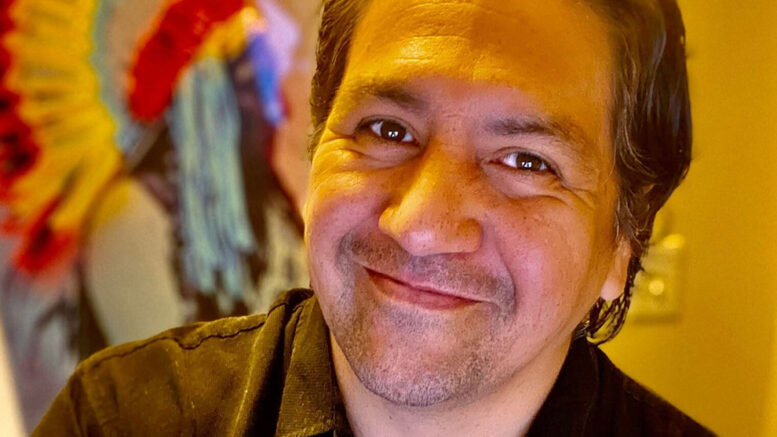
(ANNews) – For the founder of Eaglespeaker Publishing, Jason Eaglespeaker, storytelling was never simply about books. It was about survival, healing, and ensuring future generations inherit the truth from the people who lived it.
“I’m not a publisher who became Indigenous,” he says. “I’m an Indigenous person who became a publisher.”
Rooted in both his Blackfoot and Coast Salish heritage, Jason is Kainai on his mother’s side through Linda Eaglespeaker and Duwamish on his father’s side through Jeffrey Thomas of Muckleshoot. Raised by his late grandparents, Glenn and Leona Eaglespeaker, on the Blood Reserve in southern Alberta, he grew up surrounded by knowledge keepers whose stories rarely appeared in textbooks.
“There were no jobs on my rez,” he recalls. “But as a youngster I was shown that it’s not about how many resources you have, it’s how resourceful you are.”
That lesson sparked an entrepreneurial spirit at an early age. As a child, he sold frybread kits at powwows, picked and sold Saskatoon berries, traded American snacks, cut Christmas trees, recycled cans and bottles, and made crafts for the Head-Smashed-In Buffalo Jump Gift Shop.
“I was that kid who always had twenty dollars in my pocket while everyone I knew was five bucks short,” he laughs.
His path into publishing was anything but conventional. A self-described high school dropout with “zero colonial degrees, diplomas, or certificates,” Jason spent years working with Indigenous organizations, youth, Elders, artists, and educators. Along the way, he noticed an ongoing problem: many Indigenous stories were never being told.
That realization came into sharp focus while working for the Calgary Board of Education in 2008. At the time, he found few educational resources that fully captured the realities of residential schools.
So he created one himself.
Using a blue and black coil notebook from Staples, he assembled a handmade scrapbook documenting the experiences of his mother and her eight siblings at St. Paul’s Residential School near Cardston, Alberta. The project, titled UNeducation: A Residential School Graphic Novel, combined hand-drawn illustrations, survivor interviews, historical newspaper clippings, and community testimony. When he shared the single copy with educators, the response was immediate. “They wanted to buy ten.”
He dismantled his original copy and painstakingly recreated ten by hand. Soon there was demand for one hundred more, and eventually the Alberta government requested 1,500 copies. His family formed an assembly line to keep up with orders, but outsourcing the project to a commercial copy centre proved costly. “It ended up costing me more than I was paid,” he says with a laugh.
Then came a request from the federal government for 5,000 copies. Instead of walking away, Jason searched online for how to produce a library-quality publication. Two days of research later, he had taught himself the publishing business. The experience changed his life.
Eventually, he realized that waiting for mainstream publishers to create space for Indigenous voices was not enough. “If the door wasn’t opening, we needed to build our own.”
That vision became Eaglespeaker Publishing, a company dedicated to helping Indigenous people tell their own stories, in their own voices, and on their own terms.
He believes mainstream publishing often favours stories that fit familiar narratives of trauma and history. While those stories are important, he says they do not represent the full spectrum of Indigenous life.
“Where are the stories about everyday Indigenous families? Indigenous humour? Youth voices? Community projects? The stories that exist around kitchen tables every day?”
He argues that reconciliation cannot simply be performative. Institutions must move beyond symbolic gestures and invest in Indigenous-led businesses, educators, publishers, and decision-makers.
Publishers and media organizations, he says, also carry a responsibility when covering residential schools. “Residential schools are not simply a historical topic. Their impacts continue today through family separation, language loss, intergenerational trauma, and systemic inequities.”
At the same time, Indigenous people cannot be defined solely by those experiences. “Public understanding must include both the harms of the past and the strength, resilience, creativity, and success that exist in Indigenous communities today.”
His commitment to future generations also drives his work. Through his Student Voices program, he travels to schools across North America, helping students transform their stories, poetry, reflections, and artwork into professionally published books. “When students hold a published book containing their own words, something changes,” he says. “They begin to understand that their voice matters.”
Ultimately, he says his work is not only for today’s readers but for descendants he will never meet. “My true audience is my descendants,” he reflects. “Just as I look to my ancestors for guidance, my descendants will look to me. If I don’t share my story in my own words, someone else will—and I guarantee they’ll get it wrong.”

Be the first to comment on "Building the Door: How an Indigenous Entrepreneur Turned Family Stories into a Publishing Movement"