By Chevi Rabbit, Local Journalism Initiative Reporter
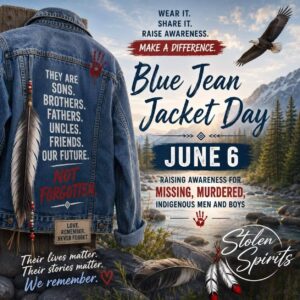
(ANNews) – On June 6, Blue Jean Jacket Day was held at Edmonton City Hall as part of ongoing efforts to raise awareness and bring community visibility to the issue of murdered and missing Indigenous people. The gathering aimed to honour families, elevate lived experiences, and strengthen public understanding of the crisis.
Blue Jean Jacket Day is growing as a grassroots awareness movement focused on bringing national attention, coordination, and funding to the crisis of murdered and missing Indigenous people across Canada.
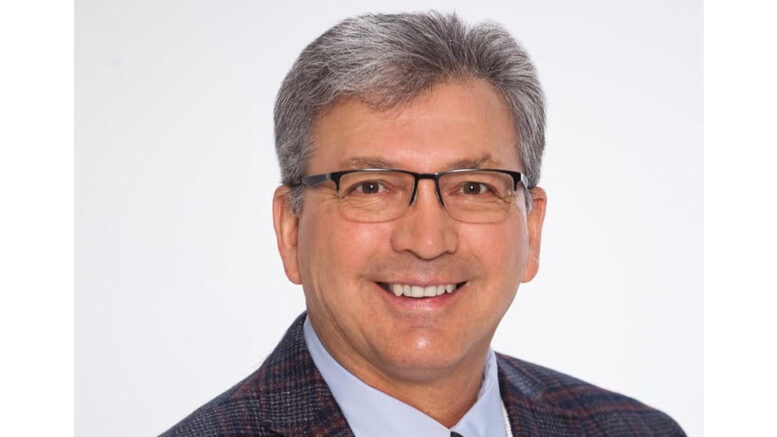
The initiative was co-founded by Cameron Alexis, Band Councillor for Alexis First Nation, alongside Stephanie Harpe. Both say the movement was created to highlight gaps in advocacy and to bring forward the often-overlooked reality facing Indigenous men, women, and 2SLGBTQ+ people.
Stephanie Harpe said the idea behind the movement came from years of advocacy work focused on Indigenous men and boys. “Blue Jean Jacket Day was founded by myself and Cameron Alexis,” she said. “He had been doing a lot of awareness for our men and boys for a long time. As a former RCMP officer and someone who has done private investigations, he was the one seeing a lot of the files of our men and boys. The numbers were very, very high, and people weren’t talking about it.”
 Harpe said the goal was to ensure Indigenous men and boys are included in conversations about violence and disappearance.
“We wanted to advocate for our men and boys and make sure that they are important and included,” she said. “In Alberta, we have hundreds of them. Our men go through a lot of things on their own, and we really want to encourage them to be more connected and communicating, and to normalize their feelings. We want wellness for them.”
She added that in some regions of Alberta, the numbers are especially alarming.
“In some of the hardest-hit areas, the numbers of murdered and missing Indigenous men have surpassed women,” she said.
Harpe also noted the movement’s growth since its inception. “It took us three years – this is our fourth annual. Last year, before Blue Jean Jacket Day, it went international. It’s now an international movement. It’s all over the world.”
Cameron Alexis said the initiative was born out of years of work in conferences, forums, and research focused on Murdered and Missing Indigenous People (MMIP).
“The Blue Jean Jacket Day movement was created as a result of several conferences, forums, and workshops,” he said. “Through those sessions and the research that came out of them, we learned there are an equal number – if not more – of murdered and missing Indigenous men as well.”
He said advocacy has not always reflected the full scope of the crisis. “We also realized there has not been enough advocacy for Indigenous men and members of the 2SLGBTQ+ community who have gone missing or been murdered,” he said.
Alexis, a retired police officer, said his experience gave him direct insight into the system. “As a retired police officer, I’ve been involved in many cases where I was entering missing persons into the Canadian Police Information Centre (CPIC) system,” he said. “Now I’m on the other side of that work – as a community leader advocating for initiatives like Blue Jean Jacket Day alongside my friend Stephanie Harpe. It’s about ensuring these people and their families are not forgotten.”
He said the movement is about raising awareness across what he called the “Canadian mosaic.”
“Far too often, Indigenous people go missing or are victims of violence, and there isn’t enough awareness or attention given to these tragedies,” he said. “That’s one of the reasons we started this initiative.”
Alexis said the goal is to move beyond awareness into coordinated action. “We would like to see a national forum for Murdered and Missing Indigenous People, along with a coordinated support system for families,” he said. “That’s part of what we hope to build through Blue Jean Jacket Awareness Day.”
He said the movement is gaining momentum. “It’s still in its early stages, but it is gaining national attention,” he said. “Every community has a story. Every family is impacted. This is happening everywhere, and it’s not isolated.”
However, he said funding remains a major barrier. “Much of this work is not funded by provincial, federal, or First Nation organizations,” he said. “We’ve seen non-profits created to address this issue, but without funding they struggle to continue. Volunteers can only go so far.”
Alexis also pointed to concerns around unidentified remains. “There are Jane Does and John Does who are buried without names or answers,” he said. “In many cases, there is no funding available to exhume them or identify who they are.”
He said stronger support from governments and industry is needed. “We would like to see provincial and federal governments, and even private industry partners, fund this initiative,” he said. “We need a systematic approach – coordinated searches, stronger databases, and proper infrastructure.”
Alexis emphasized that the crisis is ongoing and urgent.
“This is still happening,” he said. “People are going missing off streets and rural Alberta roads, whatever the case may be, and we need to create awareness that we are people and we need to survive too.”

Be the first to comment on "Blue Jean Jacket Day Movement Calls for National Action on Murdered and Missing Indigenous People"