By Jeremy Appel, Local Journalism Initiative Reporter
(ANNews) – The owners of Nation to Nation Water don’t plan on waiting for the federal government to make good on its more than decade-old promise to end drinking water advisories on First Nations reserves.
The majority Indigenous-owned company uses Japanese technology to treat residential, municipal, commercial and industrial water.
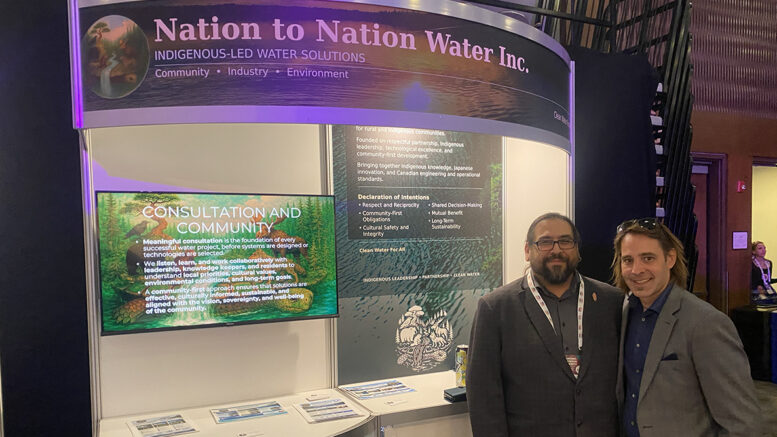
“We are Nation to Nation Water, because we’re working between both Canada and internationally, as well as working within nations across Canada and looking at how we incorporate those relationships together,” co-founder and CEO Patrick Dinsdale told Alberta Native News from his company’s display at the Forward Summit on Tsuut’ina Nation.
Dinsdale said that his “very, very new” company incorporated in December 2025, but that its ambitions are “multi-generational.”
“What we really hope to do is work with communities so that we can act as a service provider with you, and through that relationship, not only be able to provide the tech in the clean water, but actually guarantee that equipment for the longest terms possible,” he explained.
A member of Curve Lake First Nation near Peterborough, Ont., Dinsdale has spent the past decade working in “Indigenous markets” in various roles.
Through this work, Dinsdale had developed a working relationship with Nation to Nation co-founder Kyle Balsdon, a member of the Metis Nation of Ontario.
Balsden met with the company’s third partner, Ken Matsuda, whose other company LM Wastewater was part of a pilot project at the City of Calgary’s Pine Creek Wastewater Treatment Facility.
That Alberta Innovates-funded project also included the University of Calgary, Japan Sewage Works Agency and FujiClean, a Japanese firm whose compact Jokaso treatment units are the ones Matsuda’s company uses.
The Jokaso uses the same biological process as municipal wastewater treatment, moving through five chambers, with solids broken down and disposed of, followed by the fluid’s filtration, clarification and disinfection until the water is clean enough to be released.
“What makes this unit ideal for rural communities is the compactness of it,” Matsuda explained in a September 2025 UCalgary news release. “It’s like having a municipal wastewater treatment facility packed into one 40-foot shipping container — it’s groundbreaking.”
The purpose of the pilot project was to determine to what extent the Jokaso can operate in cold climates.
“That led to greater discussions about how do we get involved to resolve this ongoing issue of Indigenous communities dealing with boil water advisories, putting in drinking and wastewater systems that, in a matter of years, end up no longer working,” said Dinsdale.
These systems can become inoperable for many reasons, including a lack of funding for a major capital investment or not having local operators in the community, he added.
“I believe we’re going to have to figure out solutions, whether the government can get on board or not,” said Dinsdale.
With Matsuda’s involvement, the company has access to Japanese technology that hadn’t been previously available in Canada.
“We built those relationships through our conversations with those organizations and speaking with representatives from Japanese government and Canadian industry ourselves, and figured out we needed to set up our own company, incorporate our own facility, and create a channel to deliver this equipment and technology locally,” Dinsdale explained.
The aim, he added, is to conduct business “through an Indigenous lens, in a way that is respectful and puts community needs first.”
“Our whole philosophy, our credo, is clean water for all. That means everybody,” said Dinsdale. “We don’t just work with Indigenous communities. We work with non-Indigenous communities, so First Nations, Inuit, Metis, non-Indigenous, rural, we’re happy to come sit down and talk to people about how we can help solve those issues.”

Be the first to comment on "Indigneous-owned company uses Japanese tech to treat wastewater"