
By Jeremy Appel, Local Journalism Initiative Reporter
(ANNews) – Panelists contrasted the environmental and data security perils of the widespread adoption of artificial intelligence with the promises of Indigenous participation in the booming industry on May 13 at the Forward Summit hosted at the Tsuut’ina Nation’s Grey Eagle Resort and Casino near Calgary.
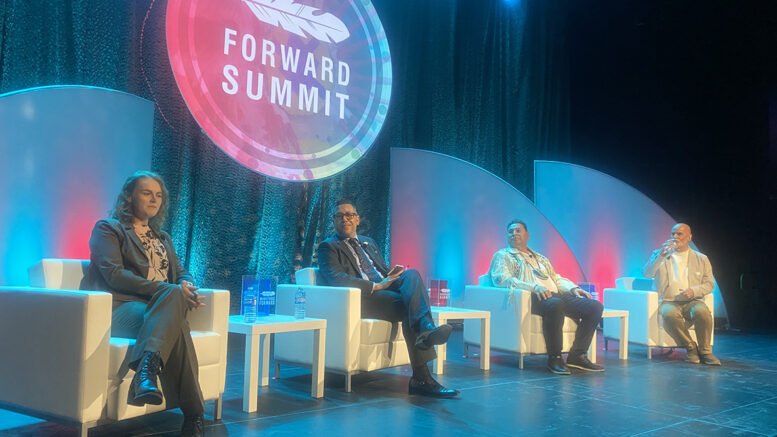
The roundtable, entitled, “AI and Indigenous Economic Reconciliation: Powering Communities in the Digital Economy,” featured Alberta Metis entrepreneur and consultant Erin Creegan-Dougherty, Mick Elliott of Okanese First Nation in Treaty 4, who is the first Indigenous business PhD student at the University of Calgary, and AI entrepreneur Jason Carter of Onion Lake Cree Nation in Treaty 6.
The annual summit brings together Indigenous leaders, industry, government and entrepreneurs to facilitate partnerships that advance reconciliation.
In addition to the Calgary summit, there are also annual summits in Vancouver and on Rama First Nation in Ontario.
Creegan-Dougherty noted that the outputs users receive from AI large language models, such as ChatGPT and Claude, are “directly correlated to the inputs” that algorithms are trained on.
“In Canada and the U.S., we’re often training it on what a lot of Western norms deem as the correct input for what they want as a business model, so they’re very much trained for one way of thinking,” she said.
“If you see there’s more diverse perspectives training a model, the answers are incredibly different.”
Carter criticized Big Tech’s “colonial harvesting” of user data from the everyday products they use to feed AI algorithms, which are then sold back to users in the form of subscriptions for AI products.
He said this underscores a need to “Indigenize” AI.
“Data is the new bison,” said Carter, referencing how the near-extinction of Turtle Island’s bison population preceded the loss of Indigenous lands and culture.
“However, we have this new economy. It’s called ‘data,’ and we need to embrace that power … and use it for good the way our ancestors taught us.”
Elliott, a former lobbyist for Imperial Oil, noted that Big Tech companies are actively lobbying against privacy safeguards that would limit their ability to collect data to feed their algorithms.
“There’s a lot of money to be made from data, so implementing data privacy means that these corporations aren’t going to make as much,” he said.
Elliott added that it’s in Indigenous people’s interest to advocate for restrictions on data collection of the sort that exist in Europe.
“We need to demand legislation moving forward, because this transactional, capitalist way of doing business is disadvantaging us as an entire population, Indigenous and non-Indigenous, and protections must come in place,” he said.
Creegan-Dougherty said the problem isn’t AI’s mass collection of data itself, which could serve as a “leveller” for smaller businesses for whom collecting large volumes of data on potential customers was previously cost prohibitive.
“If that data was able to be collected and it is not being used for extortion profit from lobbyists, then it would all be good. Unfortunately, that’s not the world we live in,” she said.
For Carter, “Indigenous people hold the key” to a less predatory form of AI that isn’t dominated by U.S.-based Big Tech interests.
He cited Telus’s recently announced plans to build “sovereign” AI data centres in Vancouver as an opportunity for Indigenous entrepreneurs to help shape its algorithms with traditional Indigenous knowledge and Indigenous scholarship.
“We need to have that kind of program training in our AI models for business for the future, so we’re not going to rely on dirty data from Google or all these large language models,” said Carter.
He likened AI to a “superpower,” which can either be used “for good, or we’re going to use it for bad.”
The data centre dilemma
Carter acknowledged the risks of AI data centres’ water and energy intensiveness.
“We’re going to leave our next seven generations with a water crisis, and their cell phone bills are going to probably triple. Your power bill is going to double, and the gas is going to keep going up,” he said.
“We need to use the superpower to actually create more business and to create solutions so our children don’t have to go hungry.”
Elliott cautioned against the risks of “mimicking capitalist ways of being,” with companies taking advantage of poverty in First Nations communities to build data centres that are being rejected in non-Indigenous communities for their environmental impacts.
Creegan-Dougherty suggested incorporating local Indigenous leaders in building and operating data centres to mitigate their environmental harms.
“Maybe we can have a data center that puts out a little bit less output, but is sustainable and doesn’t destroy the land,” she said.
Carter, the CEO of Star Nations Space Company, posed a novel solution to this problem. “Data centres should be in space, not on land,” he said, urging attendees to look up “orbital data centres.”
Proponents, which include Google and SpaceX, as well as smaller companies such as Carter’s, argue that these solar-powered satellites are a way around the scarcity of land and energy on Earth that is driving local opposition to data centres.
Because space is naturally cold, the satellites wouldn’t need massive amounts of water for cooling as they do on Earth.
“Water is for life, not machines,” said Carter. “We have to remember that all of this is great, but it’s at a huge cost.”

Be the first to comment on "Data is the new bison: Indigenous panel discusses the risks and rewards of the AI boom"