
By Troy Dumont, Local Journalism Initiative Reporter
(ANNews) – Alberta’s electoral boundary fight is becoming a test of what the province means when it talks about fair representation. On March 26, the Electoral Boundaries Commission tabled its final report recommending a new 89-seat map. Less than a month later, on April 21, the legislature created a new Select Special Committee on Electoral Boundaries to oversee another independent review, leaving the proposed lines and the controversy around them very much alive.
 Boundary reviews in Alberta are normally governed by the Electoral Boundaries Commission Act and take place every eight to 10 years. The Act requires an independent commission to review the existing electoral map, hold public hearings before and after releasing its proposals, and submit a final report to the Speaker of the Legislative Assembly. Alberta law also says redistribution is not supposed to be based solely on population. The commission must consider “effective representation,” including communities of interest such as municipalities, rural communities, Indian reserves and Métis settlements. The same statute requires Alberta to be divided into 89 proposed electoral divisions and limits how far most ridings can deviate from the provincial average population.
The current dispute turns on whether the proposed map follows that standard in practice. Gerrymandering does not always mean bizarrely shaped districts. It can also happen when a map breaks up communities that previously shared representation or expands surrounding electorates in ways that reduce a community’s collective political weight.
Lac Ste. Anne-Parkland is a single constituency encompassing Alexander No. 134, Alexis No. 133, and Wabamun No. 133A, better known as the Paul First Nation area, within a single electoral boundary. The three Treaty 6 communities are within 30 to 50 kilometres of one another, a close enough area that they may share many of the same political concerns, regional priorities and interests. Keeping them in one constituency gives Indigenous voters a chance to rally together around shared concerns inside the same electoral forum.
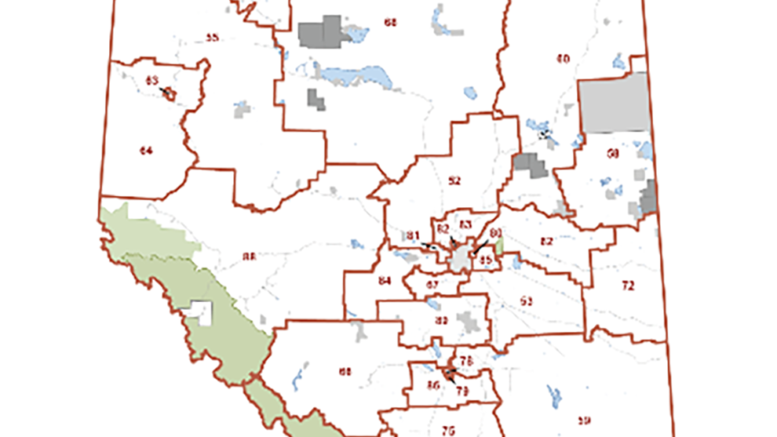
Under the proposed redraw, the area is to be broken apart. The Electoral Boundaries Commission report now redistributes the three nations among St. Albert–Sturgeon (83), Barrhead–Westlock–Athabasca (52), and Stony Plain–Drayton Valley (84).
The history of indigenous voting rights in Canada makes the stakes harder to dismiss. The federal Elections Act was amended in 1948, removing race as a ground for exclusion from voting in federal elections. However, First Nations peoples still did not gain that federal right until 1960. Alberta did not grant Status Indians the right to vote in provincial elections until 1965. For Indigenous communities in this province, political representation is one of the few ways marginalized voices can be heard, collective concerns can be brought into the legislature, and communities can push back when governments fail to reflect their interests.
That last point has been tested recently. On February 26, the Assembly of Treaty Chiefs of Treaty 6, 7 and 8 unanimously passed a vote of non-confidence in the UCP government, saying Alberta had failed to meet Treaty-based constitutional and governance responsibilities. The release tied that vote to the political climate on Treaty territories, with Treaty 8 Grand Chief Trevor Mercredi accusing the government of deepening division and failing to respect Treaty rights, constitutional obligations and the foundational relationship between First Nations and the Crown.
The electoral boundaries commission now has an opportunity to answer a straightforward question: Does the proposed map meet the province’s own legal standard of effective representation, particularly for Indigenous communities? If breaking up Lac Ste. Anne-Parkland scatters communities that share treaty history, the commission’s rationale must go beyond a population calculation. For First Nations in Alberta, the right to vote is barely sixty years old. How Alberta answers that question will say a great deal about whose voices its democracy is prepared to protect.

Be the first to comment on "Gerrymandering Indigenous Voices: Electoral Redraw Raises Questions About First Nations Representation"