by Chevi Rabbit, Local Journalism Initiative Reporter
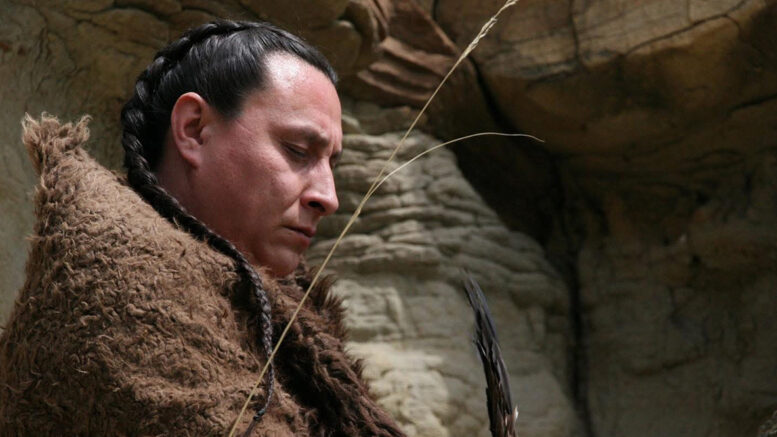
(ANNews) – A powerful voice in Alberta’s contemporary Indigenous art scene, Ryan Willert has built a visible creative legacy across Red Deer and beyond – one shaped as much by hardship and recovery as by paint, ceremony, and public space.
A member of the Stimson family and part of the Blackfoot Confederacy, Willert describes himself simply as a “Blackfoot artist.” His work now spans murals, installations, and community-based projects displayed in schools, hospitals, and public buildings throughout Alberta.
Born and raised in Southern Alberta, Ryan Jason Allen Willert is a professional muralist known for large-scale public works rooted in Blackfoot teachings and storytelling. Raised primarily in non-Indigenous communities before reconnecting with his Siksika Nation roots, he learned black-ink drawing and art sales from his father, renowned Siksika artist Richard “Dicky” Stimson. His work has appeared in exhibitions and public projects across Alberta, including collaborations connected to the City of Calgary and the Glenbow Museum. He was also one of two featured artists in the bestselling Colouring It Forward – Discover Blackfoot Nation Art & Wisdom and was named Artist of the Year by New Tribe Magazine in 2009.
From the streets of Calgary to an art career
Willert’s journey into art began in survival. “I’ve been living off my art for almost 24 years,” he said. “I started this art game about 24 years ago.”
While homeless in Calgary and panhandling, his father handed him a folder of family artwork to sell. “My dad gave me a folder of my family’s art and told me I could sell this because I was living on the streets at the time.”
Selling prints from artists in his family, including members of the Stimson lineage, became a first step away from street life, even as he struggled with addiction and identity.
“I was feeling guilty that I was selling their art,” he said. “And I wanted to start selling my own.”
At the time, he says he lacked confidence in his abilities. “I was a terrible artist. I could barely draw or paint.”
Persistence eventually led him to develop his own work, including an early black-ink drawing of a bear that became a breakthrough moment. “It was basically a survival thing at the beginning for me.”
Identity, trauma, and healing
Much of Willert’s story is rooted in the complexity of Indigenous identity and intergenerational trauma. “When I was younger, all I really seen (sic) was the alcoholism and people on the streets,” he said. “Nobody really talked about residential schools.”
As a teenager, he struggled deeply with self-worth. “When I was a teenager, I wished I was white. I hated being Native.”
He says those feelings were shaped by racism and the environment around him. “They looked down on you like you’re uncivilized or not as superior as the suburban Caucasian class at the time. And I believed it.”
Addiction followed him into adulthood. “I was an alcoholic and a drug addict, just kind of covering that pain of being unhappy with the color of my skin.”
A turning point came when he committed to sobriety and reconnected with ceremony and Blackfoot teachings. “Eleven years ago, I made commitments to really do a deep dive into our ceremonial ways.”
He credits ceremony with helping him heal and remain sober. “It’s kept me sober, and it’s really changed my art quite a bit.”
Public art and community impact
Now based in Red Deer, Willert’s work has become increasingly recognizable across Alberta. His murals and installations can be found in schools, hospitals, public buildings, parks, and gathering spaces throughout Calgary, Edmonton, and Red Deer.
His projects often center Blackfoot teachings, healing, identity, recovery, and contemporary Indigenous experiences. In Red Deer, his work includes murals at St. Francis of Assisi Middle School, St. Thomas Aquinas Middle School, and École Camille J. Lerouge School, along with several downtown public murals and civic art installations.
For Willert, the work carries responsibility beyond art itself. “I take it very serious on being a role model,” he said. “I take it very serious about being sober, being very involved in my culture.”
He hopes his story reaches others struggling with addiction and disconnection from culture.
“There’s a lot of our people, our youth, our adults, that are dealing with substance issues and not very involved in their culture,” he said. “I want people to see this and hopefully be encouraged to do the same.”
Willert says his relationship with Red Deer is rooted in gratitude. “The city of Red Deer has done so much for me.”
He also thanked people who supported him by purchasing his artwork during difficult periods of his life. “If you’re reading this and you bought art off me, either on the streets or at one of my markets, I want to say thank you.”
One of his recent projects included donating a mural to the Safe Harbour Society, which supports people experiencing homelessness and addiction.
“I lived on the streets for almost about five years, and it’s very dear to me,” he said. “Recovery is an important thing.”
Today, Willert’s work stands at the intersection of Indigenous identity, recovery, and public storytelling. For an artist who once struggled with survival and self-worth, Alberta’s walls have become both canvas and testimony – reflecting not only where he has been, but where he continues to go.

Be the first to comment on "Blackfoot artist turns survival story into public art across Alberta"