By Chevi Rabbit, Local Journalism Initiative Reporter
For members of Maskwacis, attending the Indigenous Policing Summit on the Tsuut’ina Nation near Calgary provided an opportunity to listen, learn and bring new ideas home. Several members attended the summit, which brought together speakers and policing representatives from across Canada to discuss Indigenous policing, community safety and the importance of meaningful relationships between police and First Nations.
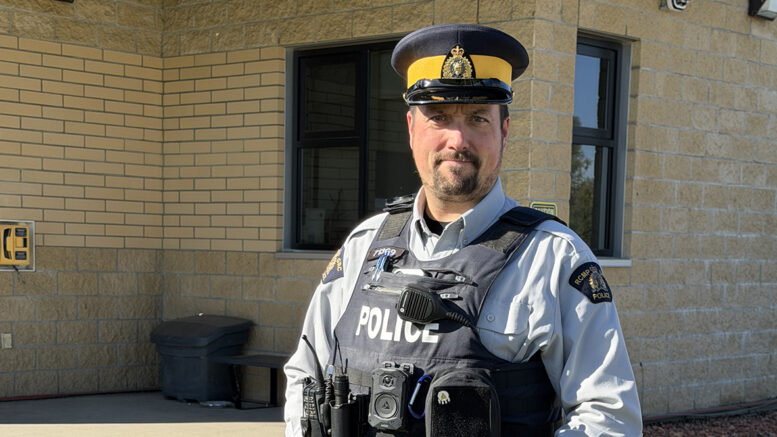
For Cst. A/Cpl. Catlin Chiasson of the Maskwacis RCMP, the summit reinforced an important message: conversations about Indigenous policing need to lead to action. “It was phenomenal that we had the opportunity to send several members there,” Chiasson said. “From what I’ve heard, the speakers from across Canada were speaking about not only having conversations, but conversations that come to fruition. So, action. Having that action on what you discussed.”
The discussions also come at a significant point in the ongoing work of reconciliation. Ten years have passed since the Truth and Reconciliation Commission released its final report and Calls to Action, while five years have passed since the National Inquiry into Missing and Murdered Indigenous Women and Girls released its final report and Calls for Justice. Chiasson said those histories cannot simply be left behind.
“We want to ensure that we’re also acknowledging the history. We can’t move past that, but we can acknowledge that, as well as bringing some of the items to action and moving forward with those conversations and as well as the action,” Chiasson said.
For the members who attended the summit, that meant returning home with ideas that could potentially be adapted to the needs of the communities they serve. One of those ideas is greater engagement with youth. A proposed youth day camp could bring young people together with police, the Nation and the four Nations served in the community. The initiative could provide an opportunity for youth to learn more about policing, understand what police officers do and why they do it, and develop relationships with officers in a community setting.
“There are absolutely discussions and actions that we can bring back to Maskwacis,” Chiasson said. “One of them would definitely be working with youth and creating a day camp where youth can work in partnership with police and the four Nations that we do have here.” The initiative could also become part of a broader Truth and Reconciliation model focused on education, relationship-building and future opportunities.
The youth initiative could also have a recruitment component. Police are actively looking for members from all four Nations, with an emphasis on encouraging community members to consider policing as a career. Chiasson said a recently introduced opportunity may also help remove one barrier for some applicants.
“If we support a member of the community to apply to the RCMP and they’ve demonstrated that they have the attributes of a police officer by working or volunteering their time, if we have an event, anything like that, we can suggest that they bypass the written exam,” Chiasson said.
The approach provides another potential pathway for community members interested in pursuing a career in policing, while also creating opportunities for police to build relationships with young people and community members before they enter the profession.
The summit also reinforced another principle: there is no single model for Indigenous policing. “One size doesn’t fit all when it comes to policing and the needs of each Nation,” Chiasson said. “Each Nation has their own needs and their own vision on where they want to go with things.”
That means police services need to remain flexible and listen to what individual Nations identify as priorities. Among the issues identified by Chiasson was addiction support, including sober-living opportunities that could provide people with a safe environment and a pathway toward maintaining sobriety and rebuilding their lives. Youth initiatives and the development of future police officers were also identified as areas where police and Nations can work together.
The approach is ultimately about adapting policing to the community rather than expecting every community to fit the same policing model. “It means that we’re flexible,” Chiasson said.
That flexibility depends on maintaining an ongoing relationship with First Nations leadership and community members. When asked about the importance of continued dialogue and collaboration on policing and community safety, Chiasson said it is the top priority. That includes gathering input from community members and maintaining relationships with Chiefs and Councils representing the Nations.
“We want to ensure that there is maintaining an open dialogue and transparency from the police to the Nations people, from the Nations people to the police,” Chiasson said. The relationship, he added, cannot be one-sided. “It takes two to make a project work, and it’s not one-sided.”
The goal is therefore to continue the conversations while ensuring they produce tangible outcomes. As communities and municipalities move toward a model of “listening to learn towards action,” the vision is for police and First Nations to jointly identify initiatives, establish responsibilities and measure the results.
“We’re very hopeful that they continue and that everybody comes to the table and we actually control the action moving forward,” Chiasson said. “We both have a way of helping each other, and that is a vision forward. That’s not only a conversation, but it’s action. We need to do things. We need to do tangible, measurable results.”
For those returning from the Indigenous Policing Summit, the next step is taking what was heard across Canada and determining what can work locally. The summit may have provided the conversations, but the work now is turning those conversations into partnerships, youth opportunities, recruitment, community supports and measurable action.

Be the first to comment on "From Conversation to Action: Indigenous Policing Summit Highlights Community-Led Approach"