By John Wirth, Local Journalism Initiative Reporter
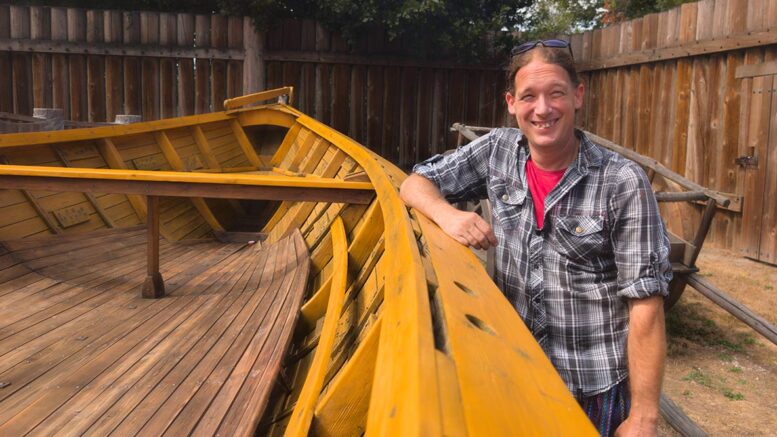
(ANNews) – Whether shaping timber in his workshop or performing on stage with a guitar, Métis artisan Patrick Calihou views visual art and musical performance as two sides of the exact same discipline.
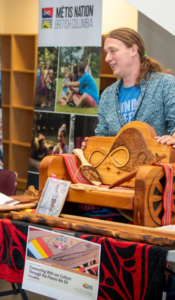
Métis artisan Patrick Calihou.
His latest work in progress sits a nearly finished fiddle in his peaceful woodshed. Based on an instrument gifted by a friend, Calihou modified the standard f-shaped sound holes into infinity symbols, reflecting the central emblem of the Métis flag.
”I wanted to have infinity holes… Make it a little bit different. Make it yours, right?” Calihou says. “Apply it to everything. Not stamp it, but apply it to every aspect. The infinity. Its never-ending, endless possibilities.”
That same philosophy carries into his public art installations, such as playground bridges and stationary carts found across Lower Mainland schools. Rather than copying static historical templates, Calihou paints motifs straight from memory and intuition.
”I didn’t Google a template to mass-produce it,” Calihou says, tapping his forehead. “It’s from here! I want to be unique in my field so people remember me, not just like the ‘cart guy.'”
When Calihou steps away from carving to play music, his physical approach to creation remains identical.
”I’m basically carving on my guitar. Everyone knows you for carving that wood, but today I’m carving on my guitar,” he explains. “It feels the same. Like you’re carving on a piece of timber, just planing it, chasing it.”
During performances—where he often operates as a one-man band managing a kick drum looper, bass, slide guitars, foot tambourine, and harmonica—Calihou enters a distinct flow state.
”When I’m playing my cultural music—the songs from my heart—I can feel it. My blood pressure rises, and I slowly start tuning out,” Calihou shares. “I get into the music, into a different zone. If you hooked up electrodes to my brain, it would be crazy. It would be like a rainbow going off.”
That “rainbow going off” isn’t just poetry. Studies of musicians in flow show a measurable shift in brain activity: the prefrontal cortex—the seat of self-critique and overthinking—quiets down, while networks for attention, reward, and motor control synchronize. In deep flow, alpha and theta waves rise, gamma bursts fire, and a cocktail of neurochemicals locks the performer into effortless, high-focus action. For Calihou, that neurological state is where culture and craft.
When he’s “carving” on the guitar, he’s not just playing songs; he’s running Métis motifs through his body in real time, translating the same infinity symbol he cuts into wood into sound. The one-man-band setup—kick drum looper, bass, slide guitars, foot tambourine, harmonica—becomes a kind of mobile workshop, where every limb is another tool shaping the same piece.
In that zone, the distinction between artisan and performer collapses. The infinity holes on his fiddle, the playground carts painted from memory, and the cultural music that sends his blood pressure up and the world away are all expressions of one principle: apply the symbol to every aspect and let the work become endless possibility. As Calihou puts it, he’s not stamping a template; he’s carving a living practice – one that keeps evolving every time he steps into the rainbow.

Be the first to comment on "Carving the Music: The evolving artistry of Patrick Calihou"