
By Jeremy Appel
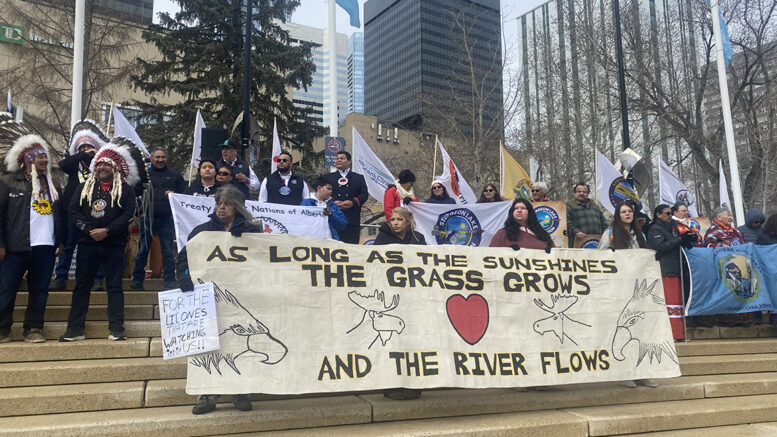
(ANNews) – A Court of King’s Bench justice has ruled in favour of Athabasca Chipewyan First Nation (ACFN) and the Blackfoot Confederacy’s efforts to nullify a petition for a referendum on Alberta’s independence.
Premier Danielle Smith and the separatist organization behind the petition have both pledged to appeal the decision.
In her May 13 ruling, Justice Shaina Leonard accepted the First Nations’ argument that the chief electoral officer (CEO) should have never approved a constitutional referendum petition that had previously been struck down in court.
“I have concluded that the CEO Decision must be quashed,” wrote Leonard.
In July 2025, CEO Gordon McClure sent a referendum petition proposal from separatist organization the Alberta Prosperity Project (APP) to the Court of King’s Bench to assess its constitutionality.
At the time, the Citizen Initiative Act prohibited referendums that ask a question that violates the Canadian Charter of Rights and Freedoms or section 35 of the Constitution Act, which protects the rights of First Nations, Metis and Inuit peoples.
Justice Colin Feasby ruled in December 2025 that Alberta’s independence would by necessity violate section 35 of the Constitution, since an independent Alberta wouldn’t be bound by the Canadian Constitution.
Alberta’s UCP government signed Bill 14 into law soon after, which amended the Citizen Initiative Act to remove its prohibition on asking unconstitutional questions.
A new separatist organization led by APP CEO Mitch Sylvestre, Stay Free Alberta, submitted its paperwork for a new independence petition with slightly changed wording, which was accepted by CEO McClure.
Stay Free Alberta claims that its petition has received more than 300,000 signatures, almost double the near 178,000 required.
Lawyers for the ACFN and Blackfoot Confederacy, consisting of Piikanii Nation, Siksika Nation and Blood Tribe, argued in court in April that McClure should have rejected the Stay Free Alberta petition, because the petitioners didn’t consult with First Nations.
James Hille, a lawyer for ACFN, told the court that Bill 14 “did not authorize” McClure to retroactively approve a petition that Feasby deemed unconstitutional, and that McClure was obligated to reject it due to the government’s lack of consultation with First Nations on the question.
In her ruling, Justice Leonard agreed that the Stay Free Alberta petition asked the “same essential question” as the APP petition that was rejected in court.
McClure’s failure to consider Feasby’s arguments, wrote Leonard, “do not inspire confidence in the outcome reached by the CEO,” making McClure’s decision “unreasonable.”
She added that even under the amended Citizen Initiative Act, the CEO has “implied jurisdiction” to determine whether a citizen-initiated proposal can proceed.
“The CEO failed to recognize this jurisdiction and assess whether the duty to consult was triggered in that case,” Leonard ruled.
In April, separatist lawyer Jeffrey Rath and government lawyer Neil Dobson argued in court that there’s no duty to consult before the petitioning process, because there’s no guarantee a petition will be successful.
“Nobody’s rights have been suspended. Nobody’s rights have been infringed, even the smallest, tiniest little bit by the gathering of signatures,” said Rath.
Mary Macaulay, a lawyer for the Blackfoot Confederacy, argued that consultation must occur “before a decision is made.”
Since Bill 14 binds the government to proceed with a citizen-initiated referendum and honour its result if its proponents collect enough signatures, Justice Leonard agreed that consultation must occur before the petition is accepted.
She emphasized that while the CEO must invoke the Crown’s duty to consult to reject a petition, the duty doesn’t belong to the CEO.
“It is the Government, as the party that would implement succession, that must engage in consultation,” wrote Leonard.
ACFN celebrates as government pledges to appeal
ACFN Chief Allan Adam praised Leonard’s ruling for underscoring the “importance of Treaty rights, meaningful consultation, and the recognition of the serious impacts decisions like these would have on First Nations communities.”
“This decision should close the chapter on the suggestion of an independence referendum. The Court has spoken – and so have First Nations,” Adam said in a statement.
Stay Free Alberta indicated that it would seek to appeal Leonard’s decision in a statement posted to Rath’s Twitter page.
“We disagree fundamentally with the decision which appears on its face to violate principles of natural justice and contain numerous errors of law,” wrote Rath.
Echoing Rath’s comments, Alberta Premier Danielle Smith said at an unrelated press conference that the government would also appeal the court’s ruling, which she characterized as “incorrect in law and anti-democratic.”
Smith has pledged to hold a vote on Alberta independence on Oct. 19 if separatists gathered enough petition signatures.
Albertans will already be voting on that day on nine other government-initiated questions regarding immigration restrictions and constitutional matters.
Keith Wilson, a land-use lawyer and prominent separatist, argued on Twitter that the provincial government should itself initiate an independence referendum through the Referendum Act.
SLCN’s injunction request denied
ACFN and the Blackfoot Confederacy weren’t the only First Nations who went before Justice Leonard in April in an effort to stop the Stay Free Alberta petition.
Sturgeon Lake Cree Nation (SLCN) took a different approach, arguing that Bill 14 improperly forced McClure to approve the petition and asking Leonard for an injunction against the part of the legislation that removed constitutional safeguards on citizen-led initiatives.
Lawyer Orlagh O’Kelly argued that the government’s decision to change the law so that the separatist petition could proceed contributed to damaged Treaty relationships, the spread of disinformation, racism, and foreign interference.
Justice Leonard also ruled on SLCN’s application on May 13, rejecting its request for an injunction.
While she acknowledged that “SLCN’s claim raises serious issues,” Leonard ruled that SLCN didn’t adequately demonstrate that the harms O’Kelly outlined were a direct result of Bill 14 or the Stay Free Alberta petition.
“This is not the end of our work,” SLCN Chief Sheldon Sunshine said in a statement. “We will continue to defend our rights through any means necessary.”

Be the first to comment on "Court of King’s Bench quashes separatist petition referendum; premier pledges to appeal"