By Chevi Rabbit, Local Journalism Initiative Reporter
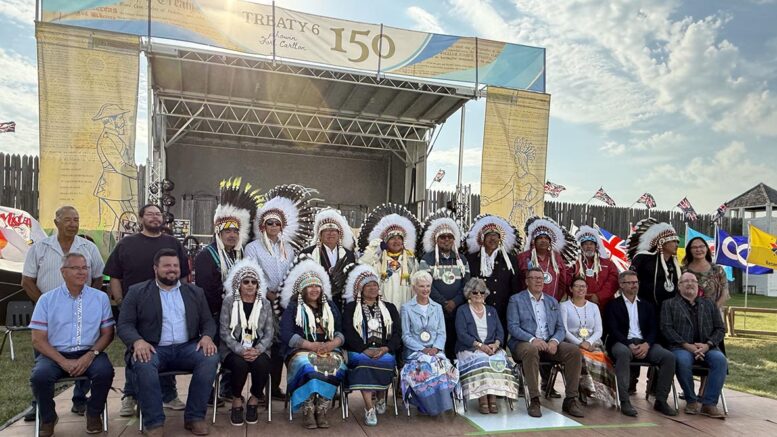
(ANNews) – For four days in August, Fort Carlton Provincial Historic Park became a place of ceremony, culture, dialogue and gathering as Treaty 6 Nations and their citizens marked 150 years since the historic agreement was first made.
Held August 20 to 23, 2026, the Treaty 6 150th Commemoration brought together First Nations leaders, Elders, youth, families, governments and visitors on the same land where Treaty 6 was first signed on August 23, 1876. The organizers described it not simply as an anniversary, but as an opportunity to honour the Spirit and Intent of Treaty and consider its continuing responsibilities.
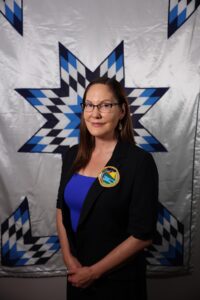
Treaty Commissioner of Saskatchewan, Dr. Kathy Walker. Photo by Benji Noon, Office of the Treaty Commissioner.
For Dr. Kathy Walker, Treaty Commissioner of Saskatchewan, the gathering represented the affirmation and strengthening of the Treaty relationship.
“It was so incredible to see so many Nations and their citizens, as well as non-First Nations citizens and partners, come together to honour Treaty 6 as a living relationship at the place where the first negotiations were held,” Walker said.
“The hope of leadership, planners and organizers was that it would be a truly, one-of-a-kind, historic experience for everyone who attended.”
The event was led by the Treaty 6 Nations with active involvement of many Nations and their leaders, youth, elders and citizens. The Office of the Commissioner and Pemiska Eco-Tourism, an enterprise of Beardy’s & Okemasis First Nation, shared the coordination of programming and logistics for the event.
Walker said the Office of the Treaty Commissioner’s mandate is to strengthen the Treaty relationship and create common understanding through research, education and forums bringing Treaty partners and citizens together.
The gathering reflected that mandate through youth, Elders, women’s and Chiefs’ forums, a Wîtaskêwin dialogue, traditional ceremonies, medicine walks and land-based programming. The official agenda also included a Village of Nations, the original Treaty 6 parchment, Treaty forums, leadership discussions, hand games, cultural performances and a commemorative ceremony.
“The gathering was grounded in ceremony, the land, culture and nations’ sharing their Treaty histories and reflections on the past, present and future of Treaty 6,” Walker said.
“There was a kêhtê-ayak or Elders forum, a youth forum, a women’s forum, and also a Chiefs’ forum where important Treaty dialogues took place.”
The Wîtaskêwin dialogue created space for Indigenous and non-Indigenous people to discuss what it means to live together on the land. Youth were also given opportunities to learn directly from the land.
“The youth had workshops on things like a crash course on Treaty,” Walker said. “The youth also asked for medicine walks, so we had a couple of people who took them on medicine walks around the area, and then also medicine walks were available to anyone else who wanted to take part in those.”
An Elders’ tent focused on another critical question: how knowledge can be carried forward.
“Led by our director of education, Elaine Sutherland, we had a discussion amongst the Elders in the Elders’ tent on basically what kind of supports they needed to ensure that they’re transmitting the knowledge that they have, to future generations.”
“And that was a really, really great discussion that will continue to unfold with action behind it,” Walker added.
Nations Coming Together
Walker stressed that the commemoration was First Nations-led. “I have to say that this gathering was really led by a core group of Treaty Six Chiefs.” Ahtahkakoop Cree Nation, Mistawasis Nêhiyawak and Beardy’s and Okemasis were among the Nations playing a central role in the development of the commemoration. Stoney Knoll was also part of the core group of Nations that approached the OTC to support the event.
Walker identified the OTC’s role as providing a big role in terms of project management and coordination, while Pêmiska Eco Tourism was a key partner.
Sturgeon Lake, Chakastaypasin, Muskoday, Mosquito Grizzly Bear’s Head and Lean Man, Muskeg and Whitefish Lake were also actively involved in planning. In addition, Chakastaypasin, James Smith Cree Nation and Peter Chapman contributed through their Unity Ride, with 19 horses travelling for three days toward Fort Carlton.
“There were just so many nations that contributed and showed up on the day of and put up their tipis and really made the event what it is,” said Walker. Four Alberta Treaty 6 Nations – Cold Lake, Whitefish Lake, Kehewin and Beaver Lake – also attended.
The participation of Nations from across Treaty 6 reinforced the gathering’s broader purpose: unity, strength and a shared relationship extending beyond provincial boundaries.
Treaty Beyond the Written Document
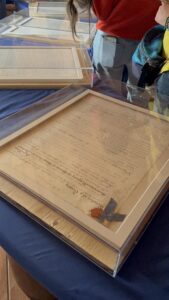
The original Treaty 6 manuscript. Photo by Angela Hill, Office of the Treaty Commissioner.
For Walker, understanding Treaty 6 requires looking beyond the written document. “Treaties are part of our shared history,” he said. “They are foundational to how we’re supposed to relate with one another.”
“But it’s also important to understand that Treaties go beyond any written document. They are the oral histories. They come from ceremony. They come from relationships with Creator and the living earth. So any written text must be interpreted within this broader context.”
Walker explained that treaty-making began through ceremony and the Pipe, reflecting a sacred understanding of the relationship. “All treaties, well, treaties one to eleven, were started with ceremony. They started with the Pipe.”
“And the significance of that is that treaties are regarded as sacred covenants, because they weren’t just between the Crown and First Nations. They were also covenants witnessed by the Creator…And the spiritual aspect of treaties is still very much alive today and is still foundational to how we understand treaties.”
Walker said understanding treaty-making requires understanding the doctrines, laws and traditions that shaped First Nations perspectives. “You have to understand all of the doctrines that go into nêhiyaw understanding of treaty making, or other Plains nations,” she said. “It takes a whole lifetime to really understand all of the doctrines, because what we’re really talking about is, you know, nêhiyaw tâpisinowin, like an entire worldview.”
She pointed to Treaty Elders of Saskatchewan, which she described as an outline of core doctrines that guided treaty-making, and recalled Elder Jimmy Miyo of Moosomin.
“He said, ‘You cannot begin to understand the treaties unless you understand our cultural and spiritual traditions and our Indian laws.’”
That understanding also informs Walker’s explanation of wîtaskêwin, which she describes as a land-sharing relationship oriented toward peace, friendship and harmony, and pimâtisowin, connected to life, culture and the continuation of Indigenous ways of living.
“When the First Nations were making treaty, they were trying to ensure the life of all creation.”
“And so treaties were supposed to help ensure life – all life in creation, but also that the life of the nations themselves continued in terms of our ways of life.”
“So the continuance of pimâtisowin or life is fundamental under treaty.”
Oral Histories and Spirit and Intent
Walker said First Nations oral histories provide an essential perspective on what treaty-making meant. “When you look at the oral histories, there was never this intent to cede or surrender land. It was really about sharing land to the depth of a plow with newcomers…That’s really important because it shows there’s differences in perspective.”
She said bridging those perspectives remains an important part of Treaty education. “One of the things that the gathering is trying to bridge is that gap, right, so that everybody knows the truth about our shared history.”
That goal was reflected in the commemoration’s official focus on the Spirit and Intent of Treaty and its continuing implementation. Organizers also stated that the gathering should contribute to substantive discussion around outstanding Treaty obligations and Treaty implementation.
Bringing History Home
One of the most significant elements of the gathering was the return of the original Treaty 6 manuscript to Treaty territory. The 150-year-old document was displayed at Fort Carlton, giving Treaty citizens and visitors an opportunity to see the original parchment. The OTC reported that it was the first time in 150 years that the original Treaty 6 text had returned to Treaty 6 territory.
The original Treaty bundle was also present, and the ceremony surrounding it became one of the gathering’s most powerful moments. Governor General Louise Arbour participated as the representative of the Crown.
For Walker, the significance ultimately came down to people. “For me personally, there were so many memorable moments. Overall, I thought it was a really memorable and powerful gathering, in terms of just the amount of people that showed up.”
More than 5,000 people attended over the four days, Walker said.
“If you were there, you felt such a great positive energy.”

That’s awesome.