
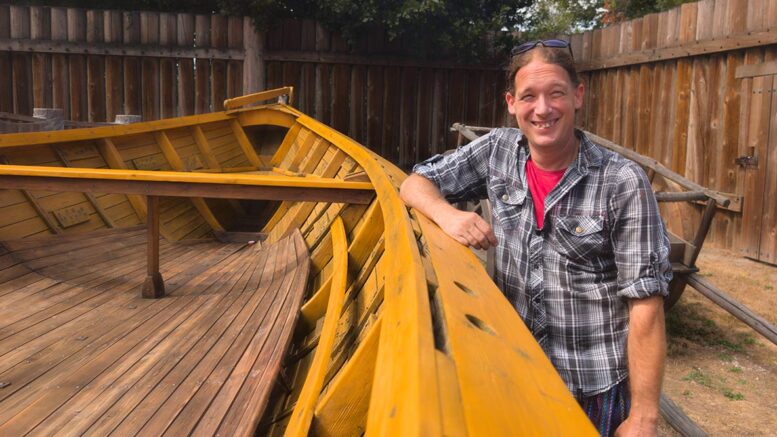
by John Wirth, Local Journalism Initiative Reporter
(ANNews) – When the decade began with forced isolation, master artisan Patrick Calihou took the solitude of a quieted world to undertake a massive historic recreation: a 43-foot “York” river boat built right in the center of Fort Langley National Historic Site. Patrick shared his perspective during an interview. Spanning stem to stern, the vessel represents the absolute maximum scale of historic fur-trade rivercraft, built with a flat bottom designed to glide across the shallow sandbars of the mighty Stó:lō (Fraser) River.
A collaborative effort sponsored by Fort Langley National Historic Site that brought together Parks Canada and Calihou, on behalf of the Métis Nation. The finished vessel now resides at the fort as a permanent landmark. But bringing it to life required battling both nature and filling in the gaps of history.
Patrick recalls that the hardest part of bending the hand-hewn planks, soaked overnight and steamed all day, wasn’t the risk of steam burns, but the relentless race against time and the freezing weather.
”It was wintertime when we were doing this, so it was cooling off faster than it normally would,” Patrick reflects. “It’s like everything was against us. And we were using the wood harvested today, not the old-growth timber our ancestors would have used. These trees are young, grown within our own lifetimes.”
The long beams that are produced today are different because they do not have the same wood grain pattern that an old growth forest would produce. Because of this, young timber has different strengths and often breaks more easily under the same conditions.
In essence, recreating the boat was significantly more difficult than it ought to have been.
Pat’s struggle was deeply personal. His great great-grandfather, Micheal Calihou, made his living building these exact vessels, and his great-granduncles piloted them.
”That was a significant part of my family’s life,” Calihou says. “My grandma’s dad and his dad were building those York boats and paddling them, and I grew up not knowing that.”
When Patrick and his team hit dead ends during construction, they found that preserved historical documents were missing key measurements. This was a common practice in the fur-trade era to protect trade secrets from competitors. With no living experts to consult, Calihou relied on ancestral memory.
”We were literally screaming out my great-grandfather’s name: ‘I know you did this, and it won’t work! Why isn’t this working? Help me, give me the answer!’… There was no one for me to call that was alive,” Calihou recalls. “We just literally pulled the answers out.”
For Calihou, every piece of timber is an act of cultural reclamation, proving that five generations of family history can be brought back into the light.
”If I didn’t do this stuff, all this would have been forgotten,” Calihou says. “It wouldn’t have been put in that book with the reconciliation for education. That’s a pretty big deal to have them honoured – five generations of my family.”
Patrick has formed such a genuine relation with the people employed with the fort that he is now involved with major renovations, carefully replacing the termite damaged wood of the fort itself.

Be the first to comment on "Reclaiming Timber: How One Métis Carver Built a 43-Foot York Boat from Memory and Heritage"