
By Chevi Rabbit, Local Journalism Initiative Reporter
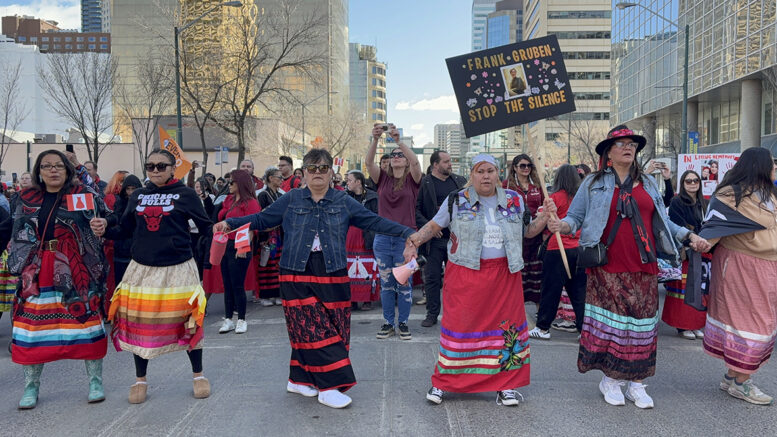
(ANNews) – Red Dress Day in Edmonton was marked by a powerful gathering of ceremony, remembrance, and community action along Jasper Avenue and at the Alberta Legislature grounds. Families, organizers, and community members came together in honour of Missing and Murdered Indigenous Women, Girls, and Two-Spirit people.
The morning began with a pipe ceremony on the hill at the Alberta Legislature grounds, setting a spiritual and reflective tone for the day. Participants stood together in quiet ceremony, grounding the gathering in Indigenous teachings and cultural practice.
Organizers and volunteers prepared the installation of red dresses, arranging them in a large circle. Speakers were also placed within the circle to reflect Indigenous ways of gathering, where knowledge and story are shared collectively rather than hierarchically.
Judith Gale, one of the organizers with Bear Clan Beaver Hills House, described the intention behind the structure. Bear Clan Beaver Hills House is an Indigenous-led volunteer outreach group that supports unhoused and vulnerable community members through patrols, food distribution, harm reduction, wellness checks, and advocacy. Gale added that the organization is always seeking donations and community support to continue its outreach across Edmonton.
“We decided on the formation of our red dresses this year… to do it in a beautiful circle and have our speakers in a beautiful circle too,” she said. “Doing an event the way our ancestors would have done it. You know, we would have sat all in a circle. We would have had the speakers, people who spoke, in the middle, and that’s exactly what we did.”
After preparations, participants gathered at Beaver Hills House Park before beginning a walk down Jasper Avenue. The procession transformed downtown streets into a visible act of remembrance and solidarity.
A round dance was held along Jasper Avenue, briefly turning the space into a site of ceremony, song, and movement.
“We took over Jasper Ave for a few minutes,” Gale said. “We had a round dance on Jasper, which was nice.”
The walk continued to the Alberta Legislature grounds, where the red dress circle stood at the centre of the gathering. Each dress represented a life, a story, and an ongoing call for awareness and justice.
Community partners, including members of the Bahá’í community, supported the event by providing a shared meal and helping create space for connection and care. A session of sharing followed, accompanied by drumming and singing, allowing participants to reflect and support one another.
“They served a lovely East Indian meal for our crowd, and then we had a session of sharing and caring,” Gale said. “We also had some beautiful drumming, some singing, and a lot of people just sharing and caring that day.”
For Gale, Red Dress Day is rooted in remembrance and spiritual connection.
“Red Dress Day signifies a day of remembrance, of recognizing our ancestors in a good way and bringing them in the forefront for that day,” she said. “Putting out red dresses so that our spirits can see from far that we are there to honour them for the day and to come and be with us.”
She described the emotional presence felt throughout the gathering.
“Honestly, I did feel that our ancestors and our relatives were all around us in a circle, and they were dancing with us, and it was a beautiful sight.”
Approximately 400 to 500 people attended the gathering in Edmonton. Gale noted that previous years have seen larger turnouts but emphasized that the importance of the day remains unchanged. She also acknowledged that other Red Dress Day events took place elsewhere in the city, reflecting broader community participation.
As a Sixties Scoop survivor, Gale has often connected her advocacy to lived experience and intergenerational trauma. She has spoken publicly about the loss of her sister, Laurel Gale, and the broader challenges Indigenous families have faced when seeking justice for missing loved ones. Her advocacy has included speaking at city council meetings, supporting encampment residents, and organizing community patrols and memorial gatherings across Edmonton.
For Gale, the work is both collective and personal.
“My sister Laurel was a 60s Scoop, just like I was… she was very abused, and we would run away,” she said. “We couldn’t find her. And then three months later, we found her in the morgue as a Jane Doe.”
She shared that her sister was found in the Laurentians region of Quebec after being missing, and at the time, there was little urgency or investigation into her disappearance.
“She was found in a ditch in the Laurentians, and the police didn’t classify it as a homicide, or they didn’t even bother to check it at all,” she said.
Gale reflected on how the case was handled in the context of the time.
“Back in those days, it was pretty well an open and shut case because our adopted mother didn’t pursue it, nor did the government,” she said. “So Laurel just became another statistic.”
She said the loss continues to shape her advocacy today.
“And here we are 40 years later, and unfortunately, my brothers and sisters are still experiencing the same travesty, the same injustice,” Gale said.
Now in her sixties, she spoke about her continued commitment to advocacy.
“Whatever time the Creator has given me left on Mother Earth, I’m going to use it to fight for a better time for our brothers and sisters,” she said. “They’re missing that great spirit, and it’s getting diminished daily by the powers that be.”

Be the first to comment on "Honouring and Remembering: Red Dress Day on Jasper Avenue in Edmonton"