By Jeremy Appel, Local Journalism Initiative Reporter
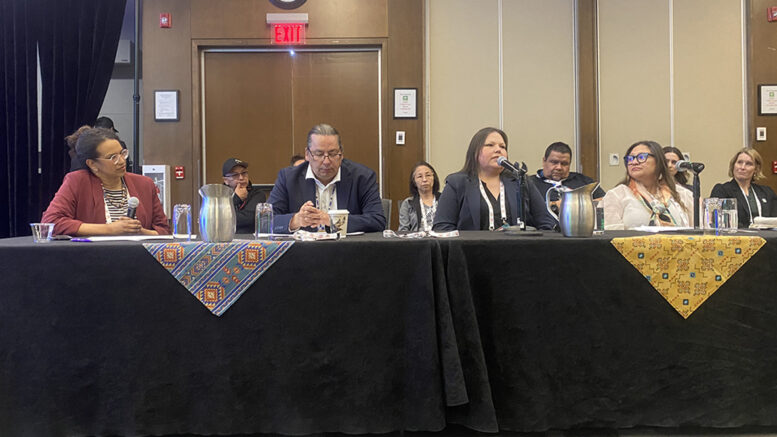
(ANNews) – The chief of Cold Lake First Nations, an advisor to Energy Minister Brian Jean and executive at resource sector engineering firm Worley offered their perspectives on how to promote Indigenous leadership in the energy sector during a May 13 roundtable discussion at the Forward Summit.
The annual summit, held at the Grey Eagle Resort and Casino on Tsuut’ina Nation near Calgary, brings together Indigenous leaders and entrepreneurs, as well as representatives of government and industry to advance reconciliation-rooted partnerships.
Moderator Shannon Joseph, chair of Energy for a Secure Future, kicked off the discussion by asking each panelist to describe the energy projects they’ve been involved in.
Cold Lake First Nations (CLFN) Chief Kesley Jacko noted that his Nation has majority ownership of a combined 40 megawatts of solar energy production, including the Duchess and Chappice Lake solar projects in southeastern Alberta.
Oil and gas startup Ethan Energy is fully owned by CLFN, which is the only Dene Suline First Nation in Treaty 6.
Jacko explained that since CLFN has been “dicked around” by oil and gas companies operating on their territories, they decided to invest in projects themselves “so nobody dictates to us.”
“We also have a casino and hotel on reserve, and you guys are free and welcome to come visit and throw in a $20,” he said to laughter.
In addition to her advisory role with the Alberta government, Melissa Mbarki is a member of Muskowekwan First Nation, an Ojibway band in Saskatchewan whose territory includes the site of Canada’s last residential school, which closed in 1997.
She said her community is seeking to transform that site into a greenhouse.
“It has the power, the gas and the water lines, so we wouldn’t have to set that up or get that infrastructure in place, because it’s already there,” explained Mbarki.
When planning to build a potash mine on its territory about a decade ago, Muskowekwan First Nation discovered some oil and gas, Mbarki added, but neither project was pursued at the time because of band leadership changes.
“Those projects are back on the table, along with a biofuels project,” she said. “What we could potentially do is use the natural gas to power our greenhouses, as well as use the farmland that we lease for canola and potentially turn that into either a sustainable aviation fuel or biofuel.”
Community members, said Mbarki, were “actively involved in these discussions” regarding energy development.
“They felt like their voices were heard, they felt like they were part of something, and they felt like they wanted to help build this project, because we’re probably experiencing one of the worst poverty rates right now,” she said.
Linnette Hodges, Worley Canada’s Indigenous relations manager, is a member of Asiniwachi Niyaw Nation, with mixed Nehiyawak and Kanienʼkehá꞉ka lineage.
“Being Indigenous myself, this is a very important job for me,” Hodges said.
Worley has a series of partnerships with academic institutions, First Nations communities and charities aimed at promoting reconciliation, she explained.
The company has an arrangement with the University of Victoria to recruit Indigenous engineering graduates to work there. Worley’s goal is for five per cent of its workforce to be Indigenous.
It also has a partnership with Mikisew Cree First Nation and Fort McKay First Nation, both in Treaty 8, to provide “vital environmental consultation services,” in which the First Nations “basically guide us in the way that we need to work on the land.”
She emphasized that building a trusting relationship with an Indigenous community “takes time.”
“Trust grows when you’re working together for a longer period of time. But the main thing, I think, is that you both have clear expectations,” said Hodges.
Environmental concerns
Chief Jacko emphasized the importance of respecting particular First Nations traditions.
“Within the Dene Suline world, land is not property or wilderness, it is a living system that includes water, animals, plants, air, fire, ancestors, stories, the laws given by the Creator, even the little bugs are part of it,” he said.
“Humans are a part of the system and hold responsibilities to it, not domain over it.”
CLFN’s investment decisions are “guided by the principles of our Elders … within the constraints of the environment we are in,” added Jacko.
“You make strategic decisions that support our long-term sovereignty [and] financial independence, but we also make sure that these decisions match up to our community values and cultural priorities as best as we can.”
Having ownership over energy projects on CLFN land empowers the First Nation to turn down partnerships that don’t respect Dene Suline ways.
“We make really good partners, because our goals and our values are clear from the start,” said Jacko.
While CLFN is invested in oil and gas, its solar investments enable the nation to diversify its energy portfolio away from resources that damage the environment.
The chief noted the cumulative impacts of oil and gas extraction on the region’s woodland caribou population, which is of immense importance to his people.
“The only way I can eat caribou now is if they get hit by a truck, and that’s just not right,” said Jacko.

The phrase “the 4 R’s” typically refers to one of these common sustainability or management principles, none of which solar power “uses” as part of how it produces energy: Reduce, Reuse, Recycle, and Recover/Repurpose/Repair (or similar variations like Reduce, Reuse, Recycle, Respond): These are waste hierarchy or circular economy principles often applied to solar panel manufacturing, end-of-life management, and broader green living. For example, the solar industry is increasingly focused on recycling panels at the end of their 25–30+ year lifespan (recovering glass, silicon, silver, copper, etc.), reusing or refurbishing panels, reducing material use in new designs, and minimizing waste/landfill impact. Only a small percentage of panels are currently recycled, but efforts are growing to make the lifecycle more circular. We have more efficient methods of creating energy!