
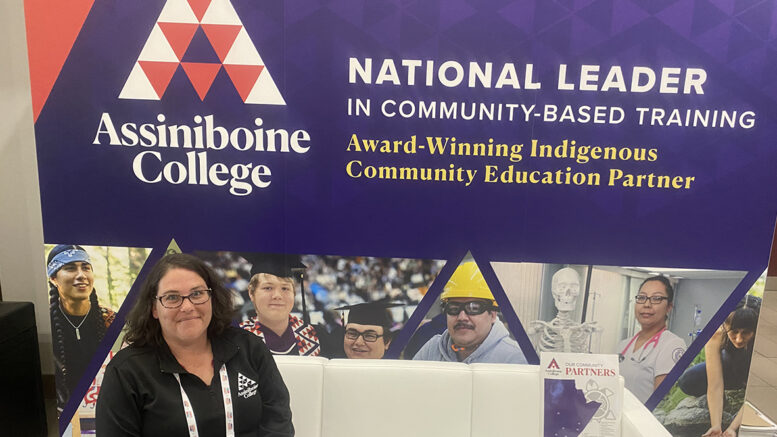
By Jeremy Appel, Local Journalism Initiative Reporter
(ANNews) – Assiniboine College isn’t just a post-secondary institution with physical campuses in Brandon, Dauphin, Winnipeg and Portage la Prairie. It also sends instructors to remote Indigenous communities to meet people where they are, literally.
“One of my main jobs is to support First Nations communities in delivering and providing training to their citizens in the community,” Assiniboine’s business development coordinator Lonnie Patterson told Alberta Native News.
This role includes establishing connections with communities, learning their training needs, developing a budget and contract for sending job training their way, “and then I hand it off to the people that actually deliver the program,” explained Patterson.
“We deliver anything from comprehensive health care aid and practical nursing to trades,” she added.
The college was one of several educational institutions, including the University of Calgary, Olds College and the Banff Centre for Performing Arts, represented at the Forward Summit on May 13 and 14 at Grey Eagle Casino and Resort on Tsuut’ina Nation.
Assiniboine had a table set up at the casino’s main concourse to promote its range of programming, and its director of Indigenous education, Kris Desjarlais, spoke on a panel on the conference’s second day.
While trades programs typically offer lengthy apprenticeships for broad fields of work, such as carpentry or plumbing, Assiniboine College has “broken these down into two to 10-week programs in and of themselves,” said Patterson, enabling training to more closely align with communities’ specific needs.
The college’s preference is to hire contract instructors and education assistants locally, but that isn’t always possible.
If they’re not local, the instructor gets “shipped up to the community” with all the necessary tools for the job and stays for the program’s duration, she explained.
“[Students are] done on Friday and on Monday, they’re often employed by the band council, working on housing and things like that,” Patterson said.
Doing a two-year trades program isn’t for everyone. “But this way, they get some skills and they can get into jobs pretty quickly,” she added.
Assiniboine also offers conventional programming at its campuses that runs for the usual semester cycle.
“The difference with our community-based training is you don’t have to start in September. You want to start drywalling in February, then we can do that,” said Patterson.
Community-based training has its challenges, like “all models of education,” she conceded.
Sometimes it’s difficult to find instructors who are willing to relocate temporarily to a remote community they’ve never visited.
Patterson said she wouldn’t characterize it as a “challenge,” but emphasized the importance of recognizing that many community members “have either experienced trauma throughout their life or are experiencing it on a regular basis,” and that “some Indigenous communities experience trauma on a far more frequent basis.”
“It is a reality that we need to respect and work with as we’re delivering programs,” she said.
Offering training in remote communities, rather than requiring students to move to a city, plays an important role in facilitating reconciliation, Patterson added.
“Student success is at the center of what we do, but empowering communities, supporting First Nations, that’s also a big part of it,” she said.

Be the first to comment on "Assinboine College meets remote First Nations communities where they are"