By Chevi Rabbit, Local Journalism Initiative Reporter
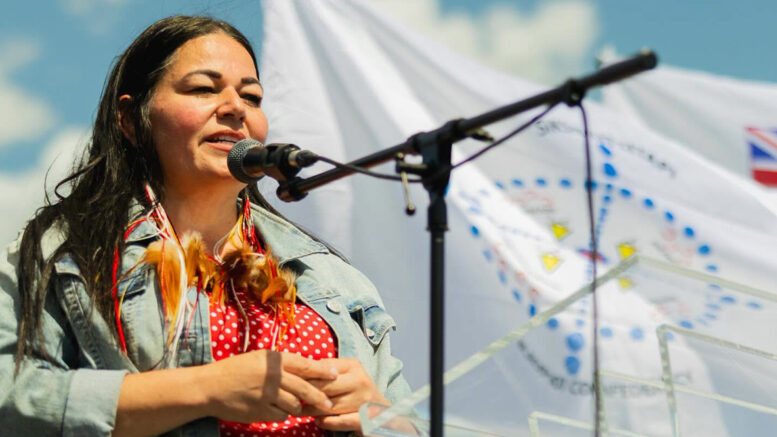
(ANNews) – This past National Indigenous Peoples Day, Alberta MLA Jodi Calahoo-Stonehouse reflected on the importance of celebrating Indigenous identity while also speaking candidly about the challenges Indigenous peoples continue to face in Alberta and across Canada.
For Calahoo-Stonehouse, the day represents both pride and visibility.
“It’s a beautiful moment where we get to celebrate who we are – our culture, our language, our lands, our identity,” she said. “It’s also an invitation for the rest of the world to see us.”
She emphasized that National Indigenous Peoples Day is not only about recognition, but also about building stronger relationships grounded in respect, understanding, and truth.
Reconciliation and Its Growing Tensions
When asked about reconciliation, Calahoo-Stonehouse offered a critical reflection on where Canada currently stands, particularly in relation to treaty rights and ongoing political debates.
She described reconciliation as increasingly complicated, especially when legal rulings and Indigenous rights are not fully respected or implemented.
“We’ve seen court rulings that affirm First Nations rights, including free, prior and informed consent, and Section 35 protections,” she said. “And yet we still see decisions moving forward that contradict those rulings.”
Calahoo-Stonehouse said this creates tension between governments and Indigenous communities and risks weakening the progress that has been made since the Truth and Reconciliation Commission. “It really puts reconciliation in jeopardy,” she said. “It dismantles a lot of the work that has been done over the past decade.”
Despite this, she stressed that reconciliation remains possible if it is grounded in meaningful action and genuine partnership. “I love when reconciliation is happening,” she said. “When we’re working in partnership, when we’re working toward a better Alberta for every citizen.”
Rising Hate and Personal Impact
Calahoo-Stonehouse also spoke about what she described as a significant rise in online hate and harassment targeting Indigenous leaders and communities. “It’s really awful, and people are afraid,” she said. “We’re seeing levels of hate on social media like we’ve never seen before – violence, name-calling, things we haven’t seen since the 1970s.”
She shared that she has personally experienced repeated harassment online. “I am called a squaw on a daily basis,” she said. “On a regular basis on my social media, I’m targeted, I’m threatened, and I’m subjected to constant harassment.”
Calahoo-Stonehouse said the normalization of this kind of abuse is deeply concerning and reflects a broader issue of racism that Indigenous people continue to face in public life and digital spaces.
She added that many Indigenous leaders are now forced to consider safety planning simply to go about daily activities, including traveling to nearby communities for basic needs. “We’ve had communities develop safety plans just so people can go to the grocery store or bank,” she said. “That level of fear is not normal.”
Treaty Responsibility and Shared Future
Calahoo-Stonehouse connected these issues back to the spirit of treaty relationships, emphasizing that treaties were intended to create peace, friendship, and shared responsibility. “When we think about treaty, it is a peace and friendship treaty,” she said. “We agreed to share the land and live in peace.”
She warned that rising hostility and disrespect undermine those original intentions and strain relationships between communities that are meant to coexist.
A Message for Youth
Despite the challenges she outlined, Calahoo-Stonehouse ended with a message of hope directed toward young people, whom she sees as essential to shaping the future. “Our young people are the hope for the future,” she said. “We really need to mobilize the coexistence of peace and friendship and the work of reconciliation.”
She encouraged youth to engage in civic life and recognize the importance of their voices in shaping political and social change. “Our young people have an opportunity to stand up and vote,” she said. “They have an opportunity to change this province so it becomes part of the Canada we all want.”
For Calahoo-Stonehouse, that vision of Canada is rooted in equality, dignity, and opportunity for all people. “A Canada that believes everyone has a right to exist,” she said, “and a right to pursue their dreams, their happiness, and their careers.”

Be the first to comment on "MLA Jodi Calahoo-Stonehouse on Reconciliation, Rising Hate, and the Future of Alberta"