
By Chevi Rabbit, Local Journalism Initiative Reporter
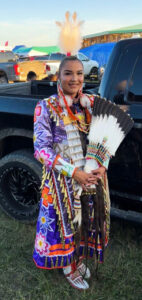
Martina Desjarlais.
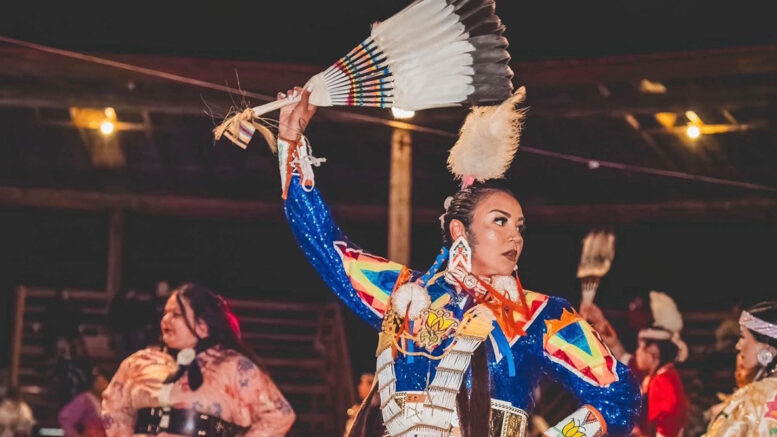
(ANNews) – For Martina Desjarlais, jingle dress dancing is more than a dance. It is a connection to family, a source of healing, and a responsibility to carry tradition forward for future generations.
Martina is from Alexander First Nation and currently lives in Bonnyville, Alberta, where she attends Blue Quills University. Her journey as a jingle dress dancer began when she was a young child. “I actually started dancing when I was little – maybe three or four years old. But I didn’t take it seriously at that time.”
Her first connection to jingle dress dancing came through her family at the Driftpile Powwow. “We were at a Driftpile Powwow, I was there with my dad and my kokum, and I was dancing in every intertribal.”
“The next night, my kokum and one of my aunties, they made me my first jingle dress. And it was like just a real little dress that only had like nine cones on it…The next day I was so happy, and they bought me water shoes, and I was dancing. I danced all day. And that’s kind of where it started.”
As Martina grew older, dancing became a deeper part of her life. In 2011, her late sister, Tonesha Walker Desjarlais, played an important role in guiding her as a dancer. “I went powwowing with her and my Uncle George that whole summer. That’s when I got my jingle dress, and my parents were getting things together for me, trying to figure out beadwork for myself.”
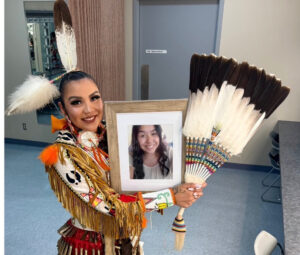
Martina holding a photo of her late sister Tonesha Walker Desjarlais.
“She was showing me the ropes – what to do, how to take care of myself, how to take care of my regalia, how to get ready, when to dance, how to dance. She kind of showed me everything.”
In 2012, Martina lost her sister in a tragic act of violence. The loss deeply affected her family.“It shocked our whole family because we’re a really close-knit family, and then it was hard. It was hard to powwow after that.”
Despite the grief, Martina continued dancing with the support of her family.“My parents and my grandparents, they kept pouring so much love into me and figuring out how to get extra cash to buy me dresses and get me to and from powwows.”
“Even my aunties, and my kokum, they all stepped up to take me to powwows because I really love dancing.”
Through dancing, Martina found healing and a way to move through difficult moments. “It’s kept me on a good path. It’s kept me grounded through some really, really dark, heavy times.”
“It’s my outlet.”
Martina says dancing allows her to release emotional and mental burdens.“If I’m carrying heavy stuff emotionally or mentally, and then I just go and dance, I kind of just let it all out on the dance floor and forget about everything that I was carrying.”
For those learning jingle dress dancing, Martina emphasizes the importance of respecting and caring for regalia. “Honestly, I would say take care of your outfit because it’ll take care of you.”
“Really respect yourself and your outfit.”
She explains that regalia carries meaning, love, and the sacrifices of family members who helped create it. “I take that as my most prized possession because my family invested so much into me and made a lot of sacrifices in order for me to have what I have.”
Martina hopes people understand that jingle dress dancing is much more than a performance. “It’s not just a dance. It’s not just a dress. It’s not just a costume…There’s so much love poured into everything that’s being made.”
“Our beadwork, it takes sometimes years to make because it’s like one bead at a time…When dresses are being made, there’s so much good energy that gets put into it.”
She believes learning the history and teachings behind the dance is an important responsibility. “In our culture, a lot of things are passed down orally. Sometimes you can’t find stuff in books and learn these things in books…You learn them from your elders or your teachers or whoever’s willing to share.”
Today, Martina continues carrying these teachings forward with her own children. “We invest a lot into our kids to be able to dance, and it’s important because it creates a strong sense of identity and helps you understand who you are, where you come from, and making family along the way.”
“It’s a good way of life to be a part of.”

Be the first to comment on "Carrying Healing and Tradition: Martina Desjarlais’ Journey as a Jingle Dress Dancer"