By Jeremy Appel, Local Journalism Initiative Reporter
(ANNews) – Besides an opening prayer from O’Chiese First Nation Elder Theresa Strawberry, there was scant Indigenous representation in the main conference hall at this year’s Carbon Capture Canada conference, held in Edmonton from September 15 – 17.
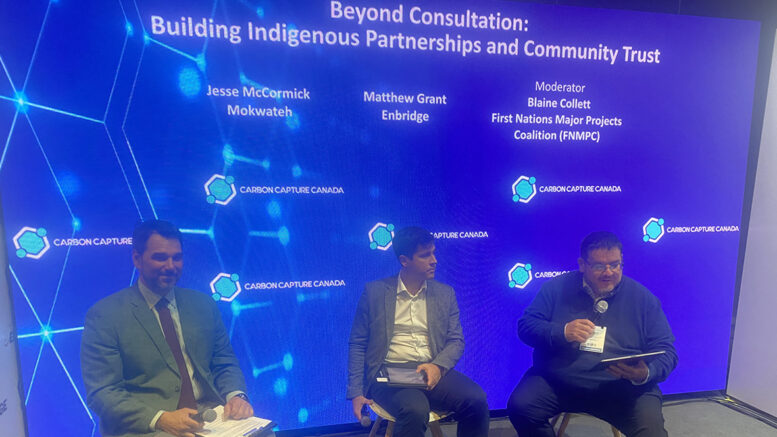
In the exhibition hall next door, Enbridge sponsored a panel discussion on Sept. 15 that focused on industry partnering with Indigenous communities to support carbon capture, utilization and storage (CCUS) technology.
Moderator Blaine Collett, senior advisor to the First Nations Major Projects Coalition, said at the panel’s outset that “one of the most important factors in determining whether these investments become a reality is trust between communities.”
“Experience has shown us that even the best projects can struggle if they are not built on a foundation of trust,” Collett added.
Matt Grant, the director of oil sands business development and low carbon at Enbridge, distinguished between “consultation, which we have to do,” and “building relationships to establish trust.”
He portrayed his company’s planned Wabamun carbon hub as a model for partnering with local First Nations communities, citing the involvement “from day one” of then-Enoch Cree Nation chief Billy Morin.
First Nations are being offered upwards of 50 per cent ownership when the project is complete, although Grant conceded that “equity isn’t always the way to go,” depending on the community’s preferences.
Anishinaabe lawyer and marketing consultant Jesse McCormick, who’s worked for First Nations, the federal government and industry at various points, agreed that the goal is “to get to that spot where you’re working in partnership, not only consulting.”
One way to do this, he added, is “showing up earlier” in the process, “creating context for partnership, working together, and doing it in a positive way.”
McCormick emphasized the importance of getting all impacted First Nations on board for a given project.
Opposition from even one band “can still have a significant impact on your budget, on your timelines, on your reputation,” he explained.
It’s incumbent upon companies looking to build relationships to know the distinct histories of the First Nations they’re working with, said McCormick, who recommended proactively hiring former chiefs or counsellors as a “powerful tool in building positive relationships.”
Grant said Enbridge has set up a “virtual town hall,” in which attendees can attend various rooms conveying information on different technical aspects of CCUS.
“We try to rely as much as possible on expert third-party material, so it wasn’t Enbridge saying something or somebody from industry saying something, but it was scientists or people with a subsurface background, for example,” explained Grant.
He emphasized the need to have emergency response plans for both the pipeline and subsurface, which are then conveyed to internal stakeholders, emergency responders and communities along the route.
“We have hundreds of kilometers of CO2 pipeline in operation right now in Alberta and Saskatchewan, and the track record has been very positive,” said Grant.
But in the United States, where the CCUS industry is more advanced, there have been issues.
An infamous CO2 pipeline rupture in Satartia, Mississippi, in 2020 required the evacuation of 200 residents and hospitalization of 45 people in the rural community.
McCormick cautioned against pressure to cut regulatory corners in order to get projects built faster.
“We’re not building confidence through the regulatory system because we circumscribe the timeline or the amount of energy and focus that First Nations can put into the process,” he said.

Be the first to comment on "Carbon capture conference side panel discusses Indigenous partnership"