By Chevi Rabbit, Local Journalism Initiative Reporter
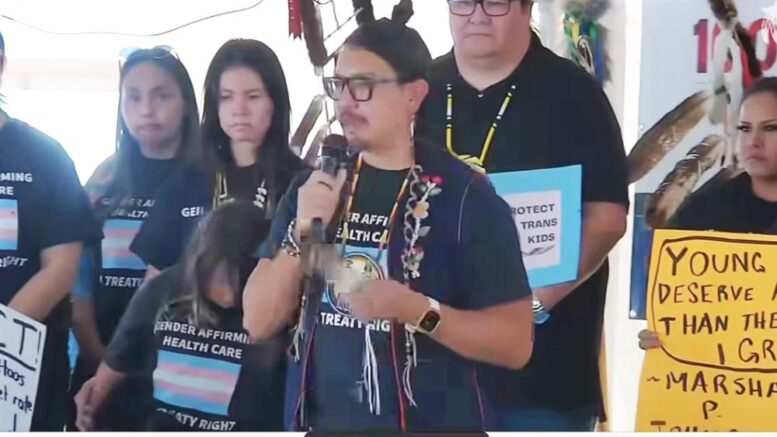
(ANNews) – Saddle Lake Cree Nation is asserting its Treaty 6 and inherent jurisdiction over health care by establishing a safe haven for gender-affirming care on its reserve lands and territories – a move Dr. James Makokis says could have implications far beyond transgender health.
The announcement came in response to Alberta legislation restricting gender-affirming medical care for transgender and gender-diverse youth. The initiative was announced on Sept. 9, 2026, exactly 150 years after Treaty 6 was agreed to at Fort Pitt.
For Makokis, a family physician and member of Saddle Lake Cree Nation, the timing was significant. “We knew immediately when these laws were announced in February of 2024 that they were a violation of not only our peace and friendship treaty, but our medicine chest,” he said.
The Nation says any Albertan will be able to access gender-affirming care on Saddle Lake Cree Nation reserve lands and territories, while existing health services for Saddle Lake citizens will remain protected.
Makokis said the decision is rooted in the Nation’s responsibility to protect its people and in its interpretation of the Treaty 6 medicine chest promise.
The Medicine Chest as a living treaty commitment
Makokis said Treaty 6 needs to be understood through the worldview and oral traditions of the Cree people who entered into the agreement in 1876. At the time, Cree leaders did not speak English. They spoke nēhiyawēwin, and Makokis said the oral understanding of the treaty must be considered alongside the written version preserved by Crown representatives.
He argues that the medicine chest promise was never intended to freeze access to health care in the year 1876. Makokis described the medicine chest kept by the Indian agent as a symbol of Western medicine available to First Nations people at the time. “That symbol would evolve into the future because it represents Western medical healthcare and Western medicine,” he said.
In Makokis’s interpretation, the treaty commitment therefore extends to modern medical services, including pharmaceutical drugs, procedures, health professionals, medical supplies and equipment. He said that understanding includes gender-affirming care.
“That also includes gender-affirming care, which includes, you know, puberty-suspending medication. It includes hormone replacement therapy. It includes services and access to clinicians and, you know, packers and binders and all of those things that gender-diverse people need,” he said.
Makokis also pointed to the federal Non-Insured Health Benefits program, which he said demonstrates that some medications associated with gender-affirming care are already covered through federal health benefits. His position is that a provincial government cannot restrict a federal treaty-related health benefit. That is a legal interpretation that could ultimately be tested through negotiations or the courts.
For Makokis, Treaty 6 is not simply a historical document. “It’s really important for our people to realize and recognize our treaty rights and how they’re powerful tools and shields for us to utilize that our ancestors envisioned over 150 years ago,” he said.
Protecting Two-Spirit people and transgender youth
The announcement is also grounded in Saddle Lake’s understanding that Two-Spirit people have always been part of Cree society. Makokis said Two-Spirit people occupied an established and respected place within Cree communities before colonization and that their presence is not a new phenomenon.
He described Alberta’s restrictions as an attack on a segment of the population and said Saddle Lake leadership viewed it as their responsibility to protect their citizens. The Nation has also extended that protection to non-Indigenous Albertans seeking care.
Makokis said Saddle Lake is developing ceremonies for Two-Spirit and transgender youth that recognize the transition from youth into adulthood and form part of the community’s broader Cree health and wellness system.
A potential breakthrough in healthcare licensing
While gender-affirming care is at the centre of Saddle Lake’s announcement, Makokis says another part of the initiative could have much broader consequences for health care across Canada. The Nation is developing what he describes as a model allowing Canadian-trained health professionals to practise within Saddle Lake’s jurisdiction without having to obtain multiple provincial licences.
Makokis said the approach could eliminate one of the major barriers facing First Nations communities trying to recruit doctors, nurses, pharmacists and specialists. “If there is a physician or a nurse or a pharmacist from Ontario who are just as equally competent to practice within their scope of practice as they are in Alberta, that we are eliminating the barriers, the jurisdictional barriers, for them to have a license within Alberta,” he said.
Makokis said provincial regulatory colleges have the ability to establish agreements and memorandums of understanding that can facilitate professional mobility between jurisdictions.
In his view, Saddle Lake’s model could therefore establish a precedent for what he describes as pan-Canadian licensure of health professionals.
“That’s exactly what Saddle Lake Cree Nation has done,” he said.
Makokis compared the concept to federal health systems, where health professionals can work across provincial boundaries under a federal system. He said the model could be particularly important for remote First Nations communities that struggle to attract physicians and other health professionals.
“Any reserve land and chief and council who choose to pursue and adopt this model can immediately have the ability to attract specialist physicians, primary care physicians, health professionals that they have trouble recruiting physically to their areas,” he said.
Makokis said Saddle Lake has already received inquiries from physicians and nurses interested in learning how they could work within the model. If adopted by other First Nations, the approach could potentially expand access to health professionals well beyond gender-affirming care.
A virtual-care hub
Saddle Lake is also looking at ways to ensure its existing health system is not overwhelmed by people travelling from outside the community. Makokis said the Nation plans to establish a virtual-care hub on reserve lands so non-Indigenous Albertans can access services remotely.
Virtual care, he said, would allow Saddle Lake to extend access without placing the same pressure on its physical health infrastructure. He pointed to existing virtual gender-affirming care providers as examples of how the model can work.
Preparing for a legal challenge
Saddle Lake is also preparing for the possibility of a legal challenge. “Obviously, you know, we’re anticipating a legal challenge potentially with the Alberta government,” Makokis said.
A GoFundMe campaign organized by Makokis, titled Saddle Lake Cree Nation Treaty Health Legal Defense Fund, has been launched to support the legal and implementation work surrounding the Nation’s assertion of Treaty health rights.
The fundraiser says donations will support legal counsel and potential litigation, development and implementation of Saddle Lake’s Health Law, Treaty legal research, responses to potential government challenges, regulatory and professional legal advice for health professionals, expert evidence, and possible court applications, interventions and appeals.
Makokis said the legal costs should not fall on Saddle Lake citizens simply because the Nation is defending what it considers to be treaty rights. He said the fundraiser has already received support from non-Indigenous people around the world.
A history of resistance
Makokis placed Saddle Lake’s actions within a much longer history of resistance to injustice. He pointed to examples including Rosa Parks and the civil rights movement, the Underground Railroad, the Stonewall uprising and the takeover of Blue Quills Residential School by Indigenous people in the 1970s. For Makokis, resistance has historically been necessary when governments or institutions restrict the rights and freedoms of marginalized communities.
He said Saddle Lake’s current position is about more than one group or one medical issue. “When these instances of dehumanization and the removal of individual freedoms affects one group, it will always extend and affect a larger group,” he said.
He also emphasized that communities have the ability to act rather than simply wait for governments to respond. “It’s really important for people to remember that they have agency, that they have the ability to do something,” Makokis said.
Looking beyond Saddle Lake
The immediate focus of Saddle Lake’s initiative is gender-affirming care and the protection of Two-Spirit and transgender people. But Makokis believes the larger story could ultimately be about Treaty jurisdiction, Indigenous health governance and the movement of health professionals across provincial boundaries. He hopes other First Nations will consider the model and work collectively to expand access to health care throughout their territories.
For Saddle Lake, the announcement represents an assertion of treaty rights. For the broader Canadian health system, it could become an experiment in whether First Nations jurisdiction can help overcome some of the regulatory barriers that have long made it difficult to deliver health care in underserved communities.
And for Makokis, it is a continuation of the responsibility he believes was embedded in Treaty 6 150 years ago.
Link to Go Fund Me Page:
Saddle Lake Cree Nation Treaty Health Legal Defense Fund

Be the first to comment on "Saddle Lake Cree Nation invokes Treaty 6 to establish gender-affirming care safe haven"