
By Chevi Rabbit, Local Journalism Initiative Reporter
(ANNews) – For Cree artist, musician, composer and curator Virginia J. Sparvier-Wells, reclaiming her birth name has become more than a legal process. It has become a journey of healing, reconnection and reclaiming a story that was interrupted through adoption.
“It has been a long time coming,” Sparvier-Wells said.
After years of creating and performing professionally as Jessica McMann, Sparvier-Wells began the process of reclaiming her birth name while honouring her marriage and artistic journey. She chose to keep Jessica as her middle name because much of her previous creative work was released under that name.
For Sparvier-Wells, a name carries family, history and belonging. “There is something about the name that your mother gives you,” she said. “A lot of Indigenous kids never get to keep that connection to their family, their lineage, and even the place.”
Her decision to reclaim her name is deeply connected to her experience as a Sixties Scoop survivor and her journey of understanding the impacts of being separated from family, culture and community.
 For many years, Sparvier-Wells searched for a deeper understanding of where she came from and where she belonged. That search eventually led her back to Cowessess First Nation, where she began reconnecting with family and community. “I really needed to know a family aspect,” she said.
Returning home introduced her to relatives she had never known, including aunties, cousins and her grandmother, Viola GoodEagle. “I met like 15 aunties and a whole bunch of cousins,” she said. “It was very overwhelming.”
A defining moment came when she attended a powwow and was introduced to her grandmother. “That brought me home. It really literally did,” Sparvier-Wells said. “If I wasn’t called that thing, I wouldn’t have ended up there, and I wouldn’t have been dancing that year that I met my Nana.”
For Sparvier-Wells, dance became the bridge between her past and her future. “It was my dancing that brought me home,” she said.
That connection to community became the foundation for her artistic journey.
Sparvier-Wells said her earlier creative work focused on processing the experiences of adoption, racism and disconnection. Art became a way to understand her story and begin healing. “My previous work that I created was really about the trauma of adoption and the things that you don’t learn,” she said.
Growing up in Calgary, Sparvier-Wells said she often experienced racism without having the language or support to understand what was happening. “I was in a really white neighbourhood. There were no other Indigenous people in my school,” she said.
Through music, writing, dance and performance, she began transforming those experiences into stories of resilience and reconnection. “I forgot to mention that when I was talking about my past work, it was also a way to heal through it,” she said.
Today, Sparvier-Wells said her artistic direction has entered a new chapter. “My new work is moving towards celebrating and looking towards a positive future now,” she said.
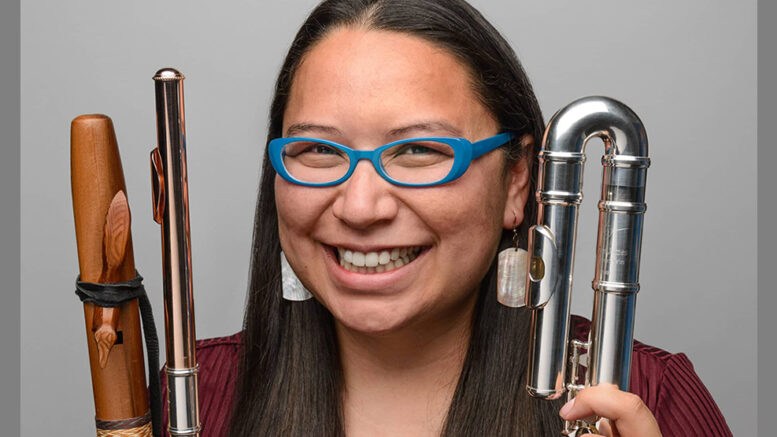
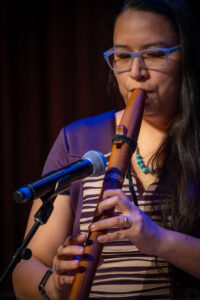
That future is reflected in her work as a classically trained flutist, composer and Indigenous classical artist. Sparvier-Wells is expanding the possibilities of what Indigenous expression can look like within classical music.
Rather than seeing classical music and Indigenous traditions as separate worlds, she brings them together through personal experience, storytelling and cultural connection. “I create my work based on my own experiences in my life,” she said. “I don’t think artwork should be used in a commercial way to connect with one culture,” she said. “I think you connect with your culture, and then the work flows.”
Her artistic vision is about bringing together every influence that has shaped her journey. “I think everything that I want to do is going to be mine,” she said. “It’s going to be merging everything that I’ve learned – jazz, classical, my experiences and what I’ve learned playing Indigenous music.”
Her path in classical music has been strengthened by Indigenous artists who helped create space for others. She credits the late Cree cellist and composer Cris Derksen of North Tallcree First Nation as an important mentor and supporter. “I’m really thankful for everything that she did for all of us,” Sparvier-Wells said.
Her own work continues to create those opportunities for future generations. Through projects such as her first album Incandescent Tales, and her second one Prairie Dusk, Sparvier-Wells has brought Indigenous voices into classical music spaces through collaboration and composition.
Her work has included collaborations with Indigenous classical musicians and composers, including Connor Chee, a Diné composer and pianist who is creating a new flute concerto written specifically for her. “This is going to be the first concerto that is written for me,” she said.
The project represents another milestone in her career as she continues expanding Indigenous presence within orchestral and classical music spaces.
Beyond performing, Sparvier-Wells has also worked as a curator and art consultant, advocating for Indigenous leadership in museums, galleries and public arts. “When you have Indigenous-led voices and authentic Indigenous people leading these things, then you get a really deep contemporary look at things,” she said.
She believes Indigenous art should not be limited by stereotypes or expectations. “We’ve always been a contemporary people, evolving with the years,” she said.
For Sparvier-Wells, Indigenous art is living, changing and continuing to tell new stories. She encourages people to support Indigenous artists by showing up, learning and engaging with local arts communities. “Even if it feels weird, get out and see that local Indigenous art show,” she said. “There are so many amazing artists in this province that we can support.”
Through reclaiming her name, reconnecting with her family and creating new pathways in classical music, Sparvier-Wells is helping redefine what Indigenous artistry can be. Her journey is not only about looking back at what was lost. It is about creating a future filled with connection, creativity and belonging.
“There’s always somebody there,” Sparvier-Wells said. “There’s always at least one person.”

Be the first to comment on "Virginia J. Sparvier-Wells reclaims her name and blazes a new trail in Indigenous classical music"