
By Chevi Rabbit, Local Journalism Initiative Reporter
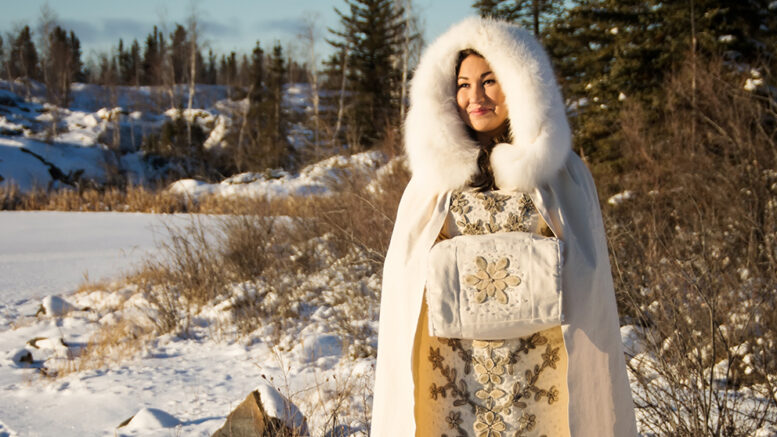
(ANNews) – For Tishna Marlowe, fashion is not simply about clothing. It is about memory, survival, identity, and carrying forward the teachings of generations who came before her.
Marlowe is the founder of Dene Couture and comes from Lutselk’e, Northwest Territories, a Dene Suliné community located on the east arm of Great Slave Lake. Lutselk’e means “Place of Small Fish.”
Her connection to fashion began long before she ever stepped into a design studio. It began through her family, her land, and the teachings of her elders. “The world expects us to be happy, positive Indigenous people while we carry these five generations on our backs, while trying to break a cycle and raise healthy men,” Marlowe says.
That history is woven into every piece she creates.
Marlowe grew up surrounded by elders, especially her grandmother Madeline Marlowe, who became her greatest teacher. “My relationship with my Grandma Madeline Marlowe, we were best friends and everything,” she says. “I got a lot of my teachings from her, from sitting beside her, watching her, gathering her supplies, doing everything she asked me to, because that’s how you learn from elders.”
For Marlowe, traditional knowledge was not something that could simply be handed over. It had to be earned through respect, patience, and presence. “You can’t just expect people to pass on their knowledge. You have to sit with them, cut their wood, make their tea, take out their garbage, sweep for them. Then they reward you. That’s how I grew up.”
Those teachings continue to guide her approach to design.
Marlowe says her ancestors’ clothing was created out of necessity, built for survival in one of the harshest environments on Earth. “My people follow the migration of the caribou,” she says. “Our clothing is so specifically made by following the seasons.”
The materials, designs, and techniques were connected to the land and the survival of the people who depended on it. “My fashion isn’t just about being a fashion designer for recognition,” Marlowe says. “My fashion is so much deeper than that. My fashion is about the survival of my people’s fashion since we’ve had to recover, and we’ve lost so much of our people and our ways of life.”
Marlowe describes herself not simply as an Indigenous fashion designer, but as a designer whose Indigenous identity informs her work. “I’m not an Indigenous fashion designer,” she says. “I’m a fashion designer who happens to be Indigenous.”
Her training combines traditional teachings with Western education. She studied costume design and construction at Olds College Fashion Institute, learning the technical skills needed for film and theatre while continuing the teachings passed down by her family. “In the traditional world, I sat, paid my dues with my elders who taught me,” she says. “In my Western world, I went to school and it was hard to get the papers.”
She believes that combination allows her to represent her culture with authenticity. “It helps me make better clothes to better represent people,” she says.
One of her most meaningful creations is the caribou antler dress, named Precy after her great grandmother Caroline’s mother. “That dress came to me in a dream,” Marlowe says.
In that dream, she saw a woman walking toward her across the snow. “She came closer and closer, and she said, ‘Make this and they will remember.’”
The dress features thousands of fish scales and hundreds of caribou antlers, along with fish vertebrae, beads, canvas, cotton thread, and sinew. “It was the third dress I made, with no skills, no nothing,” she says. “It came to me in a dream and it just bothered me, so I started.”
Another important piece is her Seven Generation Dress, created with hand smoked moose hide, beadwork, and traditional materials.
Marlowe explains that traditional handmade items were never simply decoration. “We didn’t make frivolous things because we had to haul everything everywhere, from fish camp to hide camp to caribou season,” she says. “Our jacket is a tool, our hat, our mitts, those are tools because you need them to be in winter.”
Today, Marlowe sees Indigenous fashion experiencing a resurgence, helped by technology and social media. “TikTok plays a really big tool in Indigenous culture,” she says.
She believes online platforms have allowed Indigenous youth to reconnect with skills and traditions. “You can learn how to do makeup, you can learn how to sew, you can learn how to make a cupboard,” she says.
After generations of assimilation and cultural suppression, she believes people are reclaiming what was taken. “We’ve been assimilated for so long,” she says. “We’ve been prohibited from singing our songs, and now we’re allowed to have them all back. We want our culture back.”
Marlowe says earlier Indigenous designers helped create space for artists like her. “These women inspired me to believe that I could do that,” she says.
Her advice to young Indigenous artists is simple: learn, practice, and respect the process. “Education,” she says. “Whether it’s traditional mentorship or Western teachings, getting books, looking at videos, it’s like anything in life. You have to learn and work for your craft.”
Her message to youth is to spend time with elders and understand the meaning behind the work. “Sit with your elders, learn from them, because they’re the ones that are going to teach you the motifs, the design, the reason behind it,” she says.
Now, after decades of focusing on family and community, Marlowe is entering a new chapter. “I want to thrive,” she says. “I want my people to thrive. I want you to thrive. I want designers, students, everybody in our community to thrive.”
Her dream is to create an atelier where people can gather, learn, and create. “My dream is to teach,” she says.
She hopes to offer workshops, private sewing lessons, and a space where people can create their own garments with guidance. “I want to have my own atelier that people could rent out,” she says. “You bring your own fabric, you come to my studio, and I help you make your garment.”
Marlowe is also continuing to expand Dene Couture, exploring manufacturing, fabric design, and new ways to bring her beadwork and designs into the world. “The sky’s the limit for me because I have nothing holding me back now,” she says.
But she remains committed to learning. “I always tell my students, sometimes you’re the teacher, always the student, but never the expert,” she says.
For Marlowe, creating art is an act of vulnerability. “When you show your stories in your words and I show my visual arts, we’re literally just showing you our insides,” she says.
Through Dene Couture, Tishna Marlowe is doing more than creating fashion. She is preserving cultural knowledge, honouring her ancestors, and building a future where Indigenous creativity is celebrated. Her work carries the message given to her in a dream: “Make this and they will remember.”

Be the first to comment on "Make This and They Will Remember’: Tishna Marlowe’s Dene Couture Carries Generations of Survival"