
By Chevi Rabbit, Local Journalism Initiative Reporter
(ANNews) – For nêhiyaw (Cree) artist Arsene Arcand from Alexander First Nation (Kipohtakaw) in Treaty 6 Territory, art is not simply a practice of creation – it is a continuation of teachings, relationships, and responsibilities passed down through generations.
Rooted in the guidance of his family, including the teachings of his grandfather and his uncle, acclaimed sculptor Leo Arcand, Arsene Arcand’s artistic journey has been shaped by ceremony, community, and lived cultural knowledge.
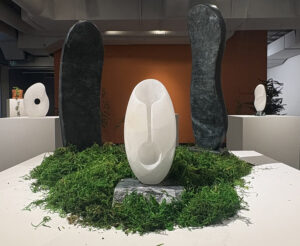
Soapstone carvings by Arsene Arcand.
For Arcand, art reflects who he is, where he comes from, and the teachings that have guided him throughout his life.
“I think just being raised traditionally around the ceremonies and just having that experience of being around lots of elders shaped me a lot,” Arcand said. “It’s shaped my practice over the years, but also who I am as a human being and individual.”
Those teachings are not separate from his artwork — they are woven into his identity. “Overall, more than that, that’s kind of just who I am as a person,” he said.
Through his work, Arcand continues to carry forward the values, stories, and relationships that have guided him, creating pieces that reflect a connection between the past, present, and future.
A Relationship With Stone
Stone has been at the centre of some of the oldest artistic traditions in the world, and for Arcand, working with the material is about more than carving – it is about relationship.
He says stone carries a connection that feels different from other artistic mediums. “There’s a certain level of relationship there that I don’t really feel with other mediums like paint or even sketching or anything like that,” Arcand said.
He describes stone as a raw and natural material that connects the artist back to the land. “I think it’s kind of like a wild material, like raw and rough,” he said.
For Arcand, transforming something from the land into a finished piece of art is part of what makes the process meaningful.
“That’s part of the attraction to it,” he said. “It’s like just getting something from the land and then having the skills to transform it into a piece of fine art is just fascinating.”
Growing Through the Indigenous Artist-in-Residence Program
As the Edmonton Arts Council’s Indigenous Artist-in-Residence, Arcand has focused not only on developing his artwork but also on contributing to opportunities for future Indigenous artists.
“My whole goal throughout this residency was to practice my artwork and to keep growing as an artist, but also as a human being,” Arcand said.
He hopes the program continues to grow and provide opportunities for future creators. “I’m hoping to do my part to grow this program in a way where it’s more likely to be funded in the future and more likely to have an impact on other future artists,” he said.
Arcand believes the residency has been meaningful and encourages other Indigenous artists to pursue similar opportunities. “I would encourage any Indigenous artist to apply for this program,” he said. “It’s wonderful.”
Protecting Cultural Teachings While Creating New Paths
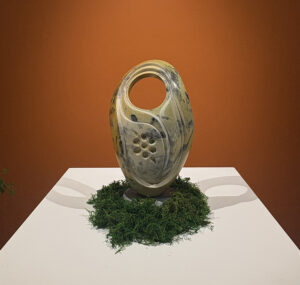
Soapstone carving by Arsene Arcand.
Much of Arcand’s work reflects kinship, ceremony, and Indigenous identity. However, he understands the responsibility of knowing what teachings can be shared and what must remain protected.
Arcand spoke about this during a panel discussion held at the end of his residency, where conversations focused on culture, identity, and artistic expression. “One of the things that we had touched on was what key parts of culture and identity are too sacred to share, especially through an open style of expression like art,” Arcand said.
For him, Indigenous artists can explore new creative directions while still respecting cultural boundaries. “There’s that little area where we can really kind of push the boundaries as artists without altering that lens of what’s sacred and what’s safe to share – what’s a closed practice and what are open practices,” he said.
Arcand says finding that balance can be challenging. “Sometimes, as an Indigenous person who grew up around the ceremonies, there are things around ceremony that I want other Indigenous people to understand and to know, just because of how beautiful it is,” he said.
However, he believes some teachings are meant to be experienced personally. “I know that it’s better that they go through those experiences on their own and experience those things as individuals rather than somebody sharing it to them,” Arcand said.
“It’s kind of like the Creator sharing that with them instead of some artist trying to share whatever piece that I understand about it.”
That understanding continues to guide his approach. “I don’t want to overshare as an Indigenous artist,” he said.
Art That Carries History and Healing
Arcand has also created significant public works connected to experiences of residential school survivors and community history.
He believes artists carry a deep responsibility when creating work connected to collective memory and healing. For him, art is not simply something created for recognition or financial gain — it carries stories forward. “It’s something that’s going to carry parts of history of a nation forward,” he said, “and amplify those things so that other people can connect with that.”
Arcand says being an Indigenous artist comes with responsibilities to community. “Being an artist, an Indigenous artist, is one of those things that you can equate with those responsibilities and obligations to your people — to do your best to carry our whole narrative forward,” he said.
Looking Toward the Future
Arcand hopes his artwork can inspire the next generation of Indigenous creators. “I think selfishly I do hope on some level that my artwork will impact or have an impact on the next generation of artists,” he said.
At the same time, he recognizes his work is part of something much larger. “I’m just a part, a small part of this whole big thing of life,” Arcand said.
His hope is for continued growth and stronger relationships within Indigenous communities and beyond. “I just hope that things just keep going and keep getting better for our people,” he said.
“I think that’s all I can really hope for as an artist.”

Be the first to comment on "Arsene Arcand: Carrying Cree Teachings Through Stone"