
By Chevi Rabbit, Local Journalism Initiative Reporter
(ANNews) – Samson Cree Nation Chief Izaiah Swampy-Omeasoo joined community members on June 13 for the annual Pride crosswalk painting, reaffirming the Nation’s commitment to supporting Two-Spirit and LGBTQ2S+ community members through Cree teachings of respect, kinship, and inclusion.
The crosswalk painting followed a Pride gathering held on June 10 and marked the eighth year of the initiative, which leaders say is rooted in the Cree principle of Wahkohtowin – the interconnected relationship between people, community, land, and spirit.
For Swampy-Omeasoo, attending the crosswalk painting was an opportunity to visibly demonstrate the Nation’s support for all community members. “I think the first thing is it goes back to honouring our cultural values that we’ve always held as Cree people, is respect and Wahkohtowin,” he said. “So, for us as a nation to be able to support our LGBTQ+ community and our relations in that community, it shows support on a physical aspect and on an image aspect.”
Swampy-Omeasoo said visible symbols of inclusion matter because they influence how people feel about themselves and their community. “When you look around and you see communities that have garbage or that have drugs or fighting going on outside daily, people pick up on that,” he said. “It takes the spirit.”
“So for us to be able to paint the crosswalk and for us to be able to show support and show that image, that takes the spirit in our community that we love and we respect and that we honour and uphold our relations in that community.”
The chief noted that the Pride crosswalk has become an important tradition within Samson Cree Nation. “This is beautiful,” he said. “I’m happy that we’re doing this again. This is the eighth year, and it shows that commitment that we have.”
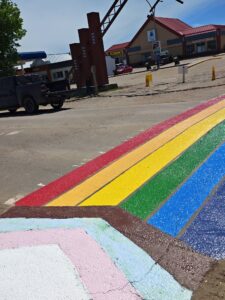
Samson Cree Nation Pride Crosswalk, Facebook.
Swampy-Omeasoo said Samson Cree Nation was the first First Nation in Alberta to establish a Pride crosswalk. He said the milestone reflects the Nation’s history of leadership and its commitment to showing love, compassion, and respect for all relations.
He said that commitment will continue under his leadership. “I’m very grateful and happy that this can continue and it will continue under my tenure as chief,” he said. “We will continue to show support to our community.”
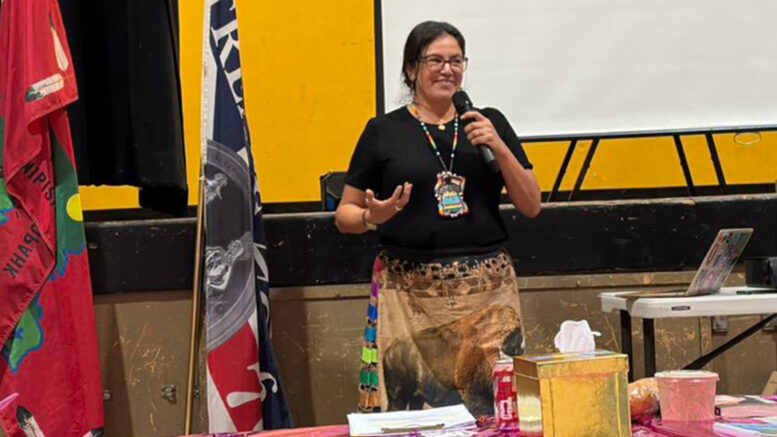
The Pride gathering on June 10 featured keynote speakers Dr. Lana Whiskeyjack, Associate Professor at the University of Alberta, and Jack Saddleback, a public speaker and equity champion, who spoke about Indigenous teachings, gender diversity, and the importance of supporting Two-Spirit and LGBTQ2S+ community members.
Whiskeyjack said gatherings like Samson Cree Nation’s Pride celebration are important reminders that gender diversity has always existed within Indigenous communities. “Oh my God, to remind our own people that we have always been inclusive of gender diversity,” she said. “It’s traditional. It’s more traditional.”
Whiskeyjack grounded her remarks in the Cree concept of Wahkohtowin, describing it as a system of kinship and relational responsibility that connects people to family, community, land, and the cosmos. “When we are talking about Wahkohtowin, you’re talking about the way you are connected, your kinship connection to your community, to the land, to the cosmos,” she said.
She said Cree teachings traditionally focused on spirit rather than physical characteristics. “We are such spirit-centered people,” she said. “Why does it depend how I express my body and how you’re going to treat me instead of looking at spirit first?”
Whiskeyjack challenged the colonial attitudes that have shaped modern understandings of gender. “So, when did we turn into being very physical-centered people?” she asked. “When did it become so foundational to judge someone based on what is between their legs?”
“When did we become so colonized?” she continued. “We can connect that to Indian residential school, Catholicism, colonialism, the binaries.”
She explained that European institutions imposed rigid systems of gender that differed from Indigenous worldviews. “A lot of the nurses and nuns in residential school were Francophone,” she said. “They come from a very binary worldview, that there’s either or, and one is higher than the other.”
Whiskeyjack said Cree language itself contains teachings about inclusion and belonging. “The more we wake up our language, the more we ask these questions about what gender diversity is from our worldview, the more we get to see how inclusive our language actually is,” she said.
She also expressed concern about the impact of anti-trans rhetoric and legislation on Indigenous youth. “We’re in this day and age where we’re not even acknowledging a good percentage of our gender-diverse and sexually-diverse kids,” she said. “So we’re missing out on medicine we need during this great change happening now.”
“This is why, even [when] you think of the anti-trans laws that are impacting our young people, you know, their mental health, the anxiety, more violence,” she said.
Whiskeyjack said Indigenous teachings recognized that every child enters the world with a unique purpose and gifts that benefit the community. “Our great grandparents had this even more heightened intelligence that they can determine a child before they’re even born,” she said.
“In fact, our great grandparents, they used to be able to name those children before they were even born because we are so connected to the cosmos and the land through our ceremonies and language.”
“They knew the gifts that every child brought into community, and every child contributed to the health and wellness of community.”
“That’s what Wahkohtowin is.”
Whiskeyjack also spoke about ceremony and Indigenous medicines as teachings of reciprocity and balance. “All these medicines in our ceremony, tobacco, sage, sweetgrass, we have all of those medicines and all of those medicines are all intersex beings,” she said.
“A lot of people don’t even realize, if you’re going to be homophobic, transphobic in these ceremonies, then why are you using intersex medicines, that are here to help us?”
“There’s that reciprocity of being a good, kind relative that our medicines, our teachings, are not even practicing it in our own communities.”
Saddleback said Indigenous-led Pride events help restore traditional understandings of gender and sexual diversity. “We are able to revitalize our historical acceptance of gender and sexual diversity within Indigenous nations from an Indigenous nations’ perspective,” he said. “Having it by community, for community, is just a pretty jazzy thing.”
Saddleback said Two-Spirit and LGBTQ2S+ people continue to face growing challenges both in Alberta and beyond. “There are a number of barriers that are happening for the community,” he said. “We’re seeing rise in transphobic sentiments, not only here within Alberta, but also in the United States, the UK and other spaces around the world.”
“It seems to be that number one, public perceptions are starting to change and increase violence against gender and sexual diverse community members,” he added.
He said Indigenous nations have a responsibility to publicly support gender-diverse community members and defend their place within their nations. “As Indigenous nations, I think it’s important that we are very vocal, very public about our acceptance of gender and sexual diversity and our historical roles and community members that are gender and sexual diverse,” he said.
“Being able to also stand up in regards to our sovereignty around our nation’s members, the acceptance of our nation members, and ensure that no other outside governments can try and legislate the erasure of our Two-Spirit or gender and sexual diverse community members.”
Together, the Pride gathering and crosswalk painting highlighted a shared message of inclusion rooted in Cree teachings. Through Wahkohtowin, speakers emphasized that every person has a place within the community and that honouring gender diversity is not a new concept, but a continuation of Indigenous values that have existed for generations.

Be the first to comment on "Samson Cree Nation celebrates Pride through culture, kinship and inclusion"