
By Chevi Rabbit, Local Journalism Initiative Reporter
(ANNews) – William Hawrelak Park in Edmonton now holds a striking new Indigenous public art landmark, as Cheyenne Rain LaGrande’s 14-foot installation Misi-mîkisak transforms one of the city’s most iconic river valley landscapes into a space of beadwork, language, and Indigenous visibility.
The monumental sculpture reimagines a beaded earring at an expanded scale – turning a familiar, intimate piece of Indigenous fashion into a large public artwork visible across the park’s lake and pathways.
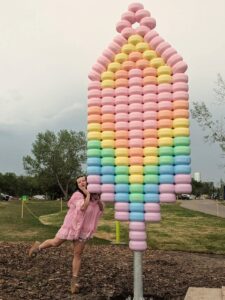
Cheyenne Rain LaGrande’s 14-foot installation “Misi-mîkisak” is on display as public art in Hawreluk Park in Edmonton.
For LaGrande, who is from the Big Stone Cree Nation and uses she/they pronouns, the installation marks a significant milestone as her first major public art commission.
“I am an artist from Big Stone Cree Nation, and my pronouns are she, they.”
She describes her practice as interdisciplinary, moving fluidly between performance, wearable sculpture, photography, video, installation, sound, fashion, and now large-scale public art.
“Yeah, I’m a visual artist. I work very interdisciplinary through a variety of mediums. My main practice is performance art… and I’m also more recently working in public art.”
At the centre of Misi-mîkisak is the idea of scale – taking something small, precise, and deeply personal, and enlarging it into a monumental form that interacts with land and sky.
LaGrande says the concept began with a simple but powerful visual idea.
“What inspired that was kind of wanting to reimagine our beautiful, delicate beadwork. It was a simple idea of wanting to see a seed bead enlarged… and trying to reimagine our traditional beadwork in a more futuristic context.”
The result is a 14-foot sculptural beaded earring that sits in dialogue with its surroundings, including the park’s lake, tree line, and sunset sky.
The title of the work holds linguistic and cultural meaning. In Cree, Misi-mîkisak translates to “large bead.” For LaGrande, naming the work in her language was both an artistic and personal decision.
“To title my work in my language is a way for me to learn it and have access to it. And I think it also encourages the public to get to know some Cree words.”
“So it was really important for me to name the piece in my language.”
While rooted in beadwork traditions such as floral designs on hides, LaGrande says she was intentional about choosing a form that reflects contemporary Indigenous life. “For me, I wanted to choose a type of beadwork that felt more contemporary… beaded fringe earrings feel like something Indigenous people wear in their fashions today.”
By elevating this everyday expression into a large-scale monument, the work bridges historical beadwork practices with present-day Indigenous identity and fashion.
A key part of the installation is its celebration of Indigiqueer and Two-Spirit identity, which LaGrande intentionally weaves into the colour palette and emotional tone of the piece. “It was very important for me to include pride, and I included rainbow and pastel colours.”
She said pastel tones are deeply tied to both her artistic language and personal memory. “Pastel colours are a motif that runs through my practice… they bring me back to my home and auntie’s houses where everything was painted in those soft colours.”
LaGrande emphasized that visibility and affirmation were central goals. “But with everything going on, I really wanted us to be visible. I wanted us to feel strong together… I hope they feel Indigenous love, Indigenous resilience, and Indigenous joy.”
“I want them to feel proud of who they are and not be ashamed… I want them to know they’re loved.”
The location of the work in Hawrelak Park’s river valley landscape also shaped its design, particularly its relationship to light and colour. “The sunset section at the top of the piece is in pastel-like orange, pink, and yellow.”
LaGrande explained that she intentionally designed the sculpture to interact with the environment. “I was really thinking about how the piece could blend into the sky and then blend into the land.”
“The baby blue on the piece is also very close to the colour of the sky… I really wanted it to be part of that reflection of land and sky.”
Beyond visual impact, LaGrande situates Misi-mîkisak within a broader sense of responsibility to land, ancestors, and community. “It makes me think a lot about our bodies in relation to the land and how we’ve been here forever.”
She said she felt gratitude that an Indigenous artist was chosen for the commission, seeing the work as part of ongoing recognition and presence.
“I was really thankful that they chose an Indigenous artist to do this piece because it’s a way of honouring us and honouring our ancestors… everything my ancestors have been through to bring me to this point.”
“This piece is a way to thank all my ancestors and everyone who has brought me to this point, and also a way to thank the land.”
At its core, LaGrande hopes the installation offers something emotional and lasting for viewers moving through the park. “I really want people to feel joy and love, and to reflect on the land and the Indigenous folks who have existed here forever.”
“I want them to feel Indigenous love, Indigenous resilience, and Indigenous joy.”
For her, the message is also personal and communal. “I want them to feel love from the community… and know that it is okay to be Indigenous queer and Two-Spirit, and that that is such a special thing.”
In transforming a bead into a 14-foot monument, Misi-mîkisak reshapes not only the physical landscape of Hawrelak Park, but also how Indigenous presence is seen, felt, and celebrated within it.

nice, but as I was reading i was wishing for more vibrant colors. Then I read the artist has connections with the pastel colors.