
by Jeremy Appel, Local Journalism Initiative Reporter
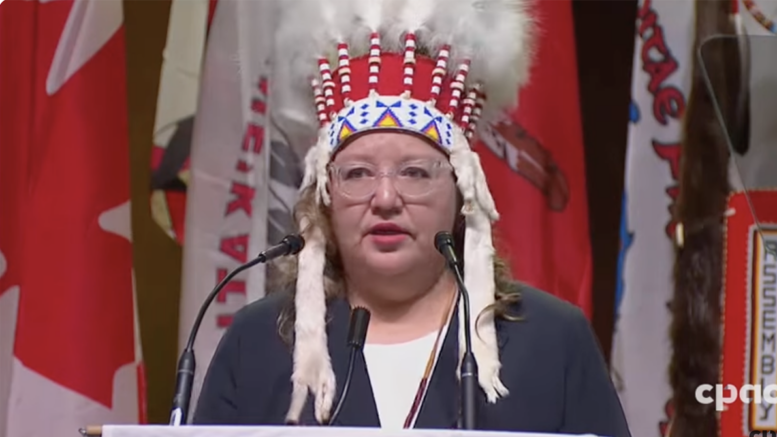
(ANNews) – Assembly of First Nations (AFN) National Chief Cindy Woodhouse Nepinak slammed the federal government’s proposed legislation regarding clean drinking water for First Nations in her opening remarks at the AFN annual general assembly on July 14.
Minister of Indigenous Services Mandy Gull-Masty introduced the First Nations Clean Water Act, or Bill C-37, in the House of Commons last month, which was announced alongside a $4.6-billion investment in water and wastewater infrastructure.
“It’s disappointing that this new bill fails to clearly designate First Nations’ rights to clean water, because no sum of money will distract from the red flags we see in this new clean water bill,” said Nepinak at Ottawa’s Rogers Centre.
According to Indigenous Services Canada, there are 38 long-term drinking water advisories in 36 First Nations communities across Ontario, Manitoba and Saskatchewan.
A previous version of the legislation, which was supported by the AFN but criticized by other First Nations leaders, died on the order paper when former prime minister Justin Trudeau announced his impending resignation and prorogued parliament in January 2025.
In 2015, Trudeau pledged to eliminate long-term drinking water advisories on First Nations reserves before 2021. He’s also pledged to close the infrastructure gap between First Nations communities and the rest of Canada by 2030.
National Chief Nepinak portrayed the new version of the water legislation as a “step back from the progress” made by the previous Liberal government on the issue.
Rather than explicitly affirming First Nations’ inherent right to clean drinking water, the bill speaks of a “progressive realization” and “best efforts” to provide safe drinking water to First Nations communities.
Nepinak described provisions to protect source water as “weak, and subject to a provincial veto.”
After the bill’s second reading, which has yet to be scheduled while the House is on summer break, it will go to the Standing Committee on Indigenous and Northern Affairs for further discussion.
“Committee members need to start traveling to communities that are living through a water crisis every day. They need to see that for themselves. They can’t stay in an Ottawa bubble here,” she said.
Leading a plenary session on Bill C-37 in the afternoon, AFN Regional Chief for Newfoundland Brendan Mitchell noted how accessing clean drinking water is a “tremendous struggle” for many First Nations communities.
“We’re getting ready to go to war for water on behalf of our communities,” said Mitchell.
He noted that unlike the previous version of the First Nations Clean Water Act, the AFN wasn’t involved in drafting the current iteration.
The AFN has passed dozens of resolutions concerning clean drinking water over the past 15 years.
“Too many people in our communities – our children, our families, our elderly people – have been waiting too long for water legislation that would help improve their lives,” said Mitchell.
Winnipeg Centre NDP MP Leah Gazan, who also spoke during the plenary, called the bill an “attempt by the Carney Liberal government to erode Indigenous rights while trying to disguise it as progress.”
In her remarks, Nepinak tied Bill C-37’s inadequate protections for First Nations water rights to impending legislation that will make “sweeping” changes that will “fundamentally alter” how the federal government approves major infrastructure projects.
She said she received a discussion paper from the government in May outlining significant changes to how major projects are approved and was initially given just 30 days to provide feedback. That deadline was extended to July 22.
“Unfortunately, the revised timeline remains inadequate given the breadth of changes proposed,” said Nepinak.
One of the major changes proposed is establishing a one-year timeline for considering the impacts of a major project.
“We have said many times, First Nations are for economic growth that will drive Canada’s prosperity, but not at the expense of our rights or of the Crown’s legal obligations to our people,” Nepinak said.
“A one-year timeline, principally designed to attract investment, subordinates the honor of the Crown to commercial imperatives.”
She contrasted the rushed timeline for impact assessments with the government’s less urgent approach towards fulfilling its commitments to closing the First Nations infrastructure gap and ending boil water advisories.
“Let’s be clear, First Nations are for setting targets and accountability,” said Nepinak. “We just wish Canada would show the same level of urgency when it comes to achieving targets they have already agreed to.”

Be the first to comment on "National chief slams federal clean water bill at AFN assembly"