
By Chevi Rabbit, Local Journalism Initiative Reporter
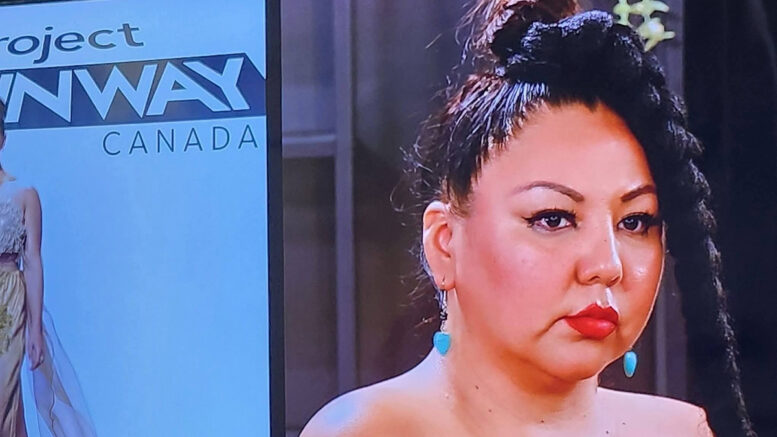
(ANNews) – On a national television stage, Indigenous designer Little Feather (Tashina) Migwans Odjig wasn’t simply showcasing fashion – she was representing Indigenous people.
“To me, it was an honour to represent Indigenous designers and my community on a national stage,” she said. “It was an opportunity to show the world that Indigenous people are strong, powerful, creative, and talented.”
For Little Feather, Project Runway Canada became a platform to challenge stereotypes and celebrate Indigenous excellence.
“I think there’s still a lot of racism and negative energy towards Indigenous people,” she said. “That’s why I feel like it’s my job to show the world that Indigenous people are talented, powerful, and strong.”
“With the garments I create, I want people to see power, confidence, and ambition.”
Rooted in Ceremony
Little Feather grew up on Manitoulin Island in a traditional Anishinaabe family, where ceremony continues to influence every design she creates.
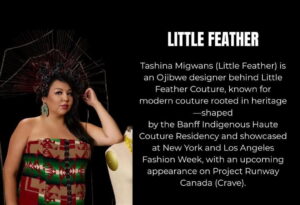
A proud moment – Little Feather was featured on a billboard during New York Fashion Week.
“I grew up in a traditional family, in the sweat lodge and Sundance ceremonies,” she said. “It’s about practicing gratitude and being humble.”
“My garments have a superpower,” she added. “When someone puts on one of my designs, I want them to receive a gift – confidence, power, and honour.”
That philosophy is reflected in her signature blanket jackets. “In our culture, blanketing someone is one of the highest honours you can give,” she said. “That’s why I use blankets in my jackets – they symbolize honour.”
Trusting Her Vision
Like many artists, Little Feather admits self-doubt became one of her biggest challenges during Project Runway Canada.
“My mentor couldn’t see the vision I had in my head,” she said. “What I learned is that no matter what happens, I have to keep believing in myself.”
From Manitoulin to International Runways
After studying fashion at George Brown College in Toronto, her career took an unexpected turn. “I didn’t even go to Toronto Fashion Week,” she said. “I never went to Vancouver Fashion Week either.”
Instead, she jumped directly onto the international stage. “I went straight from the North Shore fashion shows to New York Fashion Week, and then to Hollywood,” she said. “It was a really big leap.”
The momentum continued. “I had just completed New York Fashion Week in January and was invited to Los Angeles Fashion Week in March. By April, I had repacked my bags for my second Indigenous Haute Couture residency in Banff. Then, boom – in July I was suddenly sequestered to film Project Runway Canada.”
Banff Changed Everything
Little Feather credits the Banff Centre for Arts and Creativity with transforming both her career and her confidence.
“I would say my fashion career really started at the Banff Centre through the Indigenous Haute Couture program,” she said. “That’s where my brand and label really leveled up.”
Now the Program Manager, Indigenous Arts, she has built both her studio and her career in Banff. “This isn’t just an educational institution,” she said. “This is sacred territory. Everything I created, I did with gratitude every day.”
“I honestly don’t think any of this would have been possible if I hadn’t come here.”
Building the Future
Her work continues to grow. She recently designed a custom elk-teeth corset for Tantoo Cardinal and is collaborating with Aysanabee for the Wikwemikong Arts and Music Festival.
“I want to represent Indigenous fashion and bring other designers with me,” she said. “So we can showcase Indigenous beauty and art together.”
She is also creating a more affordable clothing line. “My jackets are usually between $1,000 and $1,500 because of the materials. But I want to create something more affordable so more people can access my designs.”
One of her favourite Project Runway Canada creations remains an avant-garde garment inspired by her daughter. “It reminded me of my daughter in so many ways,” she said. “It also pushed me into a niche I wasn’t really familiar with.”
Follow Your Heart
For Indigenous youth, her advice is simple. “Don’t listen to anyone who tells you what career you should pick,” she said. “Pick what you want. Follow your heart.”
Looking back, she never imagined her work would take her from Manitoulin Island to New York Fashion Week, Hollywood and national television.
“I just knew I wanted to make garments that had the ability to make people feel a certain way,” she said. “You never really know what you’re capable of until you try.”

Be the first to comment on "From Ceremony to Couture: Little Feather Migwans Odjig Designs with Purpose"