By Jeremy Appel, Local Journalism Initiative Reporter
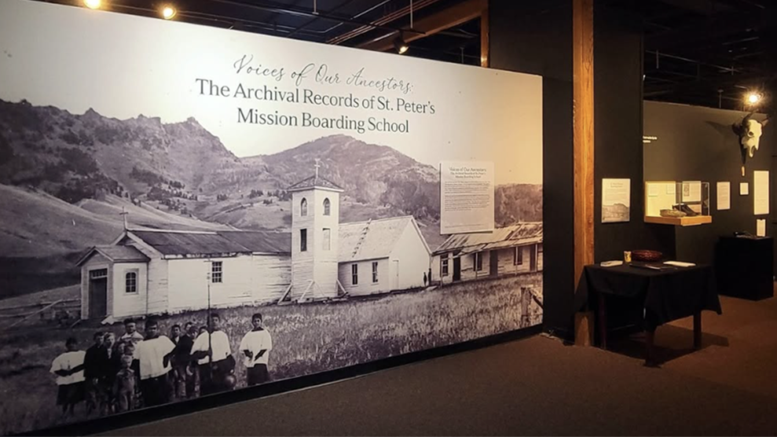
(ANNews) – A new exhibit at the History Museum and Research Center in Great Falls, Montana, has combined newly obtained Catholic Church records with survivor testimony to tell the complete story of the native boarding school where Louis Riel taught before he led the North West Rebellion.
Located just north of Great Falls, St. Peter’s Mission was the only off-reservation Catholic Indian mission boarding school in Montana, which meant that its attendees included various native tribes, as well as Metis children.
Riel taught there from 1883 to 1884, before a group of Metis leaders travelled to Montana to ask Riel to return to Canada to lead a revolt for Metis land rights.
The institution was initially intended as a boarding school for members of the Blackfeet Nation in northwestern Montana, which is a member of the Blackfoot Confederacy alongside the Kainai, Piikani and Siksika bands in Alberta.
The Voices of Our Ancestors exhibit was made possible due to the Ursuline Sisters, a group of nuns that ran the school, providing their Western Province archives to the History Museum.
These documents include enrollment ledgers, which provide the names, ages, tribal registration, arrival and departure dates, and in some cases, death dates, in addition to records that provide a glimpse of daily life at the institution.
Missoula-based historian Jimmy Grant, a member of the Montana Little Shell Chippewa Tribe whose grandmother was sent to a residential school, was contracted by an independent commission established to examine historical documents related to deaths at Catholic-run residential schools in the state.
He told Alberta Native News that his work on this topic is “directly tied to” the discovery of 215 possible unmarked graves at the former Kamloops Indian Residential School in B.C. in 2021, which “really opened up a lot of people’s eyes and drew a lot of attention to the topic.”
Since these schools were run by various Catholic orders, each with their own sets of archives that aren’t necessarily consolidated, this work took him to various states, including Indiana, Ohio, Vermont and Wisconsin.
Realizing that the Catholic orders were unlikely to have documented details of student deaths, the researchers conducted listening sessions with elders, survivors and their descendents, beginning with the adjacent Crow and Northern Cheyenne reservations in southeastern Montana.
Through this process, the research team learned that the Ursuline Sisters, which operated 10 native boarding schools, kept their records at the Ursuline Center in Great Falls. But since there are few Ursuline nuns who are still alive, the order was looking to move its archives elsewhere and had considered sending them to Boston College.
Grant spoke to the people at the Ursuline Center about the importance of keeping their records locally available to “get the word out to let people know what happened here.”
“That’s where the idea of a public exhibition came about,” explained Grant.
Besides the enrollment documents, Grant said the “most valuable records” in the Ursuline archives are the “house diaries,” which “give a day-to-day accounting” of life at St. Peter’s Mission.
The record provides commentary on the students’ achievements, “but also includes harsh things – sickness and death,” he added.
“You see that these kids were starving at certain points. It’s a lot to take in, but it really gives you another perspective, and this is a primary source of what you may have heard from oral histories,” Grant explained.
“You can pick up on things, read between the lines a little bit about what they’re not saying, and try to get a sense of what life was like.”
While using their records as historical documents, the exhibit’s curators made sure to present them in a way that kept Indigenous perspectives at the forefront.
“A lot of the history of these schools has this narrative,” said Grant. “A lot of times, it is the sisters challenging the Montana frontier to spread the word of the gospel. But this is flipping it around a little bit.”
The Ursuline archives did include some letters from survivors, which the exhibit combines with oral testimonies collected by the Montana Historical Society.
The primary purpose of the exhibit, Grant emphasized, is to bring the history to life for survivors, their descendants and future generations.
“Being able to go and spend time in the archives yourself and learn about your families, learn about the experiences, learn about the schools, I think is just much more powerful than simply going and opening a book where it may not be personal to you,” he said.

Be the first to comment on "Following Kamloops Discovery, New Exhibit Documents Deaths at Montana Catholic Boarding School"