By Chevi Rabbit, Local Journalism Initiative Reporter
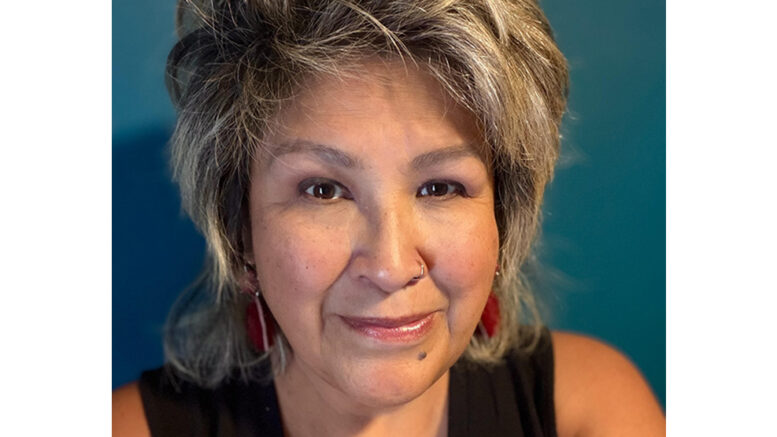
(ANNews) – For Kim Wheeler, power is not about titles, boardrooms or leading massive organizations. It is about creating space for Indigenous people to tell their own stories.
The Anishinaabe and Mohawk journalist, producer and broadcaster lives and works on Treaty 1 Territory in Winnipeg and is the executive producer of Words and Culture, a radio and podcast series about Indigenous languages.
Kim Wheeler is the executive producer of ‘Words and Culture’ – a radio and podcast series about Indigenous languages.
Wheeler was recently named one of WXN’s Canada’s Most Powerful Women: Top 100 for 2026, a recognition that made her stop and consider what the word “power” actually means.
“I feel like I’m just this radio producer who works from home.”
But Wheeler says she came to understand power differently through her work in Indigenous media. “For Indigenous people and as an Indigenous woman, I think, power means that we are rising together, that we are bringing and making space for other Indigenous voices and other Indigenous people to have a platform to speak, to share their stories,” she says. “And so to me, that is power.”
Wheeler says one of the strengths of Words and Culture is that Indigenous people have control over the creative direction, without non-Indigenous decision-makers determining whose stories are told or which guests are featured.
The hosts come from the nations whose languages are featured, allowing them to draw on their own relationships and knowledge of their communities. “I put that power back to the host to say, you tell me who the guests should be on your episodes. Because they come from your nation, they come from your community,” Wheeler says.
Season three features five Indigenous languages. The season launched with Blackfoot, hosted by actor Eugene Brave Rock, and includes hosts who are speakers and learners of the languages they represent.
For Wheeler, language revitalization is deeply personal. As a Sixties Scoop survivor, she says she does not speak her own Indigenous language.
“I learned that it’s really important for us to hold on to our languages,” she says. “But to see others embracing and learning their languages has been really inspiring. Not just to me, but I think to the listeners as well.”
Wheeler is also working on APTN’s Remembering the Children: National Day for Truth and Reconciliation, the annual national broadcast from Parliament Hill. The Sept. 30 program places residential school Survivors at the centre and includes ceremonies and performances by Indigenous artists.
The broadcast will be presented nationally in multiple languages, including English, French, Plains Cree, Anishinaabemowin, Mohawk and Inuktitut.
Wheeler says the growing audience for the program demonstrates the importance of continuing to tell these stories. “When we think that we’re not making a difference, I think we are,” she says.
She has witnessed significant changes throughout her career. When she began working in journalism, Wheeler says mainstream media often did not want positive Indigenous stories.
“The mainstream media did not want to write about positive Indigenous stories,” she says. “And I know this because I’ve pitched positive Indigenous stories over and over and over again, and was told that that’s not what our readers want.”
“My response was, ‘There is an entire Indigenous community out there that is hungry for our stories, but you’re not counting them among your readership.’ When I was working for newspapers, trying to get mainstream media interested in Indigenous stories took a lot of work from a lot of Indigenous journalists. There were a handful of us working in mainstream newspapers, including Connie Walker, Duncan McCue, Tanya Talaga and Betty Ann Adams, who were trying to break through those doors.
“But we also had people before us who were working in those spaces. And Bernelda Wheeler, my mother-in-law, she was the OG. Everybody says she was the one who helped break down the doors and barriers for the rest of us to walk through at CBC Radio.”
That legacy continues through Wheeler’s family. Her husband, writer and producer Jordan Wheeler, has worked on North of 60 and Arctic Air, while Kim’s daughter Katarina Ziervogel appeared in Marvel’s Echo. Her other daughter Maggie Ziervogel works behind the scenes in film and television. While Jordan’s daughter, Kaya Wheeler works with the Indigenous Screen Office.
Wheeler is part of a multigenerational legacy in media and the arts, spanning Bernelda, Jordan, Katarina, Maggie and Kaya. Their work reflects a shared commitment to storytelling, giving back to their community and creating space for Indigenous voices to be heard.
Looking ahead, Wheeler is also writing for k.d. lang: has always been, a major tribute to the Canadian music icon taking place Oct. 2 at Ottawa’s National Arts Centre.
The production will feature artists including Jann Arden, Michael Bublé, Allison Russell, Jill Barber, Mariel Buckley, Wyatt C. Louis, Ron Sexsmith and Jane Siberry, celebrating lang’s four-decade career.
Wheeler has admired k.d.lang since seeing her perform at the Junos as a young artist. “She was just this wild inspiration,” Wheeler says.
Now, decades later, Wheeler is helping tell the story of an artist who once inspired her. “To be able to write for a huge production like that with major international superstars, because Bublé is a superstar, is pretty exciting,” she says.
And for Wheeler, the moment carries a personal significance.
“It’s pretty exciting for, you know, a little Mohawk Ojibwe girl from the rough-and-tumble neighborhood of Weston in Winnipeg.”

Be the first to comment on "Kim Wheeler: Finding Power in Making Space for Indigenous Voices"