
By Chevi Rabbit, Local Journalism Initiative Reporter
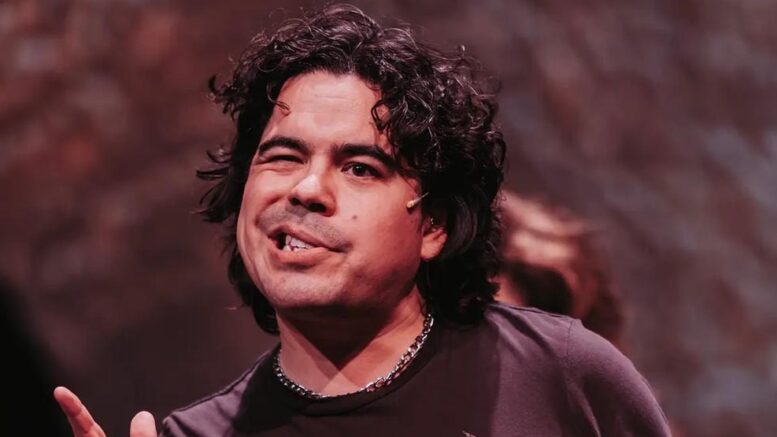
(ANNews) – For Josh Languedoc, theatre is more than a place where stories are performed. It is a space where Indigenous people can see themselves represented, reclaim ownership of their stories and explore what it means to build something different together.
Anishinaabe playwright, producer, actor, director and educator Josh Languedoc has built his work around Indigenous storytelling, representation and the possibilities of theatre. His work includes CIVIL BLOOD: A Treaty Story, Rocko and Nakota: Tales from the Land and Elon Muskrat.
For Languedoc, the responsibility of Indigenous storytelling begins with representation. After discovering his love of performing at six years old, he found himself learning theatre through a predominantly settler framework. “Once I discovered when I was six that I loved being on stage, I kind of had to learn the settler way of doing theater and adapt myself to tell settler inspired stories,” Languedoc said.
That experience was also shaped by what he did not see. “And I never saw bodies like mine, or people like me, or my culture on stage.”
 For Languedoc, Indigenous theatre can change that absence by placing Indigenous people, bodies, cultures and ways of knowing at the centre of the stage. “So just representing the culture and our bodies on stage, I think, is super important.”
But representation is only the beginning. Languedoc sees Indigenous storytelling as carrying dimensions beyond conventional theatre. Indigenous stories can contain medicine, sacredness and ritual, while not necessarily following the linear structures audiences may expect from Western storytelling.
“The stories are not necessarily linear in nature,” he said. “They’re kind of all-encompassing in nature and try to hit on all of their fronts rather than just telling a good story.”
His understanding of storytelling is also deeply connected to place. Languedoc describes his ancestry as Anishinaabe while recognizing the influence Treaty 6 territory has had on his spiritual and cultural understanding. Living in Edmonton, he has learned from Nehiyawak elders, guides and storytellers and developed connections to teachings about the animals and medicines of the territory.
“My ancestry is Anishinaabe, but I’m, like, spiritually Nehiyawak or Cree, because, growing up on these lands, I learned my teachings from a lot of Nehiyawak elders and guides and storytellers.”
That relationship with Treaty 6 has created both connection and distance. While he feels deeply connected to the territory where he lives, he also recognizes the distance between himself and the teachings of his own community. That complexity is reflected in his approach to Canadian history and Indigenous sovereignty.
Languedoc believes theatre can help Indigenous people regain control over stories that have historically been told through a colonial lens. He points to early examples of Indigenous theatre that were created by non-Indigenous writers or through the extraction of Indigenous knowledge and stories.
For him, Indigenous ownership of storytelling is inseparable from sovereignty. “I think us having ownership over the stories we want to tell and how we want to tell those stories helps create our own sovereignty within the world of theatre.”
Theatre, he believes, can also give Indigenous artists an opportunity to discover their individual voices and bring their teachings and knowledge to their communities and the broader treaty community. But Languedoc does not believe challenging an audience necessarily means alienating one.
He sees value in making audiences uncomfortable enough to question their assumptions while still providing enough safety for them to remain engaged. “I do like to challenge an audience, but I don’t want to scare them away completely.”
That approach is reflected in his work, including Rocko and Nakota: Tales from the Land, which has travelled across Turtle Island. The production has given Indigenous audience members the opportunity to see stories about their animals and cultures represented on stage. Languedoc has also seen younger audiences connect strongly with Nakota, an 11-year-old character dealing with anxiety.
Through performances and conversations afterward, audiences have shared stories of their own. Some have connected moments in the production to family members, personal experiences with anxiety or people they have lost. Others have described feeling connected to ancestors they never knew.
For Languedoc, those responses demonstrate the ability of theatre to open conversations about ancestry, family and deeper connections between people.
His play CIVIL BLOOD: A Treaty Story takes those questions into the history surrounding the signing of Treaty 6. The fictional story is inspired by real events and explores how colonization can alter relationships, family connections and individual identities.
The play asks audiences to consider not only what happened, but who carries responsibility for addressing the consequences.
Throughout the story, relationships and families begin to fall apart as the forces of colonization reshape the characters. A character who exists between Indigenous and settler worlds becomes a bridge between the two perspectives and raises questions about who the treaty people really are and who is responsible for repairing the relationship. The production was also envisioned as something that could continue beyond the stage through community discussion and reflection.
Looking toward the future, Languedoc believes Indigenous theatre needs more Indigenous artists. While rereading the work of Indigenous playwright and theatre artist Yvette Nolan, he recalled a phrase that resonated with him: “We need more of us.”
For Languedoc, that need includes more playwrights, actors and artists who can continue expanding what Indigenous theatre looks like and how Indigenous stories are told. But he believes the future begins with youth. He wants Indigenous young people to discover theatre, learn how to write plays, express their voices and recognize that their stories belong on stage if they choose to put them there.
And if a young Indigenous person told him their story did not matter, his answer would be immediate. “It absolutely matters.” He carries forward advice given to him by a mentor: “There’s no one else in this world like you, and you’re gonna see this world completely different than anybody else. Therefore your voice matters, and you can express how you see this world however you want to express it.”
Languedoc takes that lesson one step further, describing young Indigenous people as the next generation responsible for continuing the work already begun. For audiences walking into an Indigenous theatre production, his message is equally direct. “I think just go in with an open heart and go in with the idea that we have to build this together.”
For Languedoc, Indigenous artists are creating sovereignty and learning opportunities through their work, but building a different future requires collaboration. That means settlers being willing to learn, understand the harms and the good, listen to Indigenous voices and allow Indigenous artists to determine how their stories are told.
That commitment to collaboration is also evident in Languedoc’s recent work. In April, Languedoc performed in Tomson Highway’s ROSE, playing Fritz the Katz in the National Arts Centre’s Indigenous Theatre production. He described the experience as one of the most profound of his life and expressed particular pride in being part of a project that had taken decades to reach the stage. “I think one of the most profound experiences I’ll have in my life.”
His work continues to move forward. He is touring his solo show Elon Muskrat to Fort McMurray and has another play scheduled for Saskatoon. His current body of work reflects the same commitment that runs through his theatre practice: Indigenous stories deserve space, Indigenous artists deserve ownership, and audiences have a role in listening.
Ultimately, Languedoc sees Indigenous theatre as more than an opportunity to revisit the past. It is a place to question the stories Canadians have inherited, to understand the responsibilities created by that history and to give Indigenous artists the authority to determine what comes next.
It is also a place where young people can discover that their voices matter. And for Languedoc, the future of Indigenous theatre may be found in exactly that combination: more voices, more stories, more artists and an audience willing to enter the theatre with an open heart.
The goal is not simply to tell a different story. It is to build a new world together.

Be the first to comment on "Building a New World Together: Josh Languedoc on Indigenous Theatre, Storytelling and Sovereignty"