
By Chevi Rabbit, Local Journalism Initiative Reporter
(ANNews) – For 150 years, the relationship between the Royal Canadian Mounted Police and Indigenous peoples has been intertwined with the history of Canada itself. That history is complicated.
The institution now known as the RCMP began in 1873 as the North-West Mounted Police, created by the federal government as it extended Canadian authority into the West. The force marched westward in 1874, establishing posts and detachments across territory that was already home to First Nations and Métis peoples.
For Treaty 6 First Nations, that history cannot be separated from the Crown’s broader relationship with Indigenous peoples. Treaty 6 was entered into in 1876 at Fort Carlton on August 23, at Chief Beardy’s campsite on August 28 and at Fort Pitt on September 9. The Office of the Treaty Commissioner describes Treaty 6 as a living covenant between peoples, grounded in promises of mutual benefit and shared prosperity.
The 150th anniversary in 2026 therefore represents more than a historical milestone. It is an opportunity to examine what the treaty relationship means today – including for institutions that historically acted as agents of the Crown.
For the Saskatchewan RCMP, that reflection is now being expressed through participation in Treaty 6 commemorations and through an effort to change how officers understand and work with Indigenous communities.
S/Sgt. Cliff Joanis of Saskatchewan RCMP Indigenous Policing Services said Saskatchewan RCMP members were involved in several aspects of the Treaty 6 commemorations. “At Fort Carlton, we participated in the carrying of the treaty bundle and subsequent pipe ceremony to open the commemoration,” Joanis said.
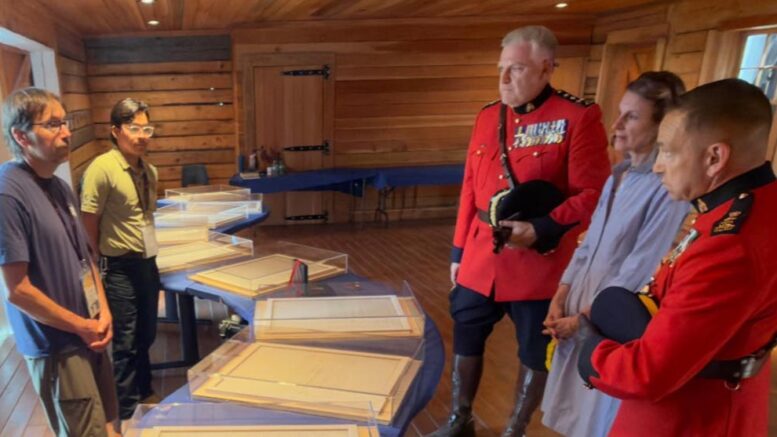
The Saskatchewan RCMP also provided security during the viewing of the original Treaty 6 parchment and assisted Indigenous Services Canada and Beardy’s & Okemasis Cree Nation during treaty days and annuity payments. Saskatchewan RCMP Commanding Officer A/Comm. Robin McNeil and Central District Commander Superintendent Brent Olberg also participated in the closing ceremonies.
For the RCMP, participation in those ceremonies is part of a relationship it now describes in terms of respect, responsibility and coexistence. “The relationship signifies an on-going commitment from the RCMP to work with our Indigenous communities founded on respect, responsibility, and co-existence,” Joanis said. “It is an invitation to work alongside First Nation communities we police to strive for healthy and safe communities.”
But such a relationship cannot be understood without acknowledging where the institution came from.
The NWMP was created during a period of rapid Canadian expansion, and the police became an important instrument through which federal authority was established across the West. The organization eventually became the Royal North-West Mounted Police in 1904 and merged with the Dominion Police in 1920 to create the modern RCMP. Over the decades, its responsibilities expanded from a western mounted force into a national police service providing federal, provincial, territorial and municipal policing.
Its history with Indigenous peoples, however, includes some of Canada’s most painful chapters.
RCMP officers were involved in enforcing government policies connected to residential schools. Between 1933 and 1996, RCMP officers were appointed as truant officers under the Indian Act and were responsible for enforcing school attendance and returning children to residential schools. The RCMP itself acknowledges this history.
The Force also acknowledges its role in the enforcement of the pass system, which restricted the movement of First Nations people despite having no basis in Canadian law. The system was used extensively across the Prairies, including Treaty 6 territory.
Those realities matter when discussing reconciliation.
The RCMP has publicly acknowledged its historical role. Commissioner Giuliano Zaccardelli apologized in 2004 for the Force’s role in the residential school system, followed by Commissioner Bob Paulson’s apology in 2014. Commissioner Brenda Lucki apologized in 2018 to families of missing and murdered Indigenous women and girls.
The institution now says that acknowledging those mistakes is necessary to building something different. “The relationship has evolved in the sense that there has been a better understanding of the meaning behind Treaty 6 and Indigenous communities,” Joanis said, emphasizing that each community has its own history and culture.
That understanding has led Saskatchewan RCMP to establish Indigenous Policing Services, whose stated purpose is to help employees provide professional, proactive and culturally appropriate policing services to Indigenous people and communities. At the community level, Joanis said, officers are encouraged to consult directly with leadership to understand local policing needs rather than assuming that the same approach will work everywhere.
The Saskatchewan RCMP has also established an Indigenous Recruiting Unit intended to increase Indigenous representation within the Force. But perhaps one of the most significant changes is what happens when a new officer arrives at a First Nation.
Joanis said communities are asked to identify an Elder or Knowledge Keeper who can provide a new officer with a brief community familiarization. That process, he explained, allows the community to welcome the officer while teaching them about its history, culture, uniqueness and challenges. It also changes who gets to define the community.
Rather than having a senior officer simply drive a new member around and introduce them to people they know, Joanis said the approach gives the community an opportunity to educate the officer directly. The distinction is important.
A police officer arriving with preconceived ideas about a community can unintentionally reinforce existing stereotypes. An officer arriving with an understanding shaped by community members has an opportunity to begin a relationship differently. “Nothing about us, without us,” Joanis said.
That principle also reflects one of the RCMP’s stated challenges in rebuilding trust. “Recognizing and acknowledging the strained history the RCMP has had with our Indigenous communities is a start,” Joanis said. “Building trust begins with honesty, transparency, and accountability.”
He compared the work of maintaining trust to polishing the original Treaty 6 medallions. “Much like the original Treaty 6 medallions made of silver, the relationship must be polished continually to keep its shine,” he said. It is an appropriate metaphor for a relationship that cannot be repaired by a single ceremony, apology or program.
The RCMP says its reconciliation work is now intended to be a shared journey rather than simply a collection of initiatives. Its stated aspirations include increasing Indigenous recruitment, improving internal education about Indigenous cultures, languages, ceremonies and histories, and providing culturally responsive policing services.
The organization has also worked with the Office of the Treaty Commissioner on a Treaty Learning Journey for RCMP officers and public servants. The course addresses treaty history, culture, spirit and intent, the Indian Act, residential schools, truth and reconciliation and contemporary Indigenous issues.
For Joanis, education is one of the essential starting points. “The first step is to start understanding the truths of First Nations, Inuit and Métis peoples,” he said. “Another crucial step is recognizing and learning about our own history with Indigenous communities.”
That distinction is important. Reconciliation is not simply learning about Indigenous people. It also requires institutions to understand themselves – their history, their authority and the ways their actions contributed to colonial systems.
The RCMP now says it is committed to acting on the Truth and Reconciliation Commission’s Calls to Action and the National Inquiry into Missing and Murdered Indigenous Women and Girls’ Calls for Justice. Its stated goals include renewing trust, strengthening communication, improving community safety and well-being, enhancing investigative standards, developing culturally literate and trauma-informed employees and supporting Indigenous employees.
But the RCMP also acknowledges that relationships will inevitably include disagreement. “As with any relationship, communication is the key – honest, open communication,” Joanis said.
The goal is not to eliminate conflict but to address it professionally through collaboration and mutual respect, he said. That may ultimately be the most meaningful measure of the RCMP’s evolution.
The organization that once arrived on the Prairies as an instrument of expanding Canadian authority now operates in communities whose treaty relationships with the Crown predate the modern police service itself. The question is therefore not whether the past can be changed. It cannot.
The question is whether an institution can understand that past honestly enough to change how it conducts itself in the present. The Treaty 6 150th anniversary provides an opportunity to ask that question publicly.
At Fort Carlton, the RCMP’s participation in the carrying of the treaty bundle, the pipe ceremony, treaty commemorations and closing ceremonies represents one visible expression of a changing relationship. But ceremonies are only the beginning.
The deeper test will happen afterward – in detachments, in conversations with Elders and leadership, in investigations, in responses to families, in recruitment, in community safety and in the everyday interactions between officers and the people they serve.
Treaty 6 was not simply an event that happened 150 years ago. It is a living relationship. And if the RCMP is serious about being part of that relationship today, its own history means it carries a particular responsibility: to remember what came before, listen to the people who have lived with its consequences, and continually earn the trust it asks communities to place in it.
As Joanis put it, reconciliation is a shared journey. The work, like the treaty relationship itself, continues.

Be the first to comment on "From Colonial Force to Treaty Partner? The RCMP and a changing relationship with Treaty 6"