
by Chevi Rabbit, Local Journalism Initiative Reporter
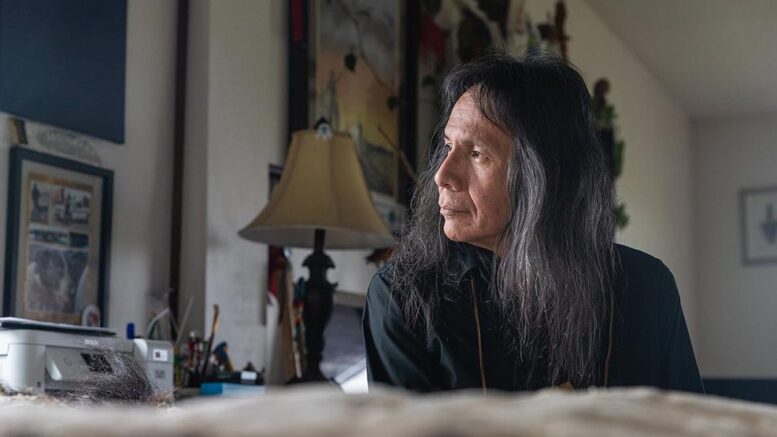
(ANNews) – For more than four decades, William Singer III has used art, education, land based learning and cultural teachings to help preserve and strengthen Blackfoot knowledge.
Now, that lifelong commitment is being recognized with one of Alberta’s significant cultural honours.
Singer, also known by his Blackfoot name Api’soomaahka (Running Coyote), has been named the 2026 recipient of the Alberta Museums Association’s Lieutenant Governor’s Award. The award recognizes his “profound commitment to artistic excellence and the preservation and vitality of Blackfoot culture.”
The award will be presented Sept. 23 at the Alberta Museums Association’s 55th Anniversary Gala and Leadership Awards Ceremony at the Wyndham Edmonton Hotel and Conference Centre.
For Singer, the recognition came as a surprise.“It was a surprise, it took a lot of work, I didn’t realize I’d be recognized,” he said. But the award also reflects what has become one of the central purposes of his life: ensuring knowledge is passed forward.
“My goal is to teach not only my people but the broader community about Blackfoot history and culture,” Singer said. “Indigenous knowledge and culture is part of the fabric of Alberta and Canada. It is important to pass knowledge on and for others to understand Blackfoot culture and history.”
Singer is a member of the Kainai Nation of the Blackfoot Confederacy and is a fluent speaker of his language. The Alberta Museums Association describes him as an accomplished artist and illustrator with more than 40 years of experience. His work has been deeply influenced by the Blackfoot worldview and by his experience as a residential school survivor.
“I’m a member of the Kainai First Nation of the Blackfoot Confederacy. I’m a fluent speaker in our language. I’m also a residential school survivor,” Singer said.
“With that, it just made it much more stronger to work at preserving our culture, regardless of the fact that we had to all endure a residential school and how a lot of that erased our culture and, you know, sort of to the point where it was going on the verge of extinction.”
For Singer, cultural preservation is not limited to artwork hanging on a wall. It begins with the land.
Learning from the land
Singer credits the late Blackfoot artist and educator Everett Soop as an important mentor in his development.
“I was a chauffeur for about three years,” Singer recalled. During that time, Soop introduced him to a way of understanding the land that would influence his work for decades.
“One day we were driving, and he told me, ‘Do you know what our original diet was?’ And he continued on and told me that our original diet consisted of roots, berries, barks, and shrubs.”
The conversation changed the way Singer looked at the landscape around him. “That’s what really got me interested in learning about the land and how it really sustains us,” he said.
He began looking more deeply at the relationship between plants, health, food sovereignty and cultural knowledge.
“My father and my family, all have various degrees of plant knowledge. But in my situation, I was an assistant to my father. He was a pipe carrier. And so when we smoked a pipe, after we were done, then he would start talking to me and sharing some teachings, and it just started to build from that.”
The knowledge, he said, is inseparable from the land. “Plants are really important to our health and our well-being. And the more that we forget and neglect this knowledge, the more we fall away from our culture and our history. Because plants and the land are basically the root of all of our culture.”
Singer is now taking that knowledge into classrooms, workshops and land-based education. “If you do not know the plants and their history, you cannot do anything else in terms of actually living a life, or even being a part of society and ceremony,” he said.
Nappy’s Garden and the disappearance of sweetgrass
One of Singer’s major efforts has been Nappy’s Garden, which grew out of his concern over the disappearance of important plants, particularly sweetgrass.
“It’s something that we have to actually really concentrate on the land,” he said. “With development and cultivation, we’re losing all of these areas where these plants grow, especially our wetlands. Also, we’re experiencing drought, like on a yearly basis, and as the years go by, the areas that these plants grow, especially sweetgrass, they disappear, and these plants disappear.”
Singer began growing sweetgrass and other culturally important plants, eventually establishing what is now known as Nappy’s Garden and a seed bank. “It was created to grow and restore the plants that are very important to us, especially sweetgrass, because it’s widely used in our ceremonies and as medicine.”
But the work quickly expanded beyond a single plant. Singer said that when sweetgrass disappears from an area, other plants that grow alongside it can disappear as well. “The work that is being done has increased now beyond sweetgrass,” he said, pointing to plants including wild bergamot, wild peppermint, yarrow and wild turnip. “These are important plants that are a big part of our history and our culture. And most of them actually are connections to the cosmos.”
For Singer, plants are not simply biological resources. They are part of a much larger cultural and spiritual relationship. “When we use our plants in terms of ceremony or medicine, especially sweetgrass,” he explained, “the smoke goes up into the air, and it goes up into the sky beings, or what we call the spirit beings or star beings.”
He connects those teachings to the stories and knowledge carried through generations.
Stories written into the landscape
One example is wild turnip, also known as Indian breadroot. Singer connects the plant to the Blackfoot story of the Morning Star and Feather Woman. “In the story of the morning star, Feather Woman was up in the heavens with the star people, and up in the heavens, what they were living off and what they would harvest was wild turnips,” he said.
According to the story as Singer teaches it, Feather Woman was forbidden from harvesting a particularly large turnip. Eventually, loneliness for her people overcame her, and she dug it up. “When she dug up the turnip and she looked in the hole, she could see way down below her camp and her people,” Singer said.
The story, he explained, connects the land, plants, sky and stars. “The hole that the turnip was, was actually where we call the North Star or Polaris.”
It is this kind of knowledge that Singer believes must be understood as part of an Indigenous knowledge system rather than separated from science, education or history.
From activism to action
Singer’s work has also included advocacy and activism, including his involvement with Idle No More. He said those experiences taught him that protecting Indigenous lands and waters requires action beyond raising awareness.
“For me, it taught me to take action,” he said. “As a collective, you know, a lot can be done, but as an individual, for myself, what I stood up for at that period of time was for the protection of our land and our waters.”
That includes the plants that depend on those lands and waters. “But it takes a lot more than just standing there with a sign. You have to take action, the initiative to do it.”
For Singer, one of the most important forms of action is education. He teaches preschool children, incorporating plant knowledge, seed collection and propagation into their learning. “The best way to move ahead is to teach our younger generations, because that’s how it always has been,” he said.
“Right now they’re learning how to be horticulturists, how to collect, how to clean seeds, how to propagate them, and then in the end, the end result is that they use and they consume those plants.”
Singer sees the children as the future caretakers of that knowledge. “The younger generation pick up on this knowledge and they retain it. And so they’re the future generation who are going to be growing these plants, and at some point they’ll be consuming these plants.”
Reclaiming food knowledge
That work also connects to Singer’s teachings around food sovereignty and health. He challenges the idea that foods commonly associated with contemporary Indigenous gatherings necessarily represent traditional Indigenous diets.
“It’s an important part to begin to become healthy,” he said. “The plants that grew and are still growing on the land have sustained our people for thousands and thousands of years, and they were healthy people.”
For Singer, returning to the land is part of restoring a relationship with food, health and culture. “The only way that we’re going to get to that point to be healthy is to go back to the land and eat these plants and use them and put them into our bodies to become healthy.”
Weaving knowledge systems together
Singer does not see traditional knowledge and Western knowledge as mutually exclusive. Instead, he believes there is an opportunity to bring the two knowledge systems together. “Traditional knowledge is as important as the Western knowledge, and there is also a way where we can combine or we can weave together this knowledge,” he said.
He describes the land as the classroom. “Our knowledge system is the land, and that’s where it all comes from. And that’s our classroom. Our classroom is outside, as opposed to be inside four walls.”
That approach is also reflected in his work with educational institutions. Lethbridge Polytechnic has highlighted Singer’s contributions to its campus, including the Buffalo Winter Count Robe, unveiled in 2023, and the Iissksiniip (Coming to Know and Learn) Coulee Walk, created in partnership with Singer in 2021. The walk explores traditional plants, their uses and Siksikaitsitapi creation stories.
Singer said Western technology can also be used alongside traditional knowledge to help restore plants that are difficult to propagate. “By combining it, creating these partnerships, we have a future where we can work together and have a better understanding of our knowledge systems.”
That future is ultimately what Singer says he is working toward. He wants people to understand that the plants growing across the prairie are not simply weeds to be removed.
“The plants that are growing here are not weeds. They’re not plants to get rid of,” he said. “They’re plants that have been here, and they’re as old as the people. They’re older than the people that are here.”
He sees the knowledge contained within those plants, the land and the stories as an enormous body of science and understanding. “It’s just basically giving that understanding of our knowledge system, how vast it is, how open it is, because not only does it encompass the land, but it encompasses the cosmos.”
As William Singer III prepares to receive the 2026 Lieutenant Governor’s Award, the honour recognizes more than an accomplished artist. It recognizes a lifetime spent carrying knowledge forward.
For Singer, that responsibility remains ongoing. “It’ll take time, but we are getting there right now,” he said.
And for him, getting there means ensuring the next generation knows where that knowledge comes from: the land, the plants, the stories and the people who have carried them forward.

Be the first to comment on "William Singer III will receive the Lieutenant Governor’s Award for preserving Blackfoot knowledge"