
By Chevi Rabbit, Local Journalism Initiative Reporter
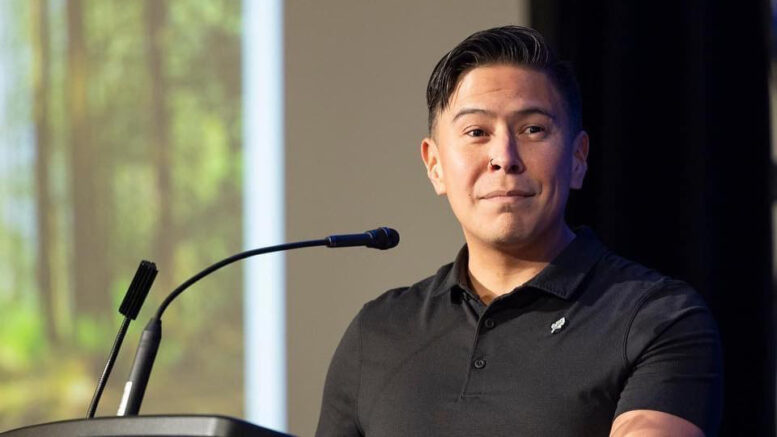
Len Pierre, owner and CEO of Len Pierre Consulting, says his company’s growth reflects a deeper shift in how institutions are beginning – often awkwardly – to approach reconciliation.
What began as informal consulting while working full-time in government has evolved into a national firm grounded in systems change and Indigenous-led education. “Five years ago, I only wanted to be a freelance consultant. And now I have a consulting firm with 37 members strong who work with us at LPC,” said Pierre.
He says the expansion was driven by what he saw as persistent gaps in institutional understanding. “The gaps that I was seeing in how institutions approach reconciliation were primarily that Canadian institutions are overly saturated in the status quo, corporate colonial cultural contexts.”
At the centre of his critique is the tendency to reduce reconciliation to administrative compliance rather than structural transformation. “So many organizations think this is business as usual. And I’m like, this is not business as usual. It’s not a tick box. It’s not an objective.”
He also challenges what he calls the “proximity myth” – the assumption that reconciliation only applies where direct relationships with Indigenous Peoples already exist. “Nowhere in the Truth and Reconciliation Calls to Action does it say you need to know an Indigenous person to engage in reconciliation.”
For Pierre, these misunderstandings reflect a deeper issue: reconciliation is still being treated as optional rather than foundational to institutional change. One of the most persistent patterns he sees is performative engagement.
“The biggest performative aspect of this work is the tick-boxy approach… it’s how tokenizing this work can be, and we see this everywhere.”
Still, he frames these missteps as part of a broader learning process rather than bad intent. “It is a natural, progressive pitfall that organizations will find themselves in,” he says.
Pierre argues that many institutions are engaging in reconciliation for the first time and must be allowed to move through stages of learning. “These very large colonial institutions have never been asked to do this work before.”
The turning point, he says, comes when organizations begin examining power directly. “Who’s making the decisions? Who’s writing your policies? Who is guiding the principles and values?”
For Pierre, reconciliation only becomes meaningful when it moves beyond symbolism into structural change. “It needs to be Indigenous-informed, Indigenous-led, and Indigenous-inspired.”
He also reframes resistance to reconciliation not as individual hostility, but as the product of conditioning. “We really name it, that these are societal beliefs that are anti-Indigenous in nature.”
Pierre describes this process as colonial socialization – the long-term shaping of beliefs through education, media, and institutions. “I don’t think the vast majority of us wake up and choose to pick a fight somewhere.”
That conditioning, he says, produces resistance and denial. “That’s where we get the resistance from. That’s where we get the denialism from.”
Rather than centring blame, he emphasizes understanding how those systems operate. “We don’t come in with blaming and pointing fingers. We look at how people have been conditioned.”
He says education must be paired with practical tools “so people can bring reconciliation into their own professional context.”
When asked about impact on Indigenous communities, Pierre points first to validation which he describes as a foundational shift within systems that have historically excluded Indigenous voices. “That’s half the work,” he says.
From there, he points to broader impacts including belonging, empowerment, and safety. “We see elders, matriarchs, Two-Spirit people, youth… who used to be afraid walking into a colonial institution now feeling empowered.”
He says representation remains central to undoing historical invisibility. “For 150 years, Canada tried to erase us and make us invisible.”
Pierre frames reconciliation not as a policy objective, but as an ongoing relationship. “The key word in reconciliation is relationship,” he says. “There’s no such thing as the perfect relationship.”
That relationship, he says, will always include tension. “That’s a natural thing in our relationship.”
Instead of linear progress, he describes reconciliation as cyclical and intergenerational. “Our oldest chiefs and matriarchs have stories about going back and forth.”
He contrasts short-term planning with Indigenous long-term thinking. “We don’t think in five-year strategic plans – we think in seven generations.”
For Pierre, sustainability is not urgency but endurance. “If we hold on to the hope that our ancestors had, we can find our own endurance.”
He notes that engagement is widening across Canada, particularly among settler allies. “With every passing day, every passing week, every passing month, we are finding more non-Indigenous settler allies who are joining our cause.”
He ultimately frames reconciliation as inevitable but unfinished. He is clear that the work remains in its early stages. “We’re only six years into this, and we have another 94 years to go.”
Pierre closes with a call for sustained learning and accountability. “Commit to lifelong learning and lifelong unlearning,” he says,
There is a final question that he says anchors his approach: When you’re making those decisions, are you making a decision that has the back of Indigenous peoples today?”

Be the first to comment on "Len Pierre on Building LPC, Colonial Socialization, and the Long Arc of Reconciliation"