
By Troy Dumont, Local Journalism Initiative Reporter
(ANNews) – As National Indigenous History Month comes to a close and the Confederacy of Treaty 6 Nations is set to commemorate 150 years since the signing of Treaty 6, it is worth looking back at the treaty history that shaped Alberta.
In 1905, Alberta became a newly minted province of Canada. Still, much of the region already had a long history, including the signing of the Numbered Treaties. Central Alberta, formerly part of the North-West Territories, and before that, Rupert’s Land, fell under Treaty 6. This agreement was negotiated and signed in 1876 at Fort Carlton, Duck Lake, and Fort Pitt, between the Crown and bands of the Cree and Nakota Sioux First Nations. Its boundaries stretched across a large part of what is now Alberta and Saskatchewan, including the Edmonton region.
In the years before Treaty 6, First Nations across the plains faced a rapidly changing world. The buffalo, which had supported food systems, trade, clothing, shelter, and ceremony for generations, were disappearing, driven to near extinction by overhunting, much of it tied to the expanding commercial hide trade, as well as environmental disruption from settlement and the railways pushing west. Disease had moved through communities, and hunger was becoming a serious concern.
At the same time, Canada had taken control of Rupert’s Land and the North-Western Territory from the Hudson’s Bay Company in 1870. It was looking west for settlement, agriculture, railway development, and political control. Canada’s push for control took on new urgency after the Cypress Hills Massacre on June 1, 1873, when a group of American wolfers and whisky traders killed at least 20 Nakoda (Assiniboine) people in present-day southwestern Saskatchewan over a dispute about stolen horses. The massacre exposed how little authority Canada actually held over the region and helped spur the creation of the North-West Mounted Police the following year, as Ottawa moved to assert law and order, along with its own presence, across the plains.
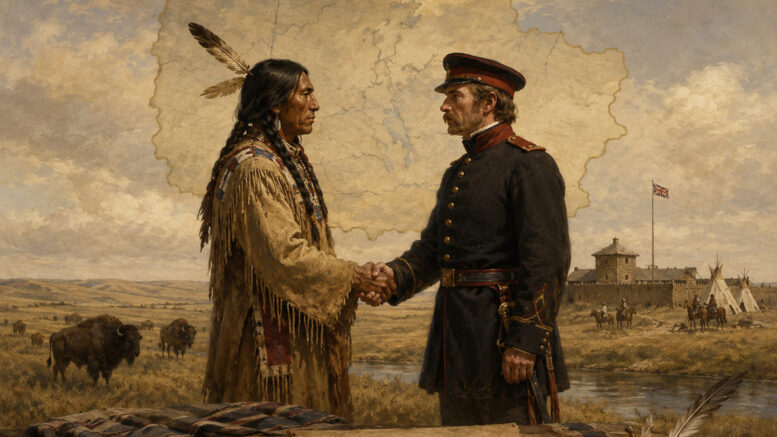
Treaty 6 was unique in several respects, largely due to the bargaining between Lieutenant-Governor Alexander Morris and Chiefs Mistawasis and Ahtahkakoop, who led the First Nations negotiators at Fort Carlton. Unlike other numbered treaties, it included significantly greater agricultural assistance, including animals and supplies, likely the result of skilled negotiating help from First Nations, notably Peter Erasmus, the English-Métis farmer they hired as a translator. The treaty also contained a clause, unique among the numbered treaties, requiring that a “medicine chest” be kept for each band. That provision is still debated today, though many now see it as an early forerunner of modern healthcare. Perhaps the most significant addition was an entirely new clause drafted at Fort Carlton: a promise of relief if bands were “overtaken by any pestilence, or by a general famine.” That famine clause was pushed for by Red Pheasant, who was then a headman under Poundmaker and later became chief.
There was also a deep divide over land. The written treaty used legal language stating that First Nations would “cede, release, surrender and yield up” their rights to the land. However, Bob Beal, writing in the University of Saskatchewan’s Indigenous Saskatchewan Encyclopedia, raises a serious concern about whether those words were understood in the same way by the First Nations who entered the treaty. He notes that Morris’s own record to Ottawa gives no indication that the surrender of land was clearly discussed or explained during the negotiations.
That difference has carried through Treaty 6 history. Many First Nations have understood treaties as agreements to share the land and maintain a relationship with the Crown. The Crown, through the written treaty text, treated the agreement as a surrender of land rights. Those different understandings have shaped generations of conflict, advocacy and treaty education.
After 1876, Treaty 6 continued to grow through adhesions by other bands. Some had chosen reserves right away and began receiving treaty supplies. Others refused, holding out in hopes of better terms, but they were holding out against a vanishing world. In 1879, the last of the great buffalo herds disappeared, leaving the remaining bands little choice. Parks Canada notes that Lucky Man and Little Pine signed that year. Big Bear held out the longest, resisting until 1882, and even then only after securing further promises of supplies from the Crown.
None of this was supposed to force First Nations onto reserves. Morris himself had said at Fort Carlton and Fort Pitt that the treaty’s provisions, including the right to hunt and fish, were meant to sit alongside First Nations’ existing way of life, not replace it. But after 1879, the government used hunger as leverage: only those settled on reserves and working for rations would be fed. Beal writes that Ottawa understood this policy would cause death and illness and pursued it anyway. Many First Nations saw the loss of the buffalo as exactly the kind of general famine the treaty’s famine clause was meant to cover, a reading shared by many observers at the time. Yet the government continued to treat rations as a favour rather than an obligation. Agricultural supplies fared little better, arriving late, inadequate, or of poor quality.
It was this failure, the treaty’s promises left unmet, sometimes deliberately, that helped drive some First Nations people to take part in the North-West Resistance of 1885.
In Alberta today, Treaty 6 lives through Nations including Alexander First Nation, Alexis Nakota Sioux Nation, Beaver Lake Cree Nation, Cold Lake First Nations, Enoch Cree Nation, Ermineskin Cree Nation, Frog Lake First Nation, Heart Lake First Nation, Kehewin Cree Nation, Louis Bull Tribe, Montana First Nation, O’Chiese First Nation, Paul First Nation, Samson Cree Nation, Sunchild First Nation, Whitefish Lake First Nation #128 and Saddle Lake Cree Nation.
Michel and Papaschase also belong in the history of Treaty 6. Both nations were disenfranchised, their reserve lands were lost, and their people were scattered through decisions made by the government. The numbered treaties have carried through generations, through promises made, promises broken, and efforts to repair what was damaged. For Alberta, history should not be used to pull people further apart. A better path is to face the record honestly and recognize that everyone living here shares responsibility for the future. Treaty 6 began as an agreement between peoples. That same idea can still guide Alberta today.

Be the first to comment on "Treaty 6, 150 years of History"