
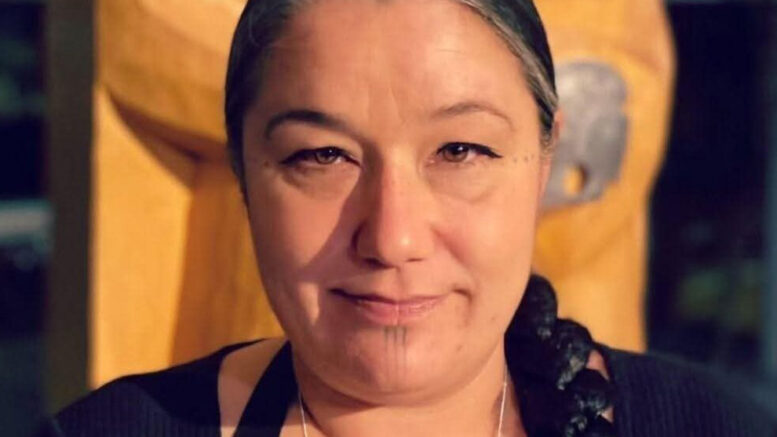
by John Wirth, Local Journalism Initiative Reporter
(ANNews) – The culinary world often measures success in managing tight margins, metrics of expansion. Typically, someone in this line of work knows when they have made it when they receive high-end accolades to hang on the wall. But for Sarah Mierau, the owner of Tradish and the Ancestor Cafe, successful business is measured by a different standard–a First Nations’ ruler.
For Mierau, that ruler is defined by the return of cultural memory and the power of healing through natural ingredients.
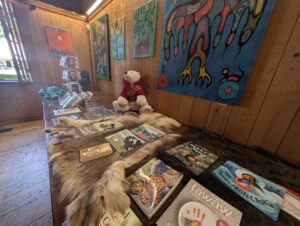
Carefully curated items for sale at The Ancestor Cafe in Fort Langley BC.
“I live for that,” Mierau reflects on her cafe, located on the historic grounds of Fort Langley, British Columbia. “Seeing that spark come into somebody’s eyes when they have something that reminds them of what their mom used to make them, or their aunties, or their kokums (grandmothers). That’s what I live for.”
Mierau’s path to becoming one of Metro Vancouver’s most prominent Indigenous culinary entrepreneurs was not a straight shot to the finish line. Her story is one that is still unfolding as it was shaped by the structural deficiencies of Canadian relations with Indigenous peoples. Her generous and important testimony of personal survival of the unforgiving Downtown East Side of Vancouver is overshadowed by her fierce return to heritage and health.
From the 60s Scoop to the Downtown East Side
Mierau is a member of the Sayisi Dene First Nation from Tadoule Lake in northern Manitoba. But like thousands of Indigenous families, her connection to her homeland was severed before she was born.
“My mom was Sixties Scooped,” Mierau explains, “she was taken as a baby, and she never made it home.”
Born in Red Deer and raised in Windborne, Alberta, Mierau moved to East Vancouver with her mother and sister when she was ten years old, settling in the Central Broadway area which to this day, despite rising property value pushing out longstanding communities, has some of the highest concentrations of Indigenous people from all over Canada. Two years later, tragedy had struck; her mother passed away suddenly, swallowed by the dark underbelly of Vancouver.
“I was homeless as a kid on the Downtown Eastside,” she says, refusing to sugarcoat the past, “I have a criminal record from when I was younger and using. My mom died in alcoholism, and the neighbourhood I grew up in… it was rampant where our elders were very, very sick. We didn’t have good examples.”
To avoid the foster care system, Sarah chose to live without a home on the streets instead. Her mother, a survivor of the Sixties Scoop, had lived through the trauma of state apprehension and warned her children of its dangers. For Sarah, homelessness was a calculated choice to escape that institutional cycle—an impossible decision born from a multi-generational fight for survival that many Indigenous families across Canada know intimately.
The turning point arrived a decade ago when Mierau chose sobriety. In the quiet space left behind her struggles with alcohol, she found herself searching for something deeper than a conventional recovery program could offer.
 “I was searching for a higher power,” she recalls, “I knew I was Indigenous, but I was really searching for my spirituality, and going to ceremonies shifted things. Then I realised that I needed to find a way to make money where I wasn’t working for other people, because I had harmed myself mentally working in places that weren’t right for me. I wanted to find a way where I could help people and still be a chef.”
One Physical Product: The Birth of Tradish
Determined to forge a new path, Mierau enrolled in a business startup course at the Native Education College (NEC) in Vancouver. It was there that a guest speaker gave her the spark that she needed: Stop overthinking. Create one physical product that people will love and need, and just do it!
Mierau thought back to her time in culinary school – a rigorous program where she had studied both culinary arts and restaurant ownership. For her graduate portfolio show, she had created a grilled pineapple habanero jam that won “Best of Show”.
“I wondered, can I make a jam, but make it Indigenous?” she thinks back, “and that’s how those plant medicine jams came.”
Within three weeks in a creative whirlwind, she had developed five distinct flavours, mapped out a professional safety plan, and secured laboratory approval. Her culinary training, which once felt like a financial burden when she was earning twelve dollars an hour in a commercial kitchen, suddenly became her greatest asset. While other startup restaurateurs routinely spend thousands of dollars hiring consultants to write food safety and operational plans, Mierau wrote her own.
“Everything fell into place so easily,” Mierau says in hindsight, “I definitely feel like I’ve been guided by my ancestors this whole time. I knew I just had to let them tell me where to go.”
Growth came fast. The business started with a jar of jam, scaled into a successful catering operation, and added a food truck in its second year. Then, in its third year, her venture has found a permanent home. While most would call The Ancestor Cafe her first brick-and-mortar, it is more accurately a timber-and-iron heritage storefront, deeply rooted in the centre of the Canadian historical site of Fort Langley.
Honouring the Ancestors
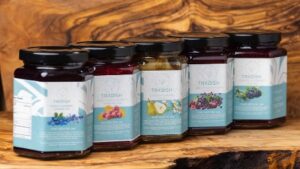 The jams are not merely run-of-the-mill consumer goods; they are vessels of memory. Following a period of profound personal loss, Mierau transformed her menu into a living family tree.
“Before last year, I lost my brother, and then a year later I lost my cousin Tracy, who actually helped me start these jams,” Mierau shares, “her favourite jam was the blueberry lavender. After I lost her, I decided to name it after her: Tracy’s Blueberry Lavender. And then I was like ‘the rest of my ancestors deserve it too.’ Now all five of my jams are named after ancestors. It’s a way to keep them alive. People are going to keep saying their names.”
This deep respect dictates how Mierau sources her ingredients. Tradish operates under strict traditional protocols that run naturally counter to mass-market capitalism.
“I follow all traditional plant medicine protocols,” she says. “That means offering tobacco, praying for the plant, only taking what I need, and never taking the ‘grandmother plant.’ It’s about having those morals as an Indigenous business where we’re not harming the planet while we do this.”
Reclaiming Space and Truth Telling
As Tradish’s profile grew, mainstream recognition quickly followed. The business has been featured in national news media, spotlighted as a challenge location on The Amazing Race Canada, and featured through APTN’s series Bannock Stops. But expanding her reach also meant navigating institutional spaces still heavy with colonial history. When first invited to open a cafe location at the Fort Langley National Historic Site, Mierau spent six months turning them down.
“It felt so weird,” she admits. “But eventually I realized: No, we need to be able to be there to tell our truth, or else everybody else is going to keep telling our truth. That’s been our issue for so long – everybody else teaching us about what happened through the fake stuff they taught us in school.”
Reclaiming that space, however, brought daily institutional frictions.
“Every day I would get the coffee station ready in the morning, I’d be looking out the window, and they’d be raising the Hudson’s Bay Company flag. It would drive me freaking nuts,” Mierau says candidly.
Refusing to let the symbol of a colonial fur-trade empire dominate her workspace, Mierau consulted with an Elder and Indigenous Tourism BC, then called a decisive meeting with the site’s management. “I told them, if they raised that flag one more time, I’d be pulling all my stuff out. And they haven’t raised it since,” she says. “This is a museum now, a historical site – it’s not owned by the Hudson’s Bay Company. If anything, you should be raising the host nation’s flag up there.”
Defining the Urban Indigenous Community
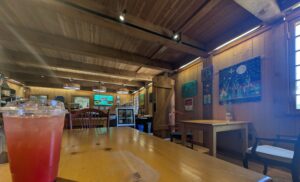 For Mierau, one of the most vital roles of the Ancestor Cafe is providing a sanctuary for Indigenous people navigating the complex reality of urban life away from their traditional home territories.
“I’ve had Indigenous people come in who were abandoned, were adopted, or who aged out of foster care, and they came into the cafe looking for community,” Mierau says. “I tell them all the time: as urban Indigenous, we are our own community. We are just as important of a community as those on-reserve.”
She finds that same sense of community among her pure entrepreneurs, whom she calls her “vendor family.”
“A lot of us are sober, a lot of us are trying to give a better life for our kids, and we support each other,” she notes. It’s a philosophy of economic solidarity that stands in stark contrast to corporate competition. “ We see another food truck, or someone trying to open a cafe, and like, ‘yes let’s do it! Let’s support them. Let’s have these on every freaking corner like a McDonald’s’.”
Mierau actively walks this talk by sharing her hard earned expertise, sending her successful food safety plans to burgeoning Indigenous businesses to help them bypass bureaucratic hurdles. She also intentionally hires Indigenous youth, stepping fully into the role of a mentor she never had growing up.
“Just living this way is being an example,” she says. “My sons are 19 and 15 now, and they don’t drink or do drugs. At their age I was a full-on addict. So breaking that cycle and showing youth that they can do this …. I’m definitely a success story.”
The Path To Food Sovereignty
Despite her success, major systemic barriers remained for Indigenous restauranteurs trying to serve authentic, traditional foods legally. Mierau points out that bureaucratic absurdity prevents her from putting traditional game meat on her daily menu.
“The traditional meats — we cannot use moose, we can’t use Caribou, we can’t use any meat that is uninspected by a commercial plant, which is ridiculous,“ she explains. “To be able to use it regularly would be life changing, especially for urban Indigenous people.”
The power of that connection became tangible for Mierau recently when she traveled back to her own First Nation community for the very first time —a journey her mother never got to make. There, she hosted a plant medicine tea blending workshop and cooked for her nation.
“I got a hunk of Caribou, brought it home, and fried it up,” she says, her voice filling with emotion. ”I swear to God, it was the weirdest feeling. It was so familiar, like I had tasted it before. It triggered this core memory, even though I had never had it in this life. My spirit remembered it, for sure.”
Looking forward, Mierau’s eyes are set on true, systemic self-determination. While she continues her popular traditional food workshops at schools and universities, her ultimate dream lies on the land.
“My dream would be to get some land where we can do on the land workshops and retreats, grow our own food, and have complete sovereignty,” she says.
Through perspiration, occasional desperation, and a heavy history she rapidly grew her business, Mierau remains deeply grounded.
“I grew up in Alberta facing a lot of racism when I was young, being called a ‘dirty Indian.’ I really just want people to see that our culture is beautiful, it’s valuable, and it needs to be respected,” she reflects. “I’m a very humble person, but when people tell me I’m famous, I use it as a time to tell them: *You can do this too. You just have to believe in yourself a tiny little bit. That’s all I did.”
Connect With the Chef
To follow along with Chef Sarah Mierau’s work and newest developments or even to cater an event, one can find their official channels here:
Website: https://www.tradishcanada.ca/
Instagram: @tradishs_the_ancestor_cafe
Facebook: @TRADISHCANADAJAM

Be the first to comment on "Rooted in Tradish: How Sarah Mierau is Healing Community Through Indigenous Flavours"