by Jeremy Appel, Local Journalism Initiative Reporter
(ANNews) – Manitoba Premier Wab Kinew is earning plaudits from First Nations leaders for publicly disputing Alberta Premier Danielle Smith’s characterization of Treaty rights and the duty to consult.
The Blackfoot Confederacy, which encompasses the Kainai, Piikani and Siksika bands in Treaty 7, issued a statement on Wednesday May 27 to applaud Kinew for “his clear affirmation that potential impacts to Treaty rights must trigger proper consultation with First Nations.”
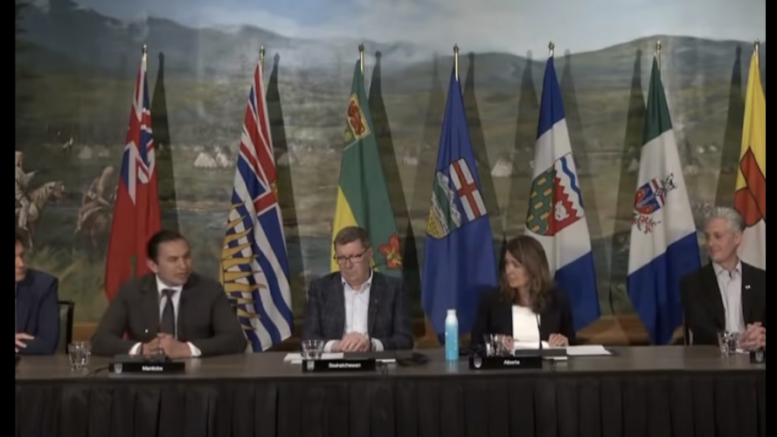
On Monday and Tuesday, Premier Smith hosted a closed-door western premiers’ meeting in Kananaskis, which was attended by Kinew, Saskatchewan Premier Scott Moe, B.C. Premier David Eby, N.W.T. Premier R.J. Simpson, Yukon Premier Currie Dixon and Nunavut Premier John Main.
The premiers held a media availability after the meeting wrapped up, in which Alberta’s October referendum on whether to hold a future referendum on independence was a major topic of discussion.
Efforts by separatists to get a citizen-initiated direct question on independence on the ballot were stymied in court earlier this month.
On May 13, Justice Shaina Leonard of the Court of King’s Bench agreed with Athabasca Chipewyan First Nation and the Blackfoot Confederacy that the Crown owed them a duty to consult prior to the petition’s approval, citing the impact of a successful independence referendum on their Treaty rights.
Smith has called Leonard’s ruling “troubling,” and has pledged to join the separatist organization Stay Free Alberta in appealing the decision.
In the days leading up to the premier’s meeting, Smith expressed interest in having a “conversation” with her fellow premiers about rewriting section 35 of the Constitution, which outlines Aboriginal rights.
At the May 26 press conference, Smith said that she regards the duty to consult as an obligation required for “major projects.”
“The issue in the court is whether that duty to consult should apply to citizen-initiated petitions, and that’s where I think the court erred in judgment and I think it’s also anti-democratic,” she said.
Immediately after Smith spoke, Kinew offered his response, which he said they discussed earlier.
“We know that is not correct, a lot of what you just said there, Premier Smith,” said Kinew, who is a member of Ojibways of Onigaming First Nation.
“It is not up to the petition gatherers to fulfill the duty to consult. It is up to you, as the Alberta government, to fulfill the duty to consult.”
In her decision, Justice Leonard explicitly stated: “It is the Government, as the party that would implement succession, that must engage in consultation.”
Premier Kinew added that he agrees with Leonard’s reasoning. “When there’s clearly going to be an impact on well-established, existing hunting and fishing rights by putting up an international border if some would have their way … that is going to infringe on rights and so there is a duty to consult,” he said.
Kinew then addressed his remarks to the “Albertan who’s been frustrated over the lack of progress on pipelines,” noting Eby’s support for liquified natural gas pipelines, as well as Kinew’s own efforts to transform the Port of Churchill into an energy export hub and establish northern trade corridors.
“This is a moment to get big things built in Manitoba. Now is the time to work together,” Kinew added. “Why don’t we hold off on this referendum talk for a year or two, and see if you get these pipelines under construction?”
After the premier’s meeting, Kinew went to Calgary, where he met with chiefs from Treaties 6, 7 and 8.
Treaty 8 First Nations of Alberta Grand Chief Trevor Mercredi noted that Kinew demonstrated “respect for proper protocol by sitting directly” with the chiefs.
“Alberta is Treaty territory, and meaningful relationships begin by sitting with the rightful leaders of the Nations,” he said in a May 26 Facebook post.
“Mahsi to Premier Kinew for taking the time to meet with our Chiefs in a respectful way.”
In its statement, the Blackfoot Confederacy emphasized that “Canada’s future cannot be advanced by bypassing First Nations.
“First Nations are not stakeholders in these matters. First Nations are Treaty partners with inherent rights, jurisdiction, and responsibilities to the land, water, resources, and future generations,” the statement read.
Assembly of Manitoba Chiefs Grand Chief Kyra Wilson expressed her support for “our relatives in Alberta as they continue to advocate for the recognition and protection of Treaty rights, inherent rights, and First Nations jurisdiction.”
“First Nations are not going anywhere. Our rights are not temporary, and they are not subordinate to provincial interests,” Wilson said in a May 26 statement. “The Treaties are sacred and enduring agreements that continue to bind this country today.

Wab Kinew: we need more leaders with your attitude, knowledge, perspective and communication skills.
Bravo! Wab Kinew for correcting Daniel Smith’s claiming the court decision of “Duty to Consult” as an error in judgment lol and bravo for your outlet in reporting in real time. Thank You