
By Chevi Rabbit, Local Journalism Initiative Reporter
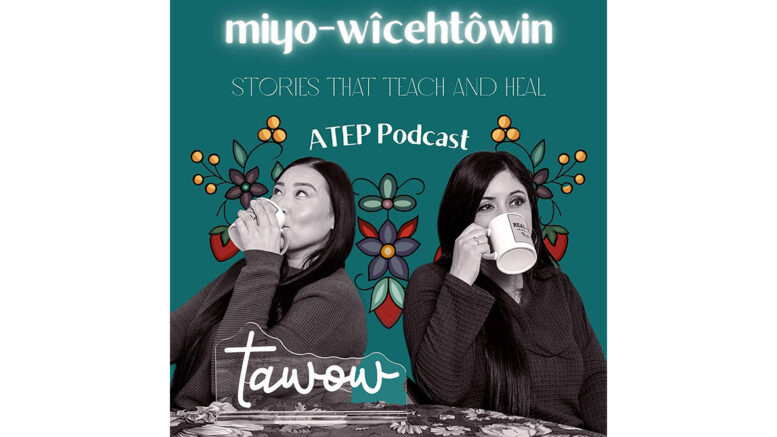
(ANNews) – Miyo-wîcêhtôwin: Stories That Teach and Heal is an Aboriginal Teacher Education Program (ATEP) initiative at the University of Alberta, created by Dr. Zahra Kasamali and Dr. Evelyn Steinhauer. The podcast is intended to bring the ATEP community – and beyond – together in good ways, amplifying both ATEP and community voices.
The series is hosted by Tammy Rae Lamouche and Dr. Zahra Kasamali, and brings Indigenous educators, learners, and knowledge holders together to share stories that centre culture, learning, and community.
“I was approached by Dr. Steinhauer and Dr. Kasamali to co-host this podcast series, and I ended up taking on the creative role alongside Dr. Zahra,” Lamouche said. “We came to the title Miyo-wîcêhtôwin, which means walking together in a good way. This podcast creates space for Indigenous voices to talk about belonging – particularly within institutions like the University of Alberta – and about returning knowledge to community, family, and classrooms. It’s grounded in relational accountability.”
Humanizing Academic Spaces
For Lamouche, the podcast is about more than sharing content – it’s about making academic spaces feel relational, accessible, and culturally grounded. “The podcast allows research and lived experience to come together in a way that feels relational, accessible, and community-centered,” she said. “It humanizes academic spaces and validates Indigenous learners’ experiences. Our stories – and the stories of the people we bring on – can resonate with students and others navigating these spaces. It also models Indigenous ways of knowing and being within institutions.”
Connecting to ATEP
The podcast is closely tied to the Aboriginal Teacher Education Program (ATEP), a Bachelor of Education degree program offered in partnership with the University of Alberta’s Faculty of Education. The program supports Indigenous learners across Alberta, including northern and rural communities, and allows students to complete courses online without leaving their communities.
Lamouche said ATEP provides culturally safe spaces that include Elders-in-residence, ceremonies, and a smudge room, helping students feel connected and supported. “What’s really powerful about ATEP is that people don’t have to leave their communities to do the Bachelor of Education,” she said. “They can take their courses online, stay connected to family and community, and bring what they’re learning back home in real time.”
Guests, Themes, and Stories
Episodes are built around themes reflecting Indigenous knowledge, teaching, and learning. Lamouche highlighted a recent conversation with Charis Auger of Big Stone Cree Nation, an ATEP advisor and fellow graduate student.
“She talks about how the program creates a supportive space for Indigenous students — especially in a large institution like the University of Alberta,” Lamouche said. “They’re often called the ‘ATEP aunties,’ because there are so many women in that space, along with men and Elders like Elder Cal. It helps students feel supported and develop a sense of belonging.”
Future episodes will explore reconciliation, mentorship, cultural safety, and returning knowledge to communities. Lamouche said the podcast creates a unique space for Indigenous learners and educators to connect, reflect, and share stories often absent from mainstream academic discourse.
Why This Podcast is Different
“There are so many podcasts out there – comedy, life coaching, a million genres – but what sets ours apart is how we bring academics into a space that’s also grounded in community,” Lamouche said. “It explores what reconciliation looks like in these spaces while sharing stories that connect community, learning, and culture.”
Walking Together in a Good Way
Tammy Rae Lamouche is a Cree singer-songwriter, actor, and educator from Whitefish Lake First Nation (Treaty 8 Territory). She has performed Off-Broadway in the acclaimed Indigenous musical Bear Grease and is known for blending contemporary R&B, pop, and soul with Cree storytelling and language. A graduate of the University of Alberta with degrees in Native Studies and Education, she is currently completing her Master of Education and is the creator of Naskwahamâtowin, a Cree early-learning resource supporting Plains Cree (Y dialect) through music, stories, and play.
“Ultimately, this podcast is about walking together in a good way, supporting each other, and sharing knowledge back with community,” Lamouche said. “It models Indigenous ways of knowing and being and creates space where research and lived experience meet. It helps listeners – students, educators, and community members alike – feel connected, validated, and inspired to carry knowledge forward.”
Through storytelling, community-centred dialogue, and relational accountability, Miyo-wîcêhtôwin: Stories That Teach and Heal is creating a space where Indigenous voices, knowledge, and experiences are celebrated – and where learning is meaningful, accessible, and shared with heart.
Listen to the podcast on Spotify: https://open.spotify.com/show/7qhGBjLv47BAIYBlz8hXQP Learn more about Tammy Rae Lamouche: https://tammyraemusic.com/bio
With gratitude to Cassie Camille for creative and visual direction, Noella Steinhauer for photography, and Shane Klein (University of Alberta) for technical, filming, and editing support.


Be the first to comment on "Singer, educator, Tammy Rae Lamouche co-hosts podcast bridging community and academia"