By Jeremy Appel, Local Journalism Initiative Reporter
(ANNews) – A proposed new northern Alberta provincial riding encompassing 18 Indigenous communities could help spur Indigenous participation in provincial politics, says the chief of Tallcree First Nation.
The new riding, Mackenzie, was proposed in the Alberta Electoral Boundaries Commission’s (EBC) October 2025 interim report. With a proposed population of 39,072, it would be the province’s largest riding geographically but the smallest by population.
The proposed boundaries were selected, according to the commission report, “with particular view to the desirability of an electoral division having a high Indigenous population.”
Mackenzie would effectively replace the existing riding of Lesser Slave Lake, with the municipal district of Lesser Slave River, including the Town of Slave Lake, moved to a reconfigured Slave Lake-Westlock-Athabasca riding and portions of Big Lake County in the southwest corner moved to Peace River-Notley.
The new riding incorporates Mackenzie County, which includes the North Peace Tribal Council nations of Tallcree, Beaver First Nation, Little Red River First Nation and Dene Tha First Nation, and Paddle Prairie Metis Settlement from the existing Peace River riding in the north, which would cease to exist.
These Indigenous communities joining the First Nations and Metis settlements in Lesser Slave Lake would give the new riding 14 First Nations and four Metis settlements, potentially increasing their power as a voting bloc.
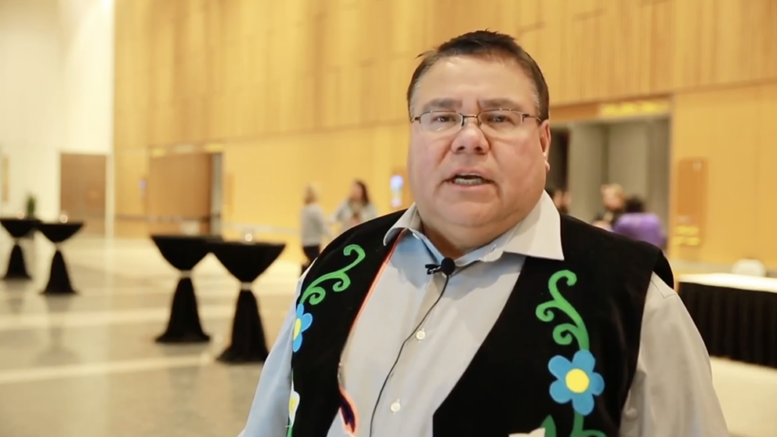
Tallcree Chief Rupert Meneen told Alberta Native News that the North Peace Tribal Council, of which he is also chief, supports the changes.
“It gives us the opportunity to put somebody in the legislature, a First Nations person, that would be our voice in there,” said Chief Meneen.
In the Peace River riding, he noted, the North Peace nations have to contend with higher turnout in the non-Indigenous communities of Peace River, La Crete, High Level, Grimshaw and Manning.
“Nobody cares about First Nations people because nobody votes,” said Meneen. “I’m trying to change that. I’m trying to get our people out to vote.”
He added that this is especially urgent, given the legislation that the UCP government has passed that conflicts with First Nations Treaty rights, namely the Alberta Sovereignty within a United Canada Act and the more recent Justice Statutes Amendment Act, which removes courts’ ability to reject referendums on constitutional grounds.
Premier Danielle Smith is “not a big supporter of our nations, unfortunately, so we need to start changing that somewhere, somehow,” said Meneen.
He acknowledged that the changes have been contentious among other Treaty 8 First Nations who are content with their current representation in the Lesser Slave Lake riding.
Scott Sinclair, the MLA for Lesser Slave Lake, is himself Indigenous. He was kicked out of the UCP caucus in March for publicly stating his intention to vote against the 2025 budget, which he argued shortchanged rural communities in favour of Calgary and Edmonton.
He published an Oct. 29 statement calling the decision to eliminate his riding an “attack on democracy,” which made no mention of Indigenous representation.
Sinclair noted that Lesser Slave Lake is already the largest riding in the province at 70,000 square kms, “which is two and a half times the size of the Netherlands.”
Mackenzie would double that size while removing the riding’s largest municipality — the Town of Slave Lake. “It’s absurd,” the independent MLA wrote.
Sinclair, whose office didn’t acknowledge an interview request, takes the removal of his riding personally. He wrote that “it’s hard not to believe” the elimination of his riding “isn’t a retaliatory move” for refusing to support the UCP budget.
But the UCP MLAs who represent the other nine northern ridings also expressed opposition to the EBC’s proposals in a joint Oct. 29 statement calling the reduction in representation “unacceptable.”
“For northern Albertans, losing our voice is not an option,” they wrote, proposing that rather than eliminating Lesser Slave Lake that its boundaries be pushed southward.
In November 2024, Justice Minister Mickey Amery introduced legislation to increase the number of ridings in the legislature from 87 to 89 to reflect population growth in the Edmonton and Calgary regions, activating the EBC.
The commission is chaired by Dallas K. Miller, a Court of King’s Bench justice who was formerly the executive director of the Home School Legal Defence Association and the Canadian Centre for Home Education.
It includes two UCP-appointed commissioners — retired University of Alberta historian Julian Martin and lawyer John Evans — and two NDP-appointed commissioners — former Alberta Party leader Greg Clark and former Sylvan Lake mayor Susan Samson.
The EBC is holding in-person public meetings for feedback on the interim report from January 12 to 14 in Calgary, and January 19 and 20 in Edmonton. Virtual meetings are scheduled on January 15 for northern Alberta, and January 15 and 16 for central and southern Alberta.
Those seeking to present to the commission can register here.
The final EBC report is due on March 28.

Be the first to comment on "Proposed new northern Alberta riding with increased Indigenous representation sparks division"