By Jeremy Appel, Local Journalism Initiative Reporter
(ANNews) – Alberta’s UCP government has passed legislation without any input from First Nations that poses severe risks to Alberta’s watersheds, according to a group of Treaty 6, 7 and 8 chiefs.
Bill 7, the Water Amendment Act, 2025, which was introduced in the Legislative Assembly by Environment and Protected Areas Minister Rebecca Schulz, received royal assent on December 12.
The legislation updates the Water Act to enable “low-risk” transfers between water basins, empower the minister to determine a transfer’s risk level, and merge the Peace-Slave and Athabasca Water Basins into one, reducing the province’s number of watersheds to six.
Previously, these transfers were decided on a case-by-case basis and required special legislation to proceed. Minister Schulz said at an Oct. 30 news conference that this process is “slow, cumbersome and delays water to getting where it is needed.”
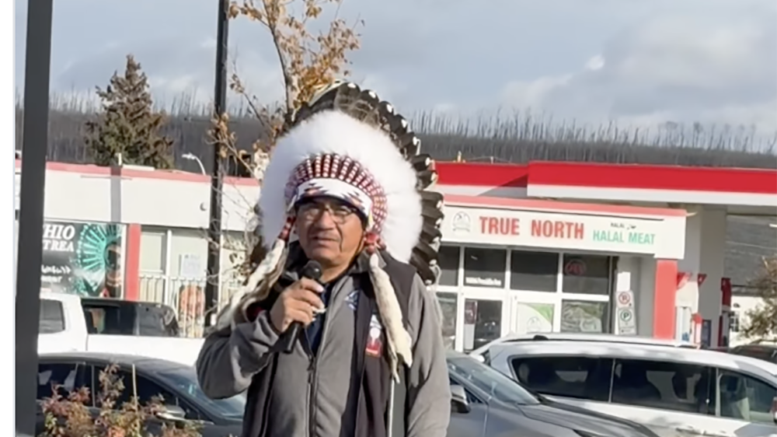
Chief Sheldon Sunshine of Sturgeon Lake Cree Nation, a representative of Treaty 8 on the Chiefs Steering Committee on Technical Services, told Alberta Native News that he was “really taken aback” when Bill 7 was introduced in late October.
Inter-basin transfers will have “severe impacts on every watershed,” as well as the people and animals who depend on them for water, said Chief Sunshine.
“The impacts are so significant to our people, it’s truly unimaginable that they would go ahead and do that without proper consultation,” he said.
Every river basin has unique scientific properties, explains the Alberta Wilderness Association (AWA), meaning a transfer from one to another risks fundamentally altering “chemical concentrations, pH, temperature, and introducing disease or invasive species into the receiving waterbody.”
“We’re dealing with such enormous cumulative impacts in our territory when it comes to resource development, and then the impacts on the water from those developments are increasingly problematic,” Sunshine said.
He suspects the government is facilitating these transfers in preparation for energy-intensive projects it has planned for northwest Alberta, specifically the $70-billion Wonder Valley AI Data Park proposed by celebrity businessman Kevin O’Leary on Sturgeon Lake Cree Nation’s traditional lands, as well as a nuclear power plant near Peace River.
“All of those things together put significant pressure on the resources — the water, the gas and everything else,” said Sunshine. “We’re the ones who are going to be ending up cleaning up whatever’s left over.”
He also cited concerns about increasing drought conditions in northern Alberta, in combination with plans for a water pipeline from the Peace River to Dawson Creek, B.C., to deal with drought in the Kiskatinaw River.
Over the summer, the Canadian Association of Petroleum Producers VP Richard Wong called existing Water Act regulations “unnecessary inefficiencies for oil and gas projects that span major basin boundaries.”
“Yet again, the Government of Alberta is stepping over First Nations’ sovereignty for short-sighted and incredibly risky moves to further the interests of industry,” said Chief Vernon Watchmaker of Kehewin First Nation in Treaty 6 in a Dec. 1 news release from the Chiefs Steering Committee.
“It will be our Peoples who will carry the burden of the Smith Government’s bad decisions.”
Wetaskiwin County Reeve John Bishop, who spoke at the government’s announcement of Bill 7, said the legislation will ensure “equitable access” to water across the province.
“Without a glacier-fed water body within our municipality, water security is critical to the success of the County of Wetaskiwin, its residents, businesses, and farmers,” he said.
The government has said Bill 7 is informed by feedback from its Water Availability Engagement, which was conducted in two phases from October 2024 to June 2025.
The results of those consultations haven’t been released to the public, but the AWA obtained documents from its first phase through a FOIP request.
The results, according to the AWA, “reveal some major differences in what is being proposed versus what the feedback collected through the public engagement recommended.”
The documents note “strong cross sector support for establishing and maintaining instream flow needs and water conservation objectives (WCOs) for all rivers, with WCOs as a key policy tool.”
“Instream flow needs describe the quantity, quality, and timing of water flow necessary to preserve and protect the function and processes of healthy, diverse, aquatic ecosystems long-term,” explains the AWA, “while water conservation objectives are the targets set by the government to mark the minimum volume and quality of water that should remain in rivers.”
More than three-quarters of the people involved in engagement had “continued expectation for careful, case-by-case analysis of inter-basin transfer applications and transparency of decision-making”.
NDP MLA Brooks Arcand-Paul, a member of Alexander First Nation, spoke against Bill 7 in the Legislative Assembly on Dec. 2, noting that some international jurisdictions have given watersheds legal personhood, including the Magpie River in Quebec.
“Water is our ancestor and it deserves our respect, not management and irresponsible bills like this one to manage it like every other resource that this province likes to claim dominion over,” said Arcand-Paul.
“We are not masters over the environment. We live in coexistence with it.”

Be the first to comment on "Treaty Chiefs Warn of “Severe Impacts” as Alberta Passes Water Legislation"