By Chevi Rabbit, Local Journalism Initiative Reporter
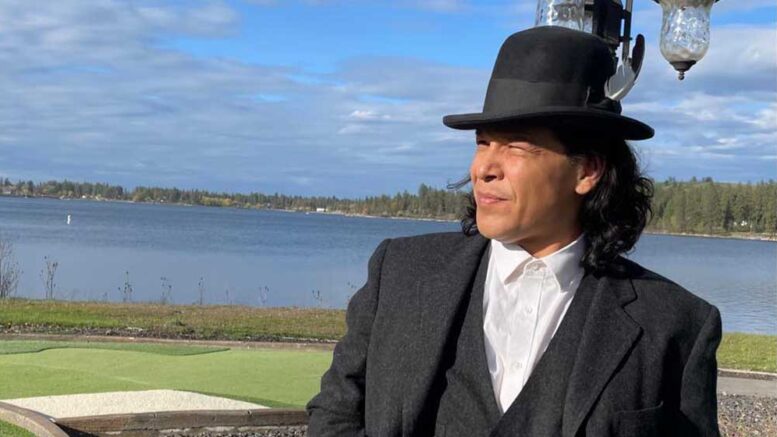
(ANNews) – For more than three decades, Plains Cree actor Nathaniel Arcand has quietly and consistently reshaped what Indigenous representation looks like on screen – not by chasing stardom, but by committing himself to story, craft, and cultural responsibility.
Arcand didn’t grow up planning to be an actor. His entry into film and television was unexpected, but once he found his footing, he made it his mission not just to succeed, but to push boundaries for Indigenous artists working within an industry that has historically offered few complex roles.
Born November 13, 1971, in Edmonton, Alberta, Arcand is Nēhilawē (Plains Cree) from the Alexander First Nation Reserve. He carries that identity with pride, grounding every performance in lived experience and cultural awareness. His breakout role came in the mid-1990s on the CBC drama North of 60, where he played William MacNeil, a smart-mouthed, troubled teen whose sharp intelligence and emotional depth resonated with audiences. The performance earned Arcand a Gemini Award nomination and marked the beginning of a career defined by depth rather than spectacle.
Nearly 30 years later, Arcand reached a new professional milestone when he became part of two major films receiving awards-season recognition in the same year. “It’s been a great journey since I started, and I feel really fortunate,” he says. “I’ve been part of a lot of good productions, and to be in not just one, but two movies in the same year recognized at the Oscars – that’s incredible. I’m rooting for both. I hope they each take home at least one, but honestly, I’m rooting for them to win it all.”
Arcand worked on both projects – Train Dreams and Sinners – in April 2024. “I did both films in April 2024, back and forth from Spokane to New Orleans. I gave my best performance to both films and then went home,” he recalls. “Next thing you know, both films were being nominated for Oscars.”
One of those projects was Train Dreams, which Arcand describes as especially moving. He attended the Netflix premiere in Los Angeles last November, where he watched the film for the first time. “It was surreal,” he says. “I thought everyone in that movie did incredible work. I cried three times during it. That movie is like watching a poem come to life. It’s a poetic story about life, and it really made me reflect.”
Arcand’s filmography spans decades and genres, including Grey Owl, Black Cloud, Cold Pursuit, and Killers of the Flower Moon. On television, he’s appeared in Smallville, Longmire, Supernatural, FBI: Most Wanted, and Heartland, where he played Scott Cardinal. He starred as Victor Merasty in Blackstone, a groundbreaking series that explored Indigenous governance, power, and community politics, and led Two Indians Talking, which won the Vancouver International Film Festival’s Most Popular Canadian Film Award in 2010.
Growing up Indigenous in Canada, Arcand says, came with early lessons about hardship and resilience. “You learn early that life isn’t always easy,” he reflects. “But our experiences, our struggles – they shape us. They give us the strength to carry our stories forward.”
That sense of responsibility informs every role he accepts. “Every role I take on carries weight,” Arcand says. “It’s not just about acting – it’s about representing a people, a history, and a culture accurately and respectfully.” Mentorship, he adds, is just as important. “I try to be the person I wish I had when I was starting out. It’s about showing that it’s possible, that there’s a path, and that your heritage is something to be proud of, not hidden.”
Despite his success, Arcand remains grounded and forward-focused. “You’ve got to keep learning and growing – that’s the natural rhythm of life,” he says. “I’ve come a long way from where I was, but I still have a long ways to go. I’m not finished. I could do other work – truck driving, whatever – but is that me? No. I want to stick to what I’ve built my career on – acting, television, entertainment. That’s where I belong.”
In recent years, Arcand has also turned toward writing and producing, though he’s candid about the challenges Indigenous creators continue to face behind the scenes. “I’ve written scripts, I have ideas, but I don’t have the right people in my corner to make them real,” he says. “I’ve kind of turned into an introvert in this world because of the way it is, especially for Native people. Today, yes, there are more Native-generated producers, but it’s still a challenge to get ideas off the page and onto the screen.”
He’s also outspoken about what he sees as creative limitations within Indigenous media itself. “There are more and more Native films and TV series, but it’s not enough,” Arcand says. “The storylines are very limited, and they’re not thinking outside the box. Most people just want to tell their own story – their trauma, their family history. And to me, that’s overdone. Every film festival, it’s the same story from last year: different title, different actors, same story. How many times can you tell it over and over?”
For Arcand, the future of Indigenous storytelling lies in imagination as much as truth. “Why aren’t we creating something new, like a Harry Potter-style character, a whole different world?” he asks. “Just be creative.”
After three decades on screen, Nathaniel Arcand remains exactly where he’s always been – committed to story, grounded in community, and pushing for something more expansive, not just for himself, but for the generations of Indigenous artists coming next.

Be the first to comment on "Nathaniel Arcand: From ‘North of 60’ to ‘Sinners’: A career of storytelling and creative risk"