By Jeremy Appel, Local Journalism Initiative Reporter
(ANNews) – The Electoral Boundaries Commission (EBC) has backtracked on a contentious proposal to establish a riding with 18 Indigenous communities by reducing the number of northern Alberta ridings in its March 23 final report.
The EBC’s purpose was to determine how to increase the number of ridings in the Legislative Assembly to 89 from 87 while balancing population growth in Calgary and Edmonton with the need to provide effective representation to regions with declining populations, including the north.
The interim report, released in October 2025, proposed reducing the number of ridings in northern Alberta to eight from nine, replacing the Lesser Slave Lake and Peace River ridings with the new riding of Mackenzie, citing the “desirability of an electoral division having a high Indigenous population.”
North Peace Tribal Council, which consists of Tallcree First Nation, Beaver First Nation, Little Red River Cree Nation and Dene Tha’ First Nation, and Paddle Prairie Metis Settlement would have joined 14 First Nations and Metis settlements that are currently in Lesser Slave Lake.
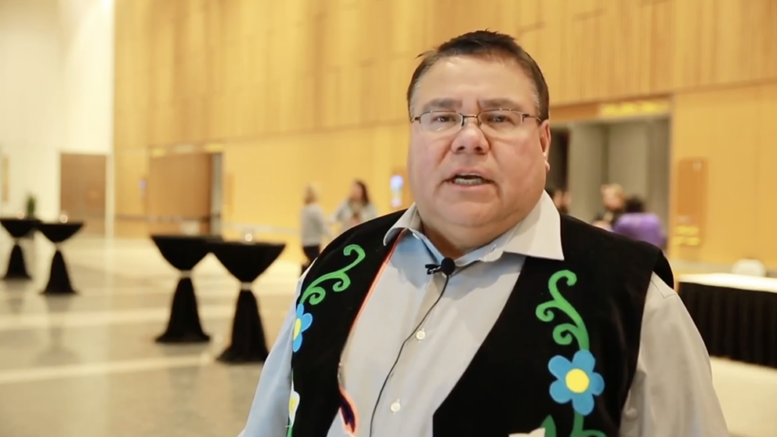
North Peace Tribal Council Chief Rupert Meneen, who is also the chief of Tallcree First Nation, told Alberta Native News that he’s unsurprised by the EBC’s reversal.
Peace River MLA Dan Williams, who resides in La Crete, “has a lot of influence on the government right now,” meaning that many of his constituents are satisfied with their level of representation, said Meneen.
The chief is not among those.
“A lot of the legislation that’s being passed is bypassing the Treaty First Nations. We don’t have a voice in government at all right now, so it’s a very antagonistic relationship that we have with the government right now,” he said.
It would have been helpful to have an Indigenous representative who could help push back against UCP government policies that are specifically detrimental to the North Peace nations’ Treaty rights, including the sale of 15,300 acres of Crown land to Mackenzie County, which the tribal council is challenging in court.
But Meneen acknowledged that First Nations leaders were divided over the merits of reducing the number of northern ridings.
The Treaty 8 First Nations in Lesser Slave Lake opposed the elimination of their existing representation, as did the constituency’s independent MLA Scott Sinclair, a non-status First Nation who presented his concerns with the proposed redistribution to the EBC in January.
In a March 26 social media video, Sinclair applauded the EBC’s decision to retain his existing riding, which he said was the result of a “team effort” from all the region’s MLAs and citizens who voiced opposition to the proposed change to the EBC.
“This is definitely a win for our area, for every community and person in it,” said Sinclair, who added that the reversal was “one of my proudest moments as an MLA.”
Mackenzie would have been the largest riding by size in the province but the smallest by population, with 39,000 people. The final EBC report notes that Lesser Slave Lake, which as proposed would have 30,000 residents, is already a majority Indigenous riding, citing the 2021 census.
“This is significant and reinforces the fact that this may be the only riding in Alberta that is composed of a majority of Indigenous individuals. Removing this riding, in our view, would therefore undermine the path to reconciliation in Alberta,” the report notes.
The final report notes that the EBC received “an incredible number of submissions that illustrated the significant problems with eliminating Lesser Slave Lake.”
“Consolidating all the northern First Nation and Metis communities within one riding would undermine reconciliation efforts by weakening the ability of Indigenous communities to engage by limiting them to only one accountable representative,” argued Linda Green in her submission.
Chief Meneen told this newspaper that having one MLA representing northern Indigenous communities would have little impact on reconciliation either way, the burden of which he emphasized is on the provincial government, not First Nations.
“This doesn’t really have anything to do with reconciliation. At the end of the day, you’re sitting with however many MLAs there are within the legislature and you’re one voice,” he said.
The UCP MLAs who represent the remaining eight northern Alberta ridings were also opposed to reducing the number of northern ridings, arguing that the size of the reconfigured ridings would be “unmanageable,” a sentiment shared by municipal officials.
In her submission to the EBC, Lesser Slave Lake Mayor Francesca Ward, whose town would have been incorporated into Mackenzie, noted that an MLA based in Westlock would “be hard-pressed” to regularly drive upwards of two hours to attend events in Lesser Slave Lake “on top of duties in their southern towns.”
Meneen told this newspaper in December that he hoped the creation of a riding with an Indigenous supermajority would encourage First Nations members in the North Peace region to get politically involved.
Now he sees mobilization against a potential independence referendum, which First Nations leaders have unanimously argued is a violation of Treaty rights, as the best opportunity to spur his people to political action.
Other Proposals
While the EBC final report maintains the degree of northern representation, the EBC proposes incorporating First Nations communities into the urban-rural “hybrid” ridings of Calgary-Glenmore-Tsuut’ina and Edmonton-Enoch.
Calgary-Glenmore-Tsuut’ina, the final report notes, was created “to recognize the link between Tsuut’ina and Calgary.”
The report notes that Enoch Cree Nation “is very integrated into the economy, culture, and infrastructure of west Edmonton,” and that incorporating Enoch into a hybrid Edmonton riding “can create cultural understanding and recognize shared interests.”
Edmonton Mayor Andrew Knack opposed this proposal in the interim report, arguing that the “priorities of the communities in the proposed hybrid electoral district are too diverse to be effectively served by a single MLA.”
The proposed Canmore-Banff riding in the March 2026 report would bring Stoney Nakoda Nation’s Eden Valley 216 Indian Reserve, which was previously in Livingstone-Macleod, into the same riding as the rest of Stoney Nakoda’s reserves, which were part of Banff-Kananaskis.
Minority Report
The final report reflects the views of EBC government-appointed chair Dallas K. Miller, a Court of King’s Bench justice, and its two Opposition-appointed commissioners – former Alberta Party leader Greg Clark and former Sylvan Lake mayor Susan Samson.
The two UCP-appointed commissioners – retired University of Alberta historian Julian Martin and lawyer John Evans – took the unprecedented step of issuing a minority report.
Martin and Evans propose the creation of 11 hybrid ridings in Calgary and three in Edmonton, as well as adopting a “hub and spoke model” for Lethbridge and Red Deer, which would carve them each into four hybrid ridings.
One of the minority’s proposed hybrids is Lethbridge-Cardston, which would include the Blood Tribe reserve.
“An MLA representing both Blood Tribe and Lethbridge South-West is better positioned to advocate solutions that work for the whole system rather than juggling competing mandates across separate ridings,” the dissenting commissioners proposed.
The majority report proposes maintaining the existing Lethbridge-East and Lethbridge-West ridings, but turning Lethbridge-West into a hybrid by incorporating a small portion of west Lethbridge County.
Miller wrote an addendum to the final report criticizing Martin’s and Evans’s “unreasonable and unconstitutional map,” which he added represents a “radical about face” from the consensus that produced October’s interim report.
“Even more importantly, it risks jeopardizing faith in Alberta democracy,” the majority wrote earlier in the report.
The government has the ability to adopt the EBC’s recommendations in full or modify them.
Justice Minister Mickey Amery has said the government is “looking at all the options” outlined in the final report.
In a March 31 statement, Alberta NDP leader Naheed Nenshi accused the UCP government of “weighing how much they will cheat to keep themselves in power.”
“Anything short of implementing the majority report in its entirety is election rigging,” said Nenshi.
Amery has dismissed Nenshi’s concerns as “typical tinfoil hat positioning from the NDP leader.”

Be the first to comment on "EBC final report backtracks on proposed northern Indigenous riding"